Benzene is a colorless, highly flammable liquid with a sweet smell, composed of six carbonatoms arranged in a hexagonal ring with alternating single and double bonds (though in reality the electrons are delocalized). It is a fundamental building block of organic chemistry, found in crude oil and used to make plastics, resins, synthetic fibers, rubber, dyes, and pharmaceuticals. Its unique stability, arising from the delocalized π-electron system, makes it the archetype of aromatic compounds.
History
Benzene was first isolated by Michael Faraday in 1825 from illuminating gas. The ring structure was proposed by August Kekulé in 1865, reportedly after a dream of a snake biting its own tail. The modern understanding of its delocalized bonding came with quantum mechanics in the 20th century.
How it works
The carbonatoms in benzene are sp² hybridized, forming a planar ring with 120° bond angles. Each carbon contributes one p-orbital electron, and these six electrons are delocalized over the entire ring, creating a stable electron cloud above and below the plane. This delocalization lowers the molecule's energy, making it more stable than a hypothetical cyclohexatriene with alternating single and double bonds. This aromaticity explains benzene's tendency to undergo substitution reactions rather than addition reactions.
In practice
Benzene is a precursor to many industrial chemicals, including styrene (for polystyrene), phenol (for resins and adhesives), and cyclohexane (for nylon).
Fun fact
Benzene was once used as a common solvent and even as an aftershave, but it is now known to be a carcinogen, and its use in consumer products is strictly regulated.
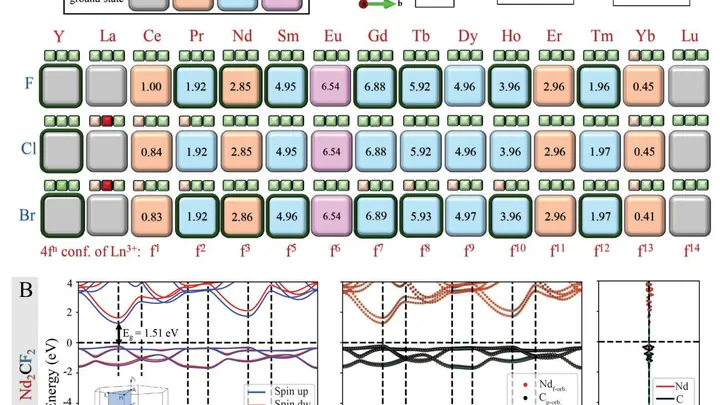
In chemistry's storeroom, records of substances no one thought were special gathered dust. It turns out that among them hide 2D materials — thin as a sheet of paper, but strong and with unexpected properties. Scientists ran a computer search through databases, and it pulled out 38 candidates that had not been recognized as 2D before.
In the cold Taurus cloud, where stars are born, telescopes have detected molecules with the smell of bitter almonds — aromatic nitriles. On Earth, you can find them in peach pits, but in space they hang in icy dust. What happens to them under the harsh ultraviolet light of young stars? Chemists recreated this process in the lab.
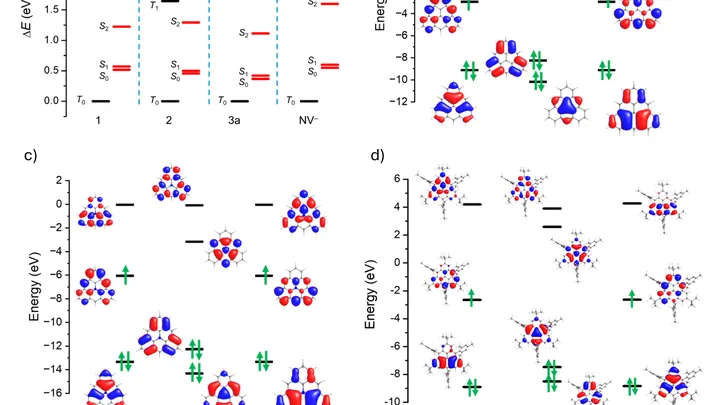
At the heart of a future quantum computer might lie a tiny organic molecule shaped like a triangle. It has two 'extra' electrons that don't pair up. Such molecules are called diradicals, and their electrons can store information in a special, quantum way.
Imagine an audition for a symphony orchestra, where out of hundreds of hopefuls, only those whose instruments sound pure and withstand the furious crescendo remain. In the world of materials, computers have learned to generate 'atomic scores'—thousands of virtual crystals that promise to become the foundation for quantum chips or superconductors.
A lone potassium atom enters a dense cloud of sodium atoms cooled to near absolute zero. Such a medium is called a Bose–Einstein condensate — all particles merge into a single quantum wave. One might expect the impurity to simply pick up a single neighbor and form a pair. But the experiment showed something else.
A pot of water always boils the same way: hit 100 degrees and bubbles start. Quantum fluids are different. When a cloud of atoms is cooled to near absolute zero, it can turn into a single matter wave — a Bose–Einstein condensate. But the transition itself, it turns out, can happen in three different ways.
In dark, cold clouds of interstellar gas, astronomers have for several years been spotting aromatic molecules — compounds built around a benzene ring (a hexagon of carbon atoms), like the benzene we know. One such substance, benzonitrile (benzene with a cyano group attached), had only been found in very calm and cold places, like the Taurus cloud.
Nitrogen, the very gas we breathe, behaves like a finicky metal under a million atmospheres of pressure. In a diamond anvil cell, it is squeezed to 78–98 gigapascals and heated with a laser to 1800–2500 kelvin. Under these conditions, N₂ molecules rearrange into crystals that can store energy more densely than explosives.
A cold cloud of atoms is like a swarm of fireflies drawn to one another. The attraction between atoms tries to pack them into a single dense ball. But quantum jitter, the unavoidable motion of particles, keeps the ball from collapsing. When the attraction is strong, the cloud breaks into separate clumps.
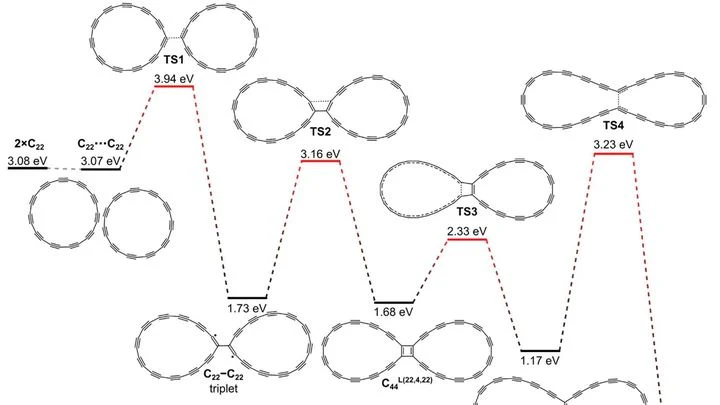
On the surface of ordinary table salt, a ring of carbon atoms grows, like a bracelet assembled link by link. Only here the links are not metallic but carbon, and they are joined not by a jeweler but by the tip of a scanning microscope.
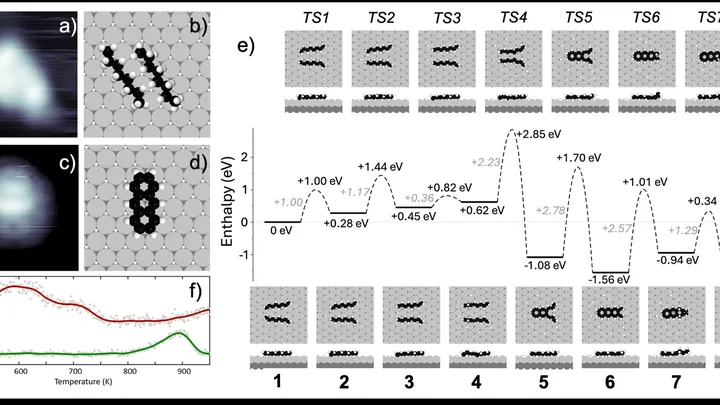
An ordinary octane molecule is a chain of eight carbon atoms, like a flexible wire. On a hot platinum surface (above 600 K), it doesn't just lie still: it starts to squirm. First, the chain bends so that its ends come closer together.
In the cold cloud TMC-1, where temperatures drop to nine degrees above absolute zero, the QUIJOTE radio telescope picked up a faint 'song' — 22 emission lines from the molecule cyclopent[c,d]indene.