Platinum is a dense, malleable, and highly unreactive heavy metal, atomic number 78. It is one of the rarest elements in Earth's crust, and its cosmic origin lies in extreme events like supernovae or neutron star mergers, where rapid neutron capture builds up heavy nuclei. This rarity and unique chemistry make it a key material in catalysis, electronics, and jewelry.
History
Platinum was first encountered by Europeans in the 18th century in South America, where it was initially considered an impurity in silver mining. Its name comes from the Spanish 'platina', meaning 'little silver'. Its unique properties were recognized by scientists like Antoine Lavoisier and William Hyde Wollaston, who developed methods to purify and work with it.
How it works
Platinum's catalytic power comes from its ability to adsorb molecules onto its surface, weakening their internal bonds and lowering the activation energy for reactions. Its electron configuration allows it to readily donate and accept electrons, facilitating redox reactions. In a catalytic converter, for example, platinum atoms on a ceramic support help convert toxic carbon monoxide and nitrogen oxides into less harmful gases.
In practice
Platinum is used in catalytic converters in vehicles, as a catalyst in the production of nitric acid and silicones, and in fuel cells. It is also essential in laboratory equipment, electrical contacts, and as a standard for the international prototype of the kilogram (until 2019).
Fun fact
About half of all platinum mined goes into catalytic converters, and it is so effective at catalyzing reactions that it is also used in chemotherapy drugs like cisplatin to treat cancer.
In a tank holding three tons of liquid xenon, buried deep underground, something stirred one day. Not the xenon itself, but one of its atomic nuclei: it received a kick with an energy of 248 thousand electronvolts and recoiled like a billiard ball struck by an invisible cue ball.
At the center of every atom lies a nucleus — a dense ball of protons and neutrons. These particles don't just crowd together randomly; they fill strict energy levels, much like floors in a skyscraper. When a floor is completely filled, the nucleus becomes especially stable — physicists call this a magic number.
The story began almost a century ago, when Edwin Hubble showed that galaxies are receding, and Fritz Zwicky and Vera Rubin later realized: to explain their motions, invisible mass is needed — dark matter.
Plutonium is a metal with attitude. One form shrinks when cooled, another swells. But at room temperature, the alloy behaves strangely: the ruler says one thing, X-rays say another. The ruler shows the sample barely grows, while X-rays see atoms in the crystal lattice moving further apart.
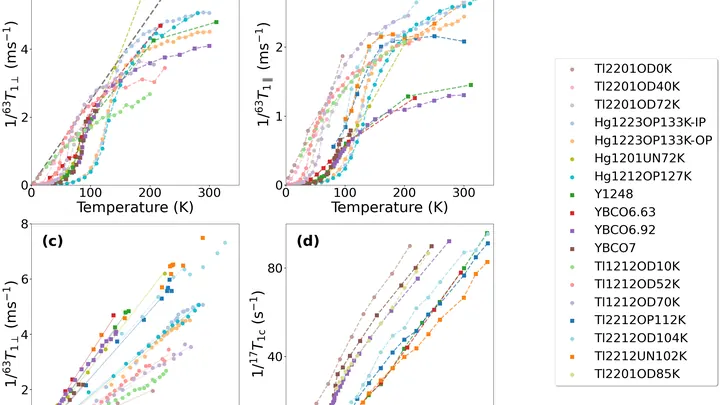
Inside copper-based superconductors, materials that carry current without loss at unexpectedly high temperatures, there is a hidden phase. It behaves like an ordinary metal, but it's invisible in standard measurements.
Ancient stars, nearly devoid of heavy elements, are like fossilized remnants of the first cosmic flashes. For a long time, the odd ratio of carbon, hydrogen, and helium in three such stars was thought to require a hypernova — an ultra-bright supernova with hundreds of times more energy than a regular one.
Hidden in the nucleus of a gold atom lies a potential future cancer treatment. When a gold target is struck by a gamma ray with an energy of about 30 megaelectronvolts, one of the nuclei loses a proton and a neutron, transforming into a rare platinum isotope — platinum-195m.
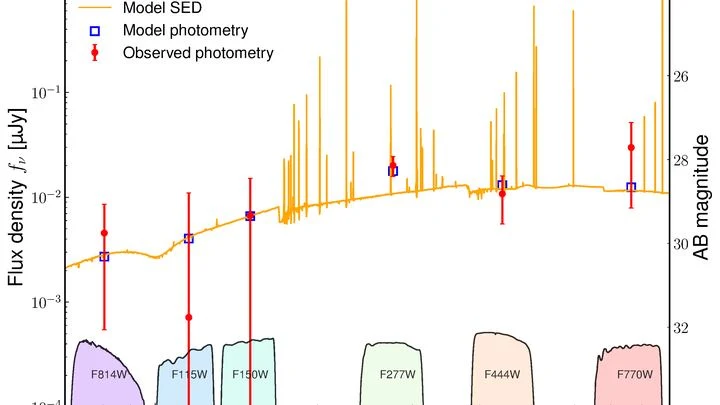
In the deep cosmos, more than 12 billion light-years away, the James Webb Space Telescope has spotted a galaxy that looks like a visitor from the dawn of creation. Its light has been traveling to us since the universe was only about two billion years old — a time when galaxies were growing especially vigorously, a period astronomers call the cosmic noon.
For two atomic nuclei to fuse, they must overcome their fierce electric repulsion — like trying to bring two angry bulls together. Normally, only monstrous energy does the trick, as in stellar cores, where Hans Bethe explained fusion back in the 1930s.