Acetylene (C2H2) is the simplest alkyne, a hydrocarbon with a triple bond between two carbonatoms. It is a colorless, highly flammable gas with a distinct garlic-like odor. In physics and chemistry, it often serves as a convenient model molecule for studying molecular structure, spectroscopy, and reaction dynamics.
History
Acetylene was discovered in 1836 by Edmund Davy, who isolated it while experimenting with potassium carbide. Its structure was later clarified by August Wilhelm von Hofmann in 1866.
How it works
The molecule consists of two carbonatoms joined by a triple bond, with one hydrogen atom attached to each carbon. This linear arrangement gives acetylene unique vibrational and rotational properties, making it a standard test case for quantum mechanical models of molecular motion.
In practice
Acetylene is widely used in oxy-fuel welding and cutting torches due to its high flame temperature, and it serves as a building block in organic synthesis for plastics and other chemicals.
Fun fact
Acetylene burns with a flame that can reach temperatures above 3,000 °C, one of the hottest achievable with a gas flame.
In an oven, a huge loaf of bread is baking. Inside the dough, there is a tiny, hottest spot: that's where the future loaf begins to rise. A hot molecular core (a region the size of the Solar System, where gas is heated to hundreds of degrees and compressed to billions of times the density of ordinary clouds) works in much the same way.
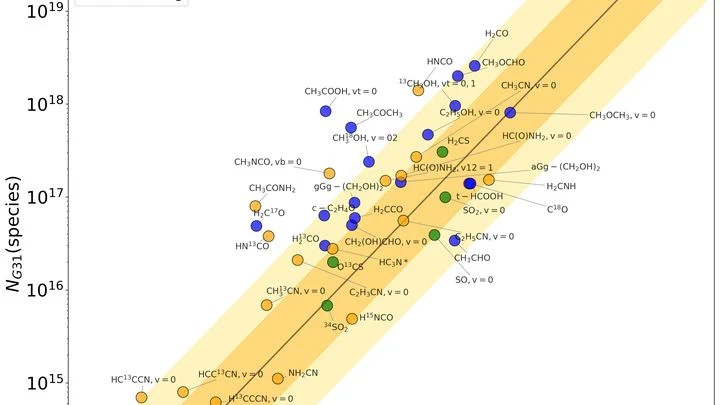
For nearly half a century, astronomers have been searching for glycine, the simplest amino acid and one of the fundamental building blocks of proteins, in the interstellar medium.
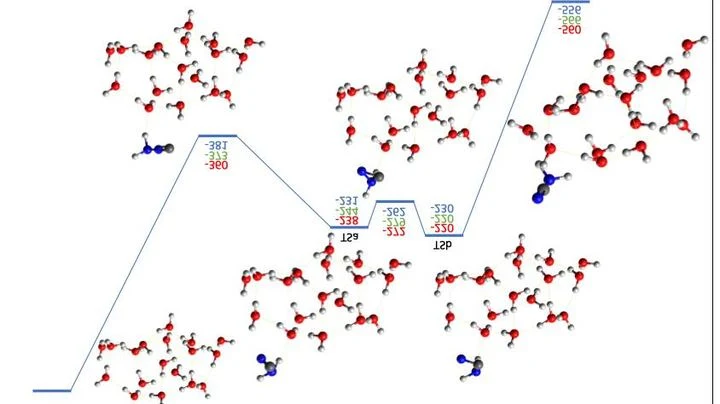
In cold clouds between the stars, dust grains are coated with ice, like windows covered with frost in winter. On this icy crust, chemical reactions take place that do not occur in gas. One such reaction is the encounter between a carbon atom and a nitrogen molecule.
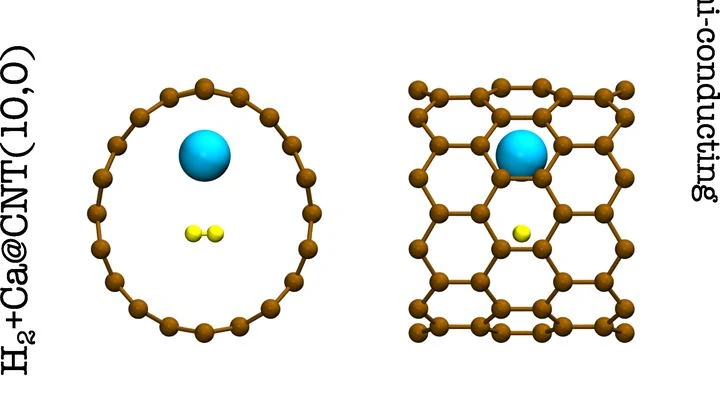
Hydrogen is an ideal fuel: when used, it only produces water, not carbon dioxide. The trouble is that hydrogen is the lightest gas, its molecules leak out of any container. Right now, cars store hydrogen in heavy tanks under extreme pressure, canceling out weight benefits.
Researchers bypassed the problem without high pressure.
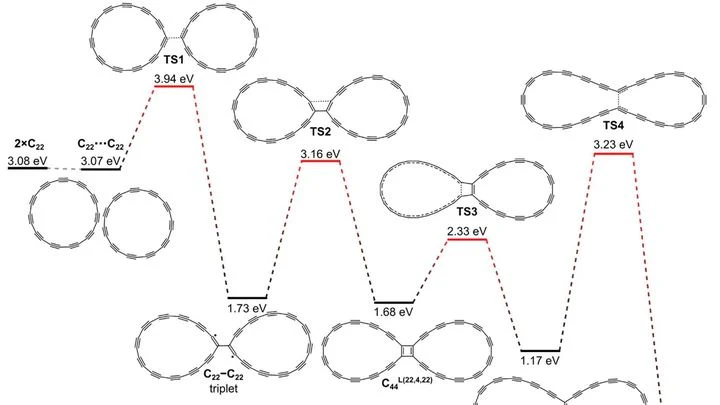
On the surface of ordinary table salt, a ring of carbon atoms grows, like a bracelet assembled link by link. Only here the links are not metallic but carbon, and they are joined not by a jeweler but by the tip of a scanning microscope.
A cage of sixty carbon atoms, shaped like a soccer ball, lets small molecules slip inside. Carbon buckyballs, fullerenes, pack into a crystal like oranges in a crate, leaving gaps between them. At 570 degrees Celsius and 30 atmospheres of pressure, hydrogen seeped into those gaps.
Astronomers using James Webb and spectroscopy (splitting light into colors) peered through dust into the center of galaxy IRAS 07251-0248. There they discovered benzene, acetylene, methane — the same hydrocarbons found in gasoline and plastics.
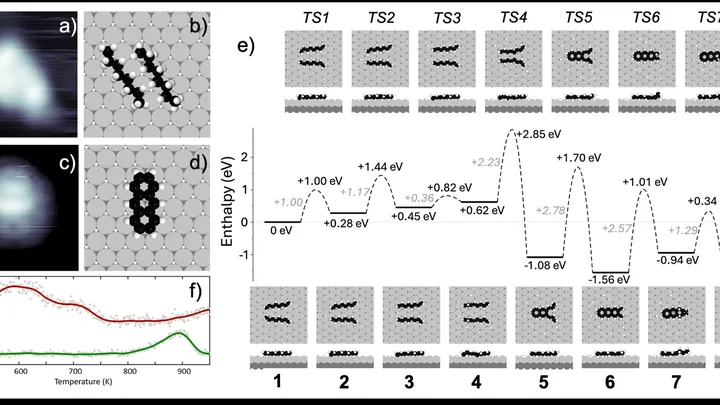
An ordinary octane molecule is a chain of eight carbon atoms, like a flexible wire. On a hot platinum surface (above 600 K), it doesn't just lie still: it starts to squirm. First, the chain bends so that its ends come closer together.
In the cold cloud TMC-1, where temperatures drop to nine degrees above absolute zero, the QUIJOTE radio telescope picked up a faint 'song' — 22 emission lines from the molecule cyclopent[c,d]indene.
A cosmic dust grain is covered in ice, and on this ice, like in a tiny kitchen, molecules are cooked. One of them is methanol, an alcohol that serves as a building block for more complex compounds in space. Previously, it was thought that methanol only forms when hydrogen atoms stick one by one to a carbon monoxide molecule.