How a Chain Becomes a Ring express
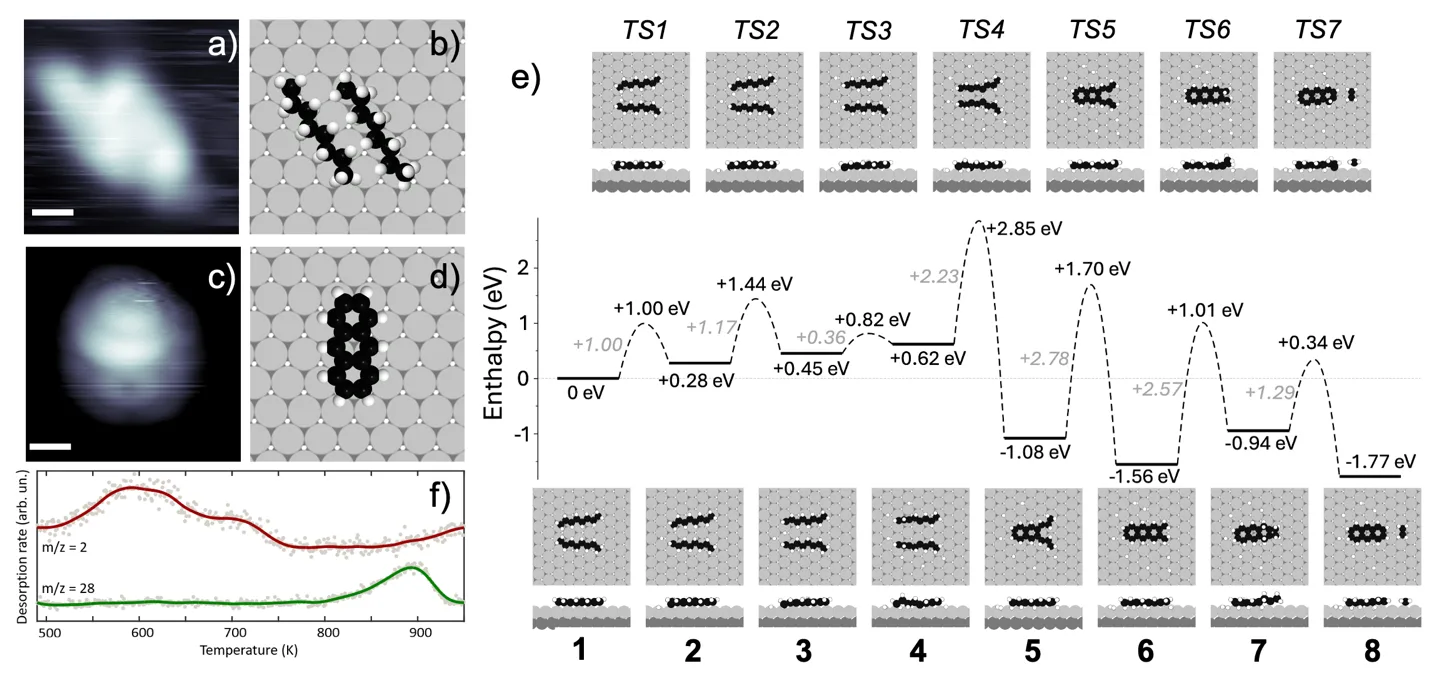
An ordinary octane molecule is a chain of eight carbon atoms, like a flexible wire. On a hot platinum surface (above 600 K), it doesn't just lie still: it starts to squirm. First, the chain bends so that its ends come closer together. Then hydrogen atoms are stripped off, and a strong bond forms between the ends — the molecule closes into a hexagonal benzene ring. This transformation is called aromatization: a flexible chain becomes a rigid, flat ring.
Sometimes two octane molecules lie side by side. Then platinum stitches their ends together, and the bond propagates along both chains like a zipper. The result is a long double molecule that can fold into more complex structures. This is how polycyclic compounds (the basis of many dyes, drugs, and plastics) are born on the surface.
The benzene ring is one of the toughest structures in chemistry: its hexagon of carbon atoms doesn't break even under strong heating.