Gas Around Galaxies: Why It Settles into Disks or Rings express
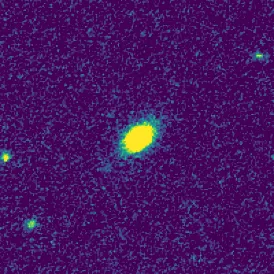
A galaxy is more than just a stellar island. Surrounding it, far beyond the edge of the visible disk, hangs a tenuous cloud of gas. It barely emits light, but it is through this cloud that the galaxy breathes: drawing in fresh hydrogen to form new stars and expelling processed material after supernova explosions.
Astronomers pointed telescopes at 113 distant galaxies and traced how this gas is distributed around each one. To do this, they used the light of quasars, bright distant beacons, that passes through the gas and leaves 'fingerprints' of hydrogen and oxygen in the spectrum. In small galaxies, the gas gathered in two directions: part lay along the plane of the stellar disk, like a pancake, and part stretched upward and downward, like pillars. In large galaxies, this pattern is absent — gas envelops them in an almost uniform layer, without pronounced clumps.
The velocities of the gas also revealed an interesting detail. Along the disk, oxygen moves in a narrower stream than toward the poles. This means that even when gas is uniformly smeared around a massive galaxy, it retains a memory of where it was born: in the disk or in outflows above it.
This pattern is not just cosmetic. It shows how a galaxy interacts with its environment. Light galaxies feel the inflow and outflow of gas more strongly; their 'breathing' is more pronounced. Heavy ones are calmer: their gravity holds everything almost symmetrically.
Original abstract
as written by the authors arXiv:2602.17593
We investigate the azimuthal dependence of H I and O VI-bearing gas in the circumgalactic medium (CGM) of 113 isolated galaxies in the redshift range 0.12 < z < 0.75, including 91 new measurements from the MUSE Quasar-fields Blind Emitters Survey (MUSEQuBES). The H I covering fraction (k_HI) within the virial radius (Rvir) of low-mass (7 < log10(M*/Msun)< 9) galaxies, for a threshold column density of log10(N(HI)/cm^-2) = 14.5, exhibits an enhancement along both the disk plane (azimuthal angle phi < 20 degree) and in the polar direction (phi > 70 degree). In contrast, such a bimodal distribution is not observed for higher mass galaxies (9 < log10(M*/Msun) < 11.3). Similarly, the O VI covering fraction (k_OVI), for a threshold of log10(N(OVI)/cm^-2) = 14.0, shows a tentative enhancement along both the projected major and minor axes for low-mass galaxies. In contrast, O VI-bearing gas around higher- mass galaxies appears more uniformly distributed, with no significant azimuthal dependence. Finally, using the halo circular-velocity-normalized pixel-velocity two-point correlation function (TPCF), we find that O VI absorbers are kinematically narrower along the disk plane compared to the polar directions of the host galaxies with similar stellar mass distributions. The observed isotropic distribution of O VI in high-mass halos suggests that its spatial distribution is governed by global halo properties; however, the O VI kinematics retain memory of the site of origin.
When quasar light passes through the gas around a galaxy, it loses brightness at very narrow wavelengths, as if thin colored glasses cut strips out of a rainbow. From these 'cutouts,' astronomers determine how much gas is present and at what speed it moves.