The Cold Coronae of Galaxies: How Star Formation Fades
Around every galaxy lies an invisible corona of cold gas. It extends far beyond the stellar disk and serves both as a fuel depot for new stars and as a graveyard for ejected material.
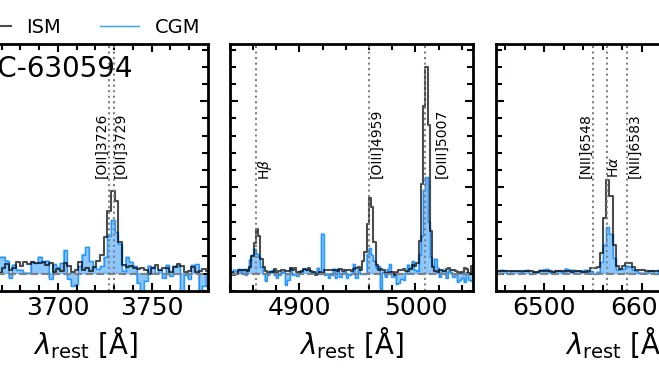
Gas and matter surrounding galaxies, studied through its distribution and chemical composition.The circumgalactic medium (CGM) is the diffuse gas and matter that surrounds a galaxy, extending far beyond its visible stars and disk. It acts as a reservoir of gas that feeds star formation and as a repository for material ejected by supernovae and black hole activity. The CGM is studied through its distribution and chemical composition, often by observing how it absorbs or emits light from background sources.
The concept of a gaseous galactic halo was proposed in the 1950s, but detailed study of the CGM as a distinct component began in the 1980s with the advent of UV spectroscopy from space telescopes like Hubble.
The CGM is detected primarily through absorption spectroscopy: light from distant quasars or galaxies passes through the CGM of a foreground galaxy, and the specific wavelengths absorbed reveal the gas's temperature, density, and chemical makeup. Its distribution can be disk-like or ring-like depending on the galaxy's mass, star formation rate, and the balance between gravitational infall and outflows driven by stellar explosions or active galactic nuclei.
Understanding the CGM is crucial for models of galaxy evolution, as it governs how galaxies acquire gas for star formation and how they recycle heavy elements into the intergalactic medium.
The CGM can contain more mass in gas than the galaxy's stars themselves, yet it is so diffuse that it would be considered a vacuum on Earth.