Measuring the Invisible: Machine Learning Reads Electronic Patterns express
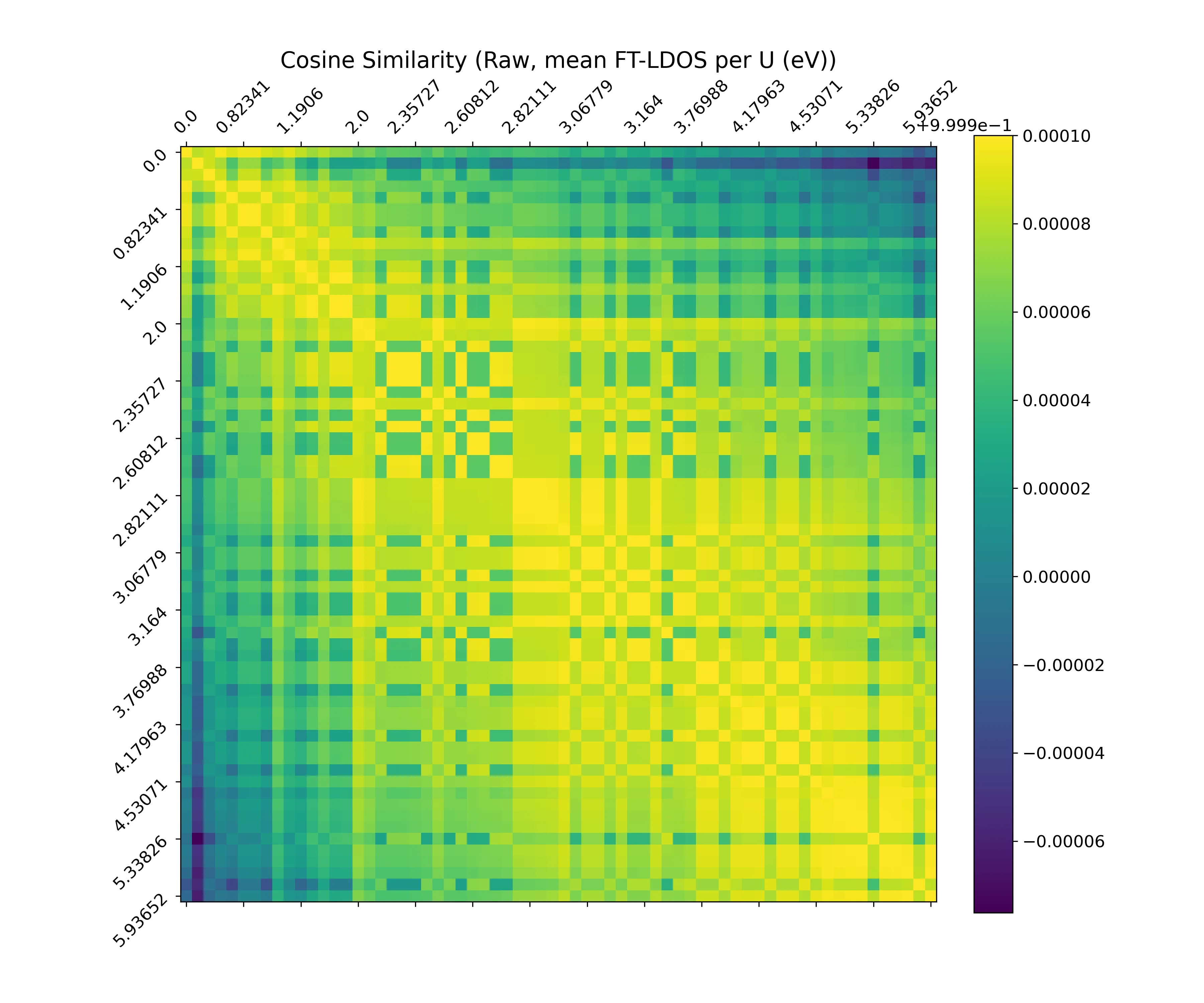
In twisted bilayer graphene, electrons behave like people on a crowded bus: each takes up space and gets in the way of neighbors. The strength of this "reluctance to share space" is called the Hubbard parameter U. It determines whether the material will be a conductor or an insulator, but measuring U directly is very difficult.
A scanning tunneling microscope (STM) takes images showing how electrons are distributed. However, for different values of U, the images look almost identical, like two photos of a crowd where people are just slightly more pressed together. The researchers trained a neural network to distinguish these subtle differences. The network looks at an image and outputs the value of U, even if the image is noisy or slightly distorted, as in real experiments.
This approach allows quick and accurate determination of the Hubbard parameter in materials where electrons interact strongly. This is important for understanding superconductivity and other unusual phenomena in layered structures.
A scanning tunneling microscope can "see" individual atoms by feeling the surface with a needle with precision down to fractions of a nanometer.