The magic angle is a very specific relative rotation — about 1.1 degrees — between two stacked sheets of graphene, a single layer of carbon atoms arranged in a honeycomb lattice. When two such layers are twisted by this angle, the electronic structure of the combined system changes dramatically: the usual energy bands, which describe how electrons move through the material, become nearly flat. Flat bands mean electrons have almost no kinetic energy, so their mutual repulsion dominates, leading to strongly correlated behavior that is rare in simple materials.
History
The concept was introduced in 2011 by Rafi Bistritzer and Allan MacDonald, who predicted that a specific twist angle would produce flat bands. The experimental realization came in 2018 when Pablo Jarillo-Herrero's group at MIT observed superconductivity in twisted bilayer graphene at this angle.
How it works
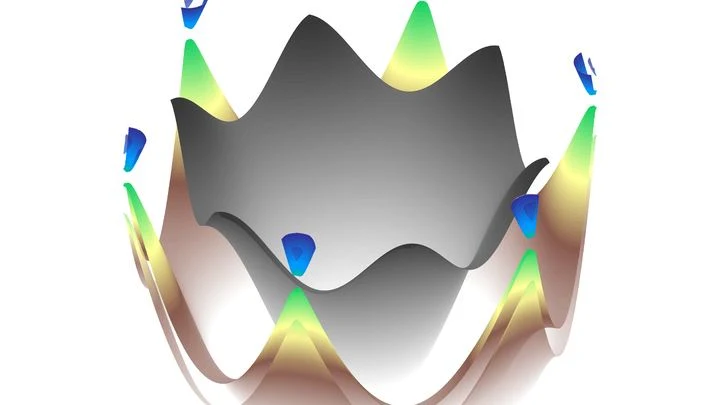
In a single graphene layer, electrons move freely and behave like massless particles. When two layers are stacked and twisted, the periodic patterns of the two lattices interfere, creating a larger moiré pattern. At the magic angle, this moiré pattern has a period that matches the electron wavelength in a way that suppresses hopping between certain sites, effectively trapping electrons in place. The result is a nearly dispersionless band — a band with almost no energy variation with momentum — which amplifies electron-electron interactions relative to their kinetic energy.
In practice
Magic-angle twisted graphene serves as a tunable platform for studying strongly correlated physics, including unconventional superconductivity and Mott insulators, and may inform the design of future quantum devices.
Fun fact
The magic angle is so precise that a deviation of just a few hundredths of a degree destroys the flat-band behavior.
A Stradivarius violin can only be made from wood that grew under special conditions. For a long time, it was believed that graphene for delicate quantum effects had to be exfoliated from graphite with tape, and that a crystal grown in a test tube was incapable of such feats. This work shows that graphene grown from a gas mixture can sound like a Stradivarius.
Hit a table, and the sound quickly fades. Elastic waves in solids usually behave like ripples on water: they spread from the source and die out. But there is a way to make them freeze in place — by creating a 'flat band' in the frequency spectrum. This is a range where waves lose their speed and pile up, like cars in a traffic jam.
In the world of two-dimensional materials, states sometimes emerge that are as extraordinary as they are fragile. One of them — the fractional anomalous Hall crystal (FAHC)—is like a quantum centaur: half ordered lattice, half topological liquid.
A switch that knows which way to let current flow. That's how a Josephson diode works — a superconducting bridge where current goes willingly in one direction but meets resistance in the other. In the new study, such a bridge was made from graphene — a sheet of carbon just one atom thick.
A graphene sheet is a one-atom-thick grid of carbon atoms. Stacking several such sheets with a specific twist yields a material with unusual properties: it can be a magnet or a superconductor depending on how you poke it. The trouble is that in natural graphite, such 'properly twisted' layers are rare, and growing them artificially is tricky.
Graphene is a carbon film exactly one atom thick. Two such sheets placed on top of each other with a slight twist behave very differently from a single sheet. At an angle of about 1.1 degrees, electrons slow down so much that the material can become a superconductor or an insulator — depending on the conditions.
Superconductivity is like a dance of electrons: they move in pairs without losing energy. In conventional superconductors, this dance is set by the electron velocity.
A sheet of graphene, a carbon lattice just one atom thick, under a powerful laser beam behaves like a road where a toll barrier suddenly appears. Electrons that were freely racing through the material suddenly hit a forbidden zone: an energy gap they cannot leap across. This was predicted theoretically before, but no one had ever seen it directly.
In the woven basket pattern, where the strands interlace into triangles, some electrons get stuck in place, like coins wedged in the gaps of the weave. Other electrons roam freely across the whole basket, like light filling a room. Physicists have long sought the moment when these two types of electrons start to influence each other, and now it has been found in the material CsCr6Sb6.
Two layers of a magnetic material, rotated relative to each other by fractions of a degree, like two slightly offset screens on a window. In their normal state, they don't produce anything special, but at a certain twist angle, an unexpected effect emerges.
Two-dimensional bismuth on a silicon substrate is a promising material for future electronics. Its edges conduct current without loss, like a highway with no traffic lights. But bismuth itself is delicate: air and moisture quickly degrade its properties.
A laser flash hits a one-atom-thick layer of silver sitting on bilayer graphene, and within quadrillionths of a second, a gap opens in graphene's electronic structure where none existed before. It's as if an ordinary wire momentarily became a semiconductor: electrons stop flowing freely, and a band gap appears.