Atomistic simulation is a computational technique that models materials by explicitly tracking the positions and interactions of individual atoms or molecules. Instead of treating a material as a continuous blob with bulk properties, it builds a virtual sample where every atom obeys the laws of physics — typically Newton's equations for classical motion, or the Schrödinger equation when quantum effects dominate. This allows researchers to predict properties like mechanical strength, thermal conductivity, or chemical reactivity before ever touching a real sample.
History
The field emerged in the late 1950s with the first Monte Carlo simulations of hard spheres by Metropolis and the molecular dynamics work of Alder and Wainwright in 1957. The technique gained widespread use in the 1980s with the development of reliable force fields and growing computing power.
How it works
The simulation starts with a set of atoms placed in a box, with a defined interaction potential — a mathematical function that describes how the energy of the system changes as atoms move. The computer then iteratively calculates the forces on every atom, updates their positions by tiny time steps, and repeats this millions of times. For quantum accuracy, methods like density functional theory solve the electronic structure at each step, while classical force fields use simpler approximations for speed. The result is a trajectory of atomic motion that can be analyzed to extract macroscopic properties.
In practice
Atomistic simulation is used in materials science to design battery electrolytes, in drug discovery to screen molecular interactions, and in semiconductor research to predict defect behavior. It also helps optimize thin-film coatings and understand radiation damage in biological cells.
Fun fact
Modern simulations can track the motion of over a billion atoms simultaneously, allowing researchers to simulate the fracture of a real-sized metal sample on a supercomputer.
DFTB is a high-speed train in the world of quantum chemistry: hundreds of times faster than classical DFT, yet still on electronic rails. But its engine — iterative self-consistency of charges — sometimes resembles an orchestra where each instrument starts from an arbitrary note.
A false vacuum is not just a supercooled liquid, but a quantum hologram, ready to spring to life under the right projection. Its decay is described by the tunneling of a quantum field from a metastable minimum, and the classic calculation via Euclidean instantons is as elegant as a still life under spotlights.
Hybrid perovskites are the rising stars of photovoltaics: their efficiency is growing so fast it feels like we're on the brink of a solar revolution. But these materials, like intricate atomic mosaics, are extremely vulnerable — moisture, heat, and light quickly turn them to dust.
A translator who translates not words but the very structure of a conversation runs into trouble when the chat moves beyond a quiet room. In a familiar simulation on a spatial lattice, everything follows a strict script. But the moment the interlocutors find themselves in a noisy square, where sound is distorted by echoes and the crowd keeps changing direction, the script falls apart.
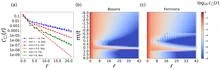
The quantum world is full of transformations. Sometimes a system made of one type of particle starts behaving as if it harbors completely different ones. For example, in a chain of bosons, sociable particles that like to crowd into the same state, fermions from the Standard Model may unexpectedly appear, even though they usually keep to themselves.
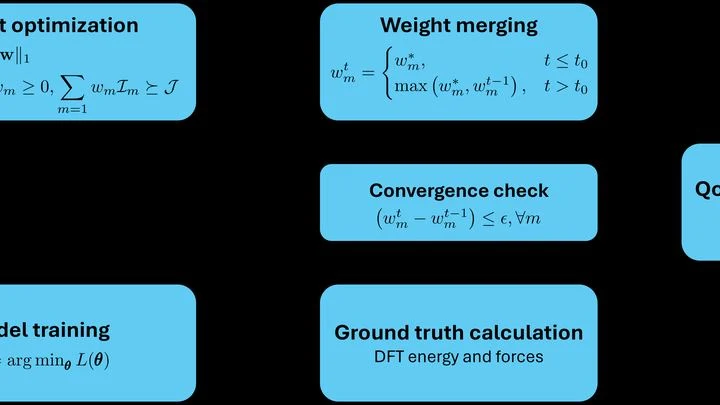
Computational studies of material behavior have long suffered from two extremes: either fast but inaccurate models, or accurate but slow physical calculations. Modern programs, trained on data, have nearly resolved this dilemma — now the bottleneck is not computing power, but human routine: setting up simulations and checking results.
Paimon works like an autonomous chef.
A chef doesn't waste ingredients cooking the whole dish to check the taste: they just taste a drop of sauce. The same logic underlies the "information matching" method for predicting metal strength. Instead of expensive calculations of every atom's behavior, scientists "taste" only simple indicators linked to plasticity — a metal's ability to bend without breaking.
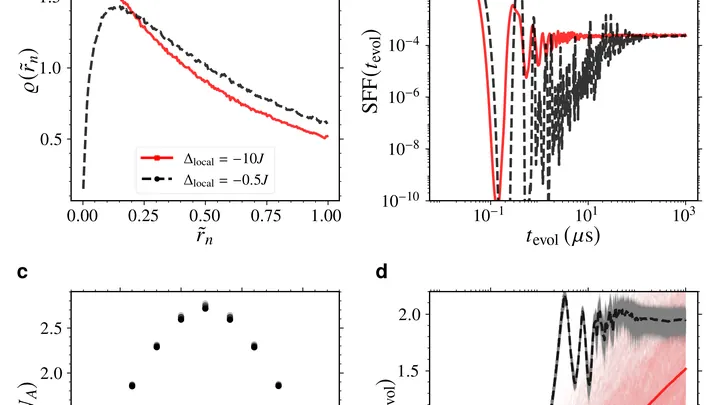
Quantum entanglement is like an invisible web that connects particles even when they are far apart. In large systems (say, a piece of material) this web can either quickly weave through all the atoms or tangle into a knot and stay put. The first case is called quantum chaos, the second localization.
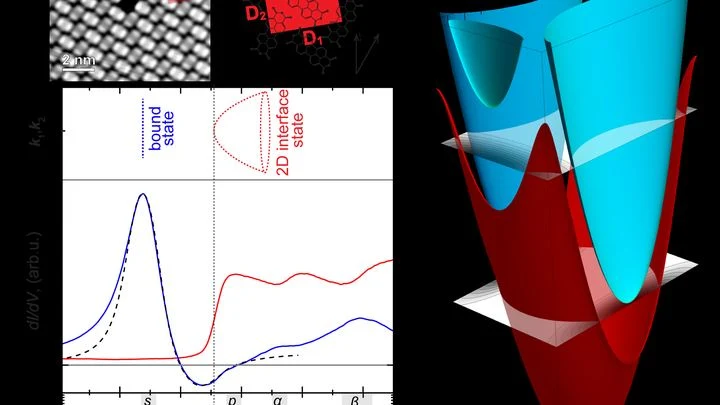
A wafer-thin film of organic molecules was grown on a silicon substrate. In this film, as if on a sheet of graph paper, tiny "pens"—artificial atoms — were laid out with the tip of a scanning tunneling microscope.
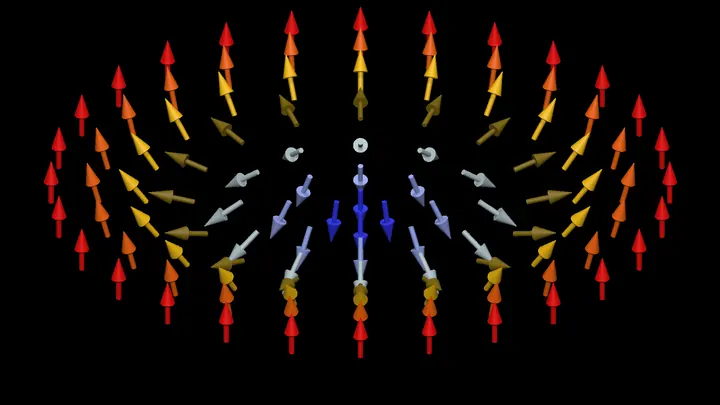
In a field trap, scientists assembled a crystal — 150 ions at ultra-low temperature. Each ion behaves like a tiny magnet, capable of rotating in any direction. By controlling forces that depend on this rotation, physicists made all the magnets swirl into a common vortex called a skyrmion.
Viscoelastic materials — polymers that, like dough, retain a memory of every touch: their response to impact depends on their deformation history. Maxwell and Boltzmann provided the mathematical description long ago.
When two atomic nuclei collide, the outcome depends on their energy and the angle at which the fragments fly apart. Typically, such calculations demand enormous computing power, and accuracy hits a wall due to approximations.
In a cold cloud of atoms chilled to near absolute zero, energies can behave like threads that weave into braids. These braids are not just a pretty image: their pattern is tied to topology, the branch of mathematics that studies properties preserved under continuous deformations.
A three-seat swing never stops: one rider is always left hanging. That’s a frustrated magnet — a perpetual dance with no rest. To study it, physicists built a quantum simulator from 256 atoms, meticulously mimicking the crystal TmMgGaO₄.
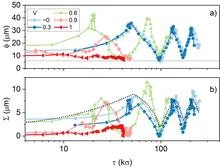
The boundary between two liquids is like an invisible skin: it's there, but you can't touch it with your finger. Scientists have found a way to measure its elasticity without touching it. They made a tiny probe oscillate above the surface, and between the probe and the interface lay a thin film of liquid.
Deep inside every hard drive or flash drive lies a material that can 'remember' an electric field. Such a material is called a ferroelectric. When you apply a voltage, tiny regions inside the crystal (domains, like compass needles) flip. Flip the needle one way, you've written a one; flip it back, a zero. But what happens to the atoms at the moment of that flip?
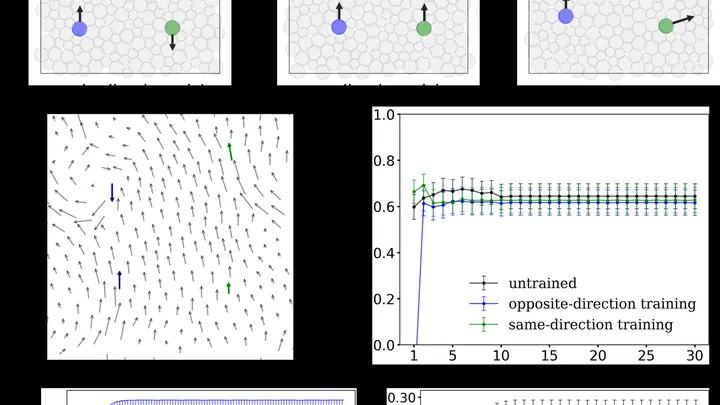
A handful of sand on a table is just a pile. But if you shake the grains just right, the pile starts behaving like a memory: it remembers which motion follows which. In the new experiment, particles were moved cyclically, and after training, they reproduced the desired pattern even without a full command.
The secret lies in the contacts between particles.
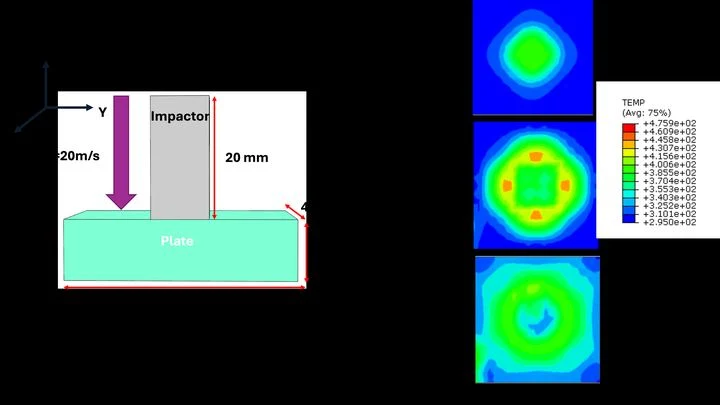
Tearing apart an aluminum cube just a few nanometers wide is like trying to watch a droplet fall in slow motion when the camera itself is firing at machine-gun speed. Atoms inside the metal vibrate trillions of times per second, while real deformation in the lab takes minutes.
A chef tastes the soup after every pinch of salt and instantly decides what to add next. That's roughly how the new setup for growing thin crystalline films works — except instead of taste, it uses an image from an electron microscope, and instead of a chef, a computer program.
A pot of water on the stove is just water, but inside each molecule, a continuous dance goes on. Hydrogen and oxygen atoms jitter, even at absolute zero, because that's how the quantum world works. These jitters change how much heat water stores and how it flows.
In twisted bilayer graphene, electrons behave like people on a crowded bus: each takes up space and gets in the way of neighbors. The strength of this "reluctance to share space" is called the Hubbard parameter U. It determines whether the material will be a conductor or an insulator, but measuring U directly is very difficult.
A chemist searching for a new drug is like a cook without a recipe: they have a list of desired properties but millions of possible ingredients. Each trial is costly and time-consuming, so you need to experiment wisely.
The new program SEISMO acts like a chef who tastes the dish after every step and immediately decides what to add next.
Inside a battery, like a layered cake, different solid layers sit side by side. The meeting point, the interface, behaves capriciously: stresses concentrate there, and over time the battery ages. To understand these processes, we need computer models that see every atom. But accurate calculations are too expensive, and fast ones are too crude.
A neutron star is a sphere the size of a city, but it weighs as much as one and a half Suns. Inside such a sphere, matter is so compressed that a teaspoon of it would weigh billions of tons. But physicists don't fully know what this matter is made of.
In the lab, time usually ticks on the wall: hands, digits, a frequency standard. But for the Universe, there are no external clocks. The Wheeler–DeWitt equation, the main law of quantum gravity, contains no time at all, and all fundamental theories lack an inbuilt arrow of time.
Two actors on the same stage. One is a fermion, finicky and demanding, hard to make follow the rules of a quantum simulator. The other is a boson, easygoing and undemanding, ready to take any role. The director hopes the audience won't notice the substitution.