Two Mutant Brothers: Why One Gene Change Can Alter Lung Cancer's Fate express
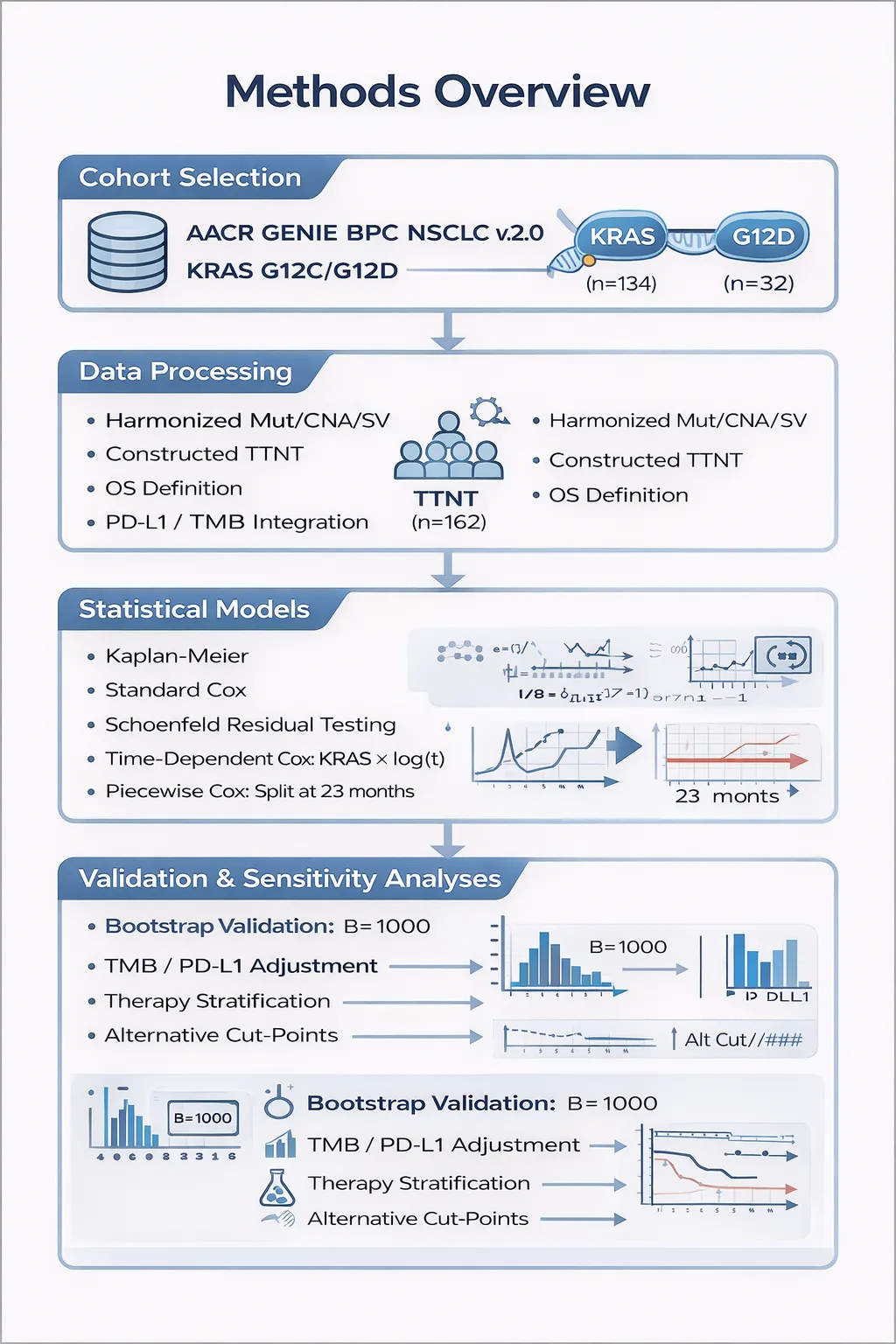
Cancer cells are like broken cars: one glitch makes them drive without stopping. In the KRAS gene, such glitches happen most often. But glitches come in different flavors: the wrong amino acid can sit in one spot of the protein, and that determines how the tumor behaves.
In the new study, two such glitches were compared: G12C and G12D. Patients with G12D had a longer time before the next treatment, especially in the first two years. After two years, the difference fades, but overall survival is still better for G12D. Tumors with G12C more often carry additional glitches in the STK11 and KEAP1 genes, which make the cancer more aggressive.
So far, drugs are approved only against G12C, while none exist for G12D. The results suggest we need to develop separate drugs for each mutation. Then treatment becomes more precise, like a key fitting its own lock.
Original abstract
as written by the authors arXiv:2602.19295
Background: KRAS mutations are the largest oncogenic subset in NSCLC. While KRAS G12C is now targetable, no approved therapies exist for G12D. We examined time-to-next-treatment (TTNT) and overall survival (OS) differences between G12C and G12D, allowing for time-varying hazard effects. Methods: De-identified data from AACR Project GENIE BPC NSCLC v2.0-public were analyzed. TTNT served as a real-world surrogate for progression-free survival. Co-mutations (TP53, STK11, KEAP1, SMARCA4, MET), TMB, and PD-L1 were harmonized. Kaplan-Meier, multivariable Cox, and a pre-specified piecewise Cox model (split at median TTNT = 23 months) were applied. Schoenfeld residuals assessed proportional hazards; bootstrap resampling (B=1000) evaluated stability. Results: Among 162 TTNT-evaluable patients (G12C n=130; G12D n=32), median TTNT was 28.6 versus 32.0 months (log-rank p=0.79). Adjusted Cox regression showed no overall hazard difference (HR=0.85; 95% CI 0.53-1.37; p=0.50), but Schoenfeld testing indicated borderline non-proportionality (p=0.053). Piecewise Cox modeling revealed time-varying effects: early TTNT hazard favored G12D (HR=0.41; 95% CI 0.17-0.97; p=0.043) with significant KRAS x period interaction (HR=3.33; p=0.021) and late-period attenuation (HR=1.38; 95% CI 0.77-2.47; p=0.285). Bootstrap resampling confirmed this pattern (median HRearly=0.39; HRlate=1.41). Among 278 OS-evaluable patients (133 deaths), G12D showed improved OS (adjusted HR=0.63; 95% CI 0.39-0.99; p=0.048). G12C tumors exhibited higher TMB (9.79 vs 7.83 mut/Mb; p=0.002) and greater STK11/KEAP1 enrichment. Conclusions: KRAS G12D demonstrated early TTNT advantage and improved OS. Late-period TTNT differences were non-significant (post-hoc power: 12.3%). These exploratory findings require validation in larger cohorts but support allele-specific therapeutic development for G12D.
The G12C and G12D mutations differ by just one letter in the DNA, but one makes the tumor sensitive to a drug, while the other does not, yet.