Rings of Carbon Atoms: How Scientists Assembled a Molecule from 88 Links express
On the surface of ordinary table salt, a ring of carbon atoms grows, like a bracelet assembled link by link. Only here the links are not metallic but carbon, and they are joined not by a jeweler but by the tip of a scanning microscope. Physicists have learned to weave such bracelets up to 88 atoms long and test how they conduct electricity.
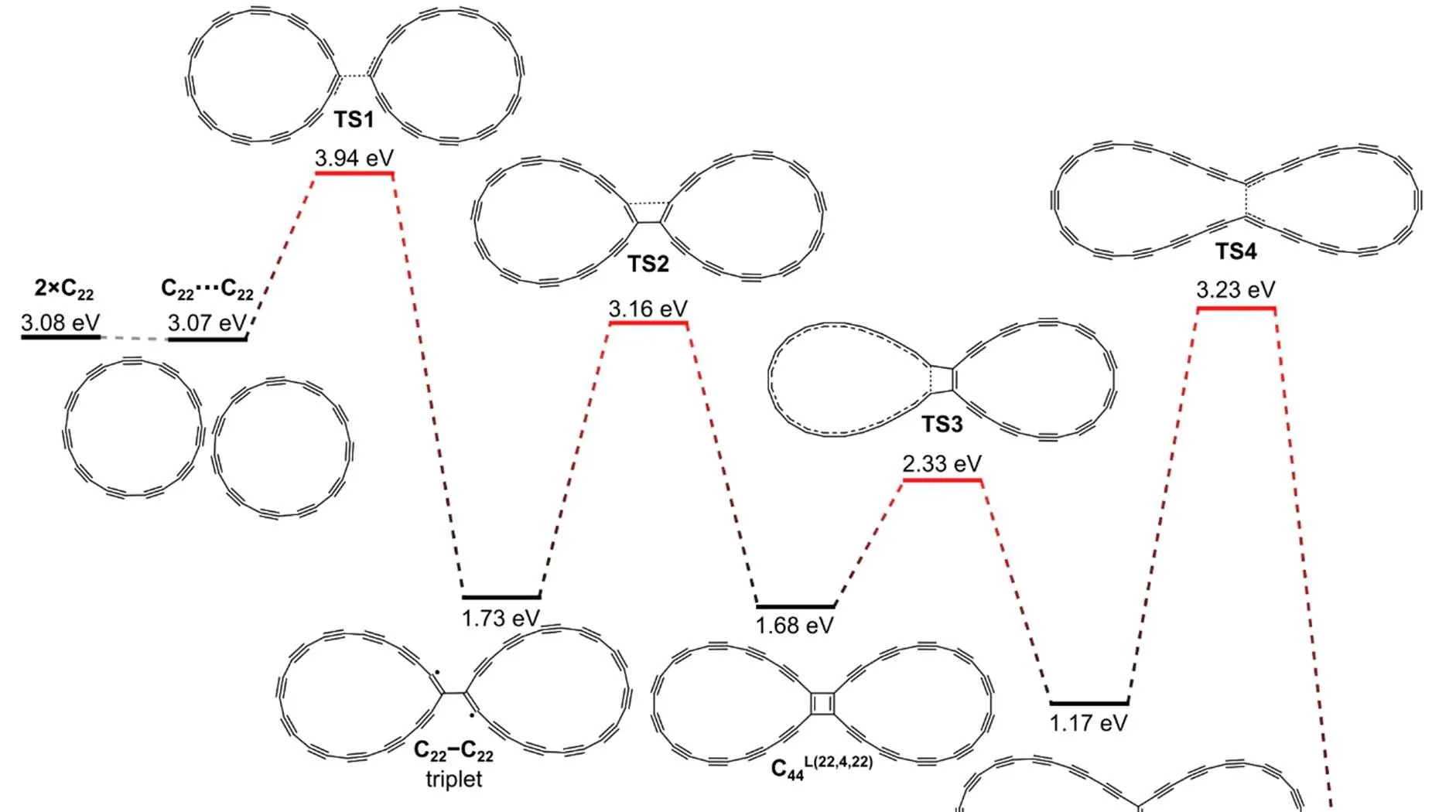
Each ring is a cyclocarbon molecule. It has no side branches, only a closed chain of atoms. To build a large ring, scientists first made small building blocks of 20 and 22 atoms, then fused them together with the same microscopic tip. The result was rings of 42, 44, 46, 66, and 88 atoms.
The difference between rings with atom counts divisible by four (20, 44) and their neighbors (22, 42) repeats each time, but it weakens as the rings grow. For the 88-atom ring, it is barely visible. This means that very large carbon rings lose their aromaticity and behave like ordinary conducting wires.
Such molecular bracelets could become the basis for wires just one atom thick. If we learn to link them into chains and control the current, we could build electronic circuits assembled literally from individual molecules.
The 20-atom carbon ring is the smallest one ever assembled and measured. Its diameter is less than a nanometer, tens of thousands of times thinner than a human hair.
In Ted Chiang's story "Understand," the protagonist creates ultra-thin structures by manipulating atoms — much like the way carbon rings are assembled in this work.