In mathematics, a ring is a set on which two associative operations are defined, usually called addition and multiplication. Addition must form an abelian group (there is a zero and subtraction), and multiplication is distributive over addition (a⋅(b + c) = a⋅b + a⋅c). Typical rings: integers ℤ, polynomials in one variable ℤ[x], square matrices of order n. If multiplication is commutative, the ring is called commutative. Ring theory studies ideals — subsets that resemble 'multiples of a given number', and their properties, which allows solving equations in integers and classifying algebraic objects.
History
The term 'Zahlring' was introduced by David Hilbert in 1897 in the context of rings of integers in algebraic number fields. Systematic development of general ring theory was carried out by Emmy Noether in her work 'Idealtheorie in Ringbereichen' (1921), where she established conditions for chain termination of ideals and their connection with decomposition into primes. Axiomatization of the definition of a ring was completed by the 1930s through the works of van der Waerden and other algebraists.
How it works
Rings serve as a language for describing extensions of numbers. The residue ring ℤ/nℤ models integer arithmetic modulo n, which underlies RSA encryption. The polynomial ring k[x1,…,xn] over a field k corresponds to affine space 𝔸ⁿ, and its quotient rings describe algebraic varieties. In quantum mechanics, self-adjoint operators on a Hilbert space form a Jordan ring, and measurable classes form a ring with convergence closure. Endomorphism rings of abelian groups reveal deep connections between linear algebra and homological algebra.
In practice
Cryptosystems that protect your messages in messengers are built on polynomial rings.
Fun fact
In the ring of even numbers, there is no identity (neutral element for multiplication) because 1 is odd. Nevertheless, it is a fully-fledged ring with its own ideals.
Every winter, hospitals fill up, and by summer they seem to empty. Epidemics breathe like the tide. But why do waves of disease keep rolling in, even without new mutations? Mathematicians found an answer in a tug-of-war between two strains.
Within a single epidemic, two virus variants often coexist.
Hidden within thin layers of tantalum selenide (TaSe₂) is a property that defies conventional physics. When guest atoms were added between the layers of this material, the structure lost its center of symmetry, and inside, superconductivity with armor emerged.
In 1998, mathematician David Boyd noticed something strange. He was studying the Mahler measure of polynomials, a quantity that gauges the "complexity" of their roots, and found that for a family of curves, it always equals a special rational number times the derivative of an L-function.
If you take a table of numbers where the sum of squares in each row and column is 1, and you want to maximize the sum of fourth powers, the answer will only be permutations of coordinates. The fourth power sharply penalizes division: 0.5 gives only 0.0625, while 1 remains 1. It's advantageous to give the entire weight of a row and column to one cell, filling it with +1 or -1, and the rest with zeros.
7 278 601 292 779 396 715. That’s exactly how many unlabeled chordal graphs, graphs with no induced cycles of length four or more, can be built on twenty vertices. This number isn’t a puzzle for a supercomputer; it’s the exact output of a new algorithm that treats symmetry as a tool, not an obstacle.
In 1953, mathematician Alexander Grothendieck proved a theorem that became a cornerstone in the theory of tensor products. It states that for ordinary function spaces, two natural norms, the projective and the injective, are equivalent up to a universal constant. In other words, two ways of measuring the 'size' of combinations of vectors give similar results.
Two dice lie in different rooms. If they are 'entangled,' a roll of one instantly determines the outcome of the other — even at a distance. In the quantum world, such a link is called steering: one party, by performing measurements on their side, seems to dictate the state of the partner.
A quantum particle traveling around a closed ring leaves two distinct 'records' along its path. The first is like a fingerprint on a doorknob: it remains unchanged no matter how many times you turn the knob, and it only tells you about the shape and material.
You can feel an unfamiliar object along its length, across its width, or diagonally: each time gaining new information. But what if one way of feeling tells you absolutely nothing about what another would reveal? That's exactly how mutually unbiased bases work in quantum mechanics: measuring in one of them leaves you completely in the dark about the outcome in another.
A handful of matches falls on the table. Each lies however it lands, but in our minds we turn each into an arrow — from one end to the other. Now ask: can you get from one point to another by moving only in the direction of the arrows? A group of points where you can reach any one from any other is called a strongly connected cluster.
At a party, guests don't just chat in pairs; they gather in circles of shared interests: three discussing movies, four debating sports. The usual acquaintance map, like a phone's contact list, can't capture that: it only sees one-on-one links.
Strings in physics don't just vibrate: they live in a space that itself can change its properties. Sometimes, additional fields, akin to invisible lines of force, are superimposed on this space.
The night sky sometimes throws up riddles that take your breath away. One of them is a ring of galaxies stretching across a third of the horizon. Astronomers have named it the “Giant Ring on the Sky”: a cluster of galaxies stretched into a thin filament and closed into a circle about 400 megaparsecs in diameter.
A cell about to divide first marks its waist. Beneath its membrane, in a thin gel of protein filaments, movement begins. The filaments flow like a slow river, and a belt forms in the middle of the cell. This belt tightens more and more until the cell is pinched in half.
Scientists built a computer model of this process.
Your finger is a living sensor: beneath the skin, arteries pulse in time with your heart. Traditional blood pressure cuffs squeeze your arm and give a single number, but this ring uses eight electrodes to pass a weak current through the tissue and map blood flow.
A ring of magnetic atoms resembles a round dance where each participant holds hands with their neighbors. In ordinary magnets, each atom has its own permanent magnetic moment, and they interact like little arrows striving to align opposite to each other.
Ring-shaped reefs, atolls, are usually explained like this: corals grow along the edge of a volcanic island while the island slowly sinks. What's left is a hollow ring that can stretch for kilometers. But satellite images show similar rings around very small reefs where there are no volcanoes and no subsidence.
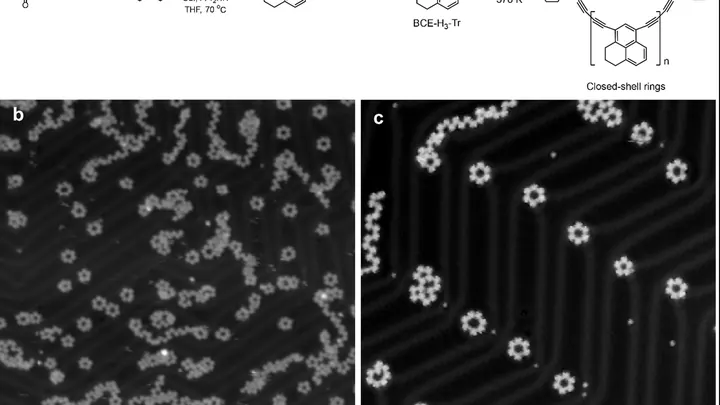
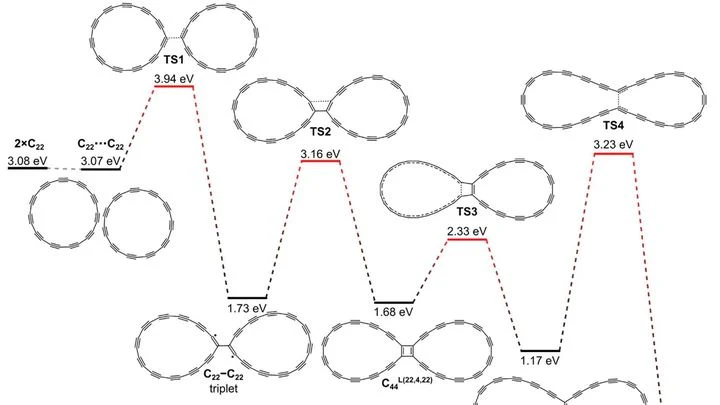
On the surface of ordinary table salt, a ring of carbon atoms grows, like a bracelet assembled link by link. Only here the links are not metallic but carbon, and they are joined not by a jeweler but by the tip of a scanning microscope.
A century ago, quantum mechanics gave the world a neat picture: a particle rotating around a point can only have certain discrete amounts of angular momentum, integer multiples of Planck's constant. This rule seemed as solid as the law of gravity, and it followed from simple algebraic arguments.