Scientist

Walter Baade

1893–1960 · Astronomy, astrophysics
German astronomer who discovered stellar populations and significantly refined the cosmic distance scale. His work with Fritz Zwicky led to the prediction of neutron stars.

Biography

Born in 1893 in Schröttinghausen, Germany. He studied at the University of Göttingen, receiving his doctorate in 1919. He worked at the Hamburg Observatory, then emigrated to the USA in 1931 and began working at the Mount Wilson Observatory. During the war, he was a German citizen, which restricted his movements but allowed him to observe extensively during blackouts. It was then that he discovered stellar populations. Later he worked at the Palomar Observatory. He received the Catherine Bruce Medal and other awards.

Key discoveries

💡 During World War II, Baade observed stars at night in blacked-out Los Angeles, which allowed him to resolve the central part of the Andromeda Galaxy into stars for the first time. He meticulously verified every hypothesis and once said that he triple-checked his calculations before believing in the doubling of the size of the Universe.
"He compared stars to people, saying they are born, age, and die, and through them one can read the history of the entire Galaxy."
Concepts
metallicitystar formation
Laws
Hubble's law
Scientists
Margaret BurbidgeHans BetheNancy Grace RomanTheodore LymanEmile ClapeyronJames Jeans

Related articles

Echo of an Explosion in a Quiet Harbor
In the quiet harbor of the Local Bubble, a rarefied cavity of hot gas around the Sun, an explosion recently thundered. A supernova went off tens of parsecs away, and its echo still lingers in the neighborhood, reshaping the cosmic-ray landscape.
High Energy2025-10-302 minarXiv:2510.26112express
Stellar Explosions as Particle Accelerators of Record Energies
When a massive star exhausts its thermonuclear fuel, its core collapses, and the outer layers are ejected into space at speeds of thousands of kilometers per second. This is how a supernova remnant is born — an expanding cloud of shock-compressed gas spanning light-years.
Stellar2026-01-081 minarXiv:2601.05317express
Fireworks Called Off: Star Shrouded in Smoke
Some stars fizzle out like a dud firework: instead of a bright blast, just a cloud of smoke. Usually, a massive star ends with a supernova explosion, leaving a black hole. But sometimes there's no bang: the star collapses straight into a black hole, almost unnoticed.
High Energy2026-01-081 minarXiv:2601.05363express
How One Supernova United Different Types of Explosions
Some superluminous supernovae show a bright oxygen imprint in their light and expand rapidly, while others do not. It seemed like different phenomena. But supernova PTF12dam broke the rules: as its brightness grew, its oxygen signature changed, shifting from one type to another.
High Energy2026-01-121 minarXiv:2601.07394express
A Cosmic Blast That Scattered Iron Unevenly
When a massive star runs out of fuel, it collapses and explodes, scattering the material from its interior across space. The remnant of such an explosion, Cassiopeia A, has long been known to astronomers for its lopsided appearance: bright clumps of material are scattered unevenly.
Fluid Dynamics2026-01-202 minarXiv:2601.13582express
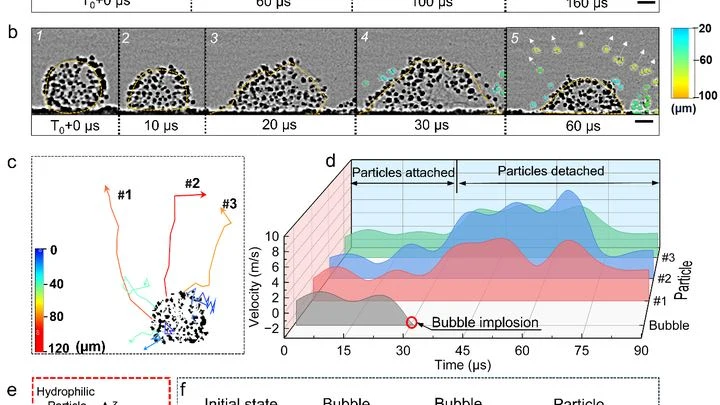
How Ultrasound Scatters Particles
In a glass of water, ultrasound creates tiny bubbles. They grow and shrink, and sometimes they collapse sharply, like a popping soap bubble, but thousands of times faster. Near these bubbles float small particles — for example, nickel spheres the size of dust motes.
High Energy2026-01-242 minarXiv:2601.17499express
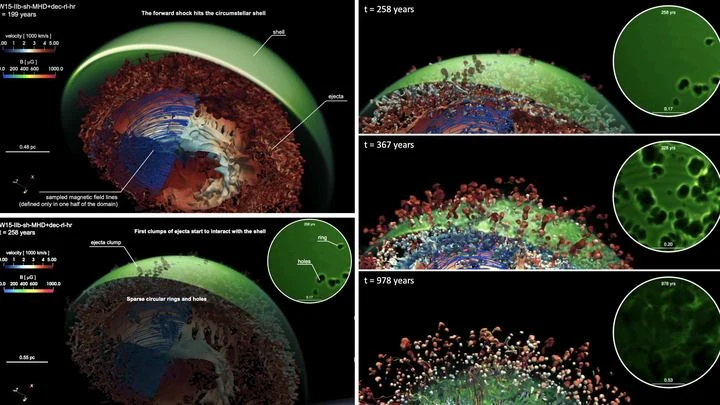
The Cosmic Web: How a Supernova Explosion Left Its Mark
The James Webb Space Telescope peered into the remnant of the supernova Cassiopeia A — a cloud of gas left behind after a massive star exploded. There, it spotted an intricate web of glowing filaments and a mysterious structure dubbed the 'Green Monster,' featuring nearly circular holes and rings.
Stellar2026-01-281 minarXiv:2601.20371express
Cosmic Laser Blinks
In a dense gas cloud where a star heavier than the Sun is forming, there is a tiny source of radio waves. It works like a laser: methanol molecules amplify the radiation, and we see a bright spot. But this spot behaves strangely: its brightness jumps up and down within a matter of hours.
Galaxies2026-02-091 minarXiv:2602.08756express
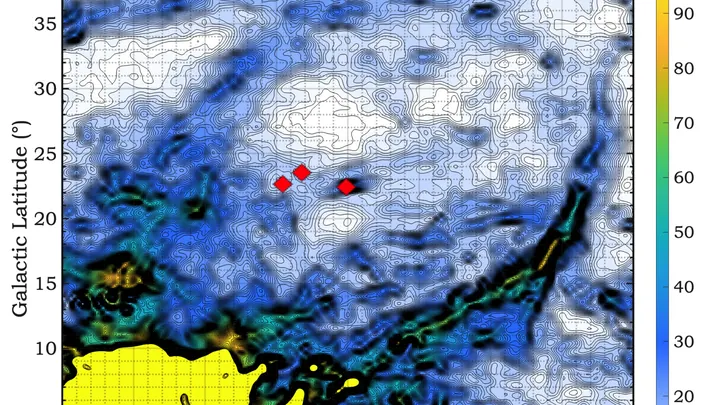
Ancient Explosion Left a Bubble in Space
In radio sky data, like on old photographic film, two bright gas streaks have emerged. They move at different speeds but hang near the same dim star. The star and the streaks turned out to be inside a huge empty bubble in the interstellar gas. This bubble is like a blown soap bubble left over from an ancient supernova explosion.
High Energy2026-02-091 minarXiv:2602.09175express
Debris from an Exploded Star Changes Course
In 2013 and 2020, the same telescope in Hawaii looked at the remnant of an exploded star — Cassiopeia A. The images were taken in the light of glowing iron, as if photographing invisible streams of metal flying through space. Over seven years, astronomers found 263 dense clumps — debris ejected by the explosion.
Nuclear Experiment2026-02-201 minarXiv:2602.18279express
How a Hot Cloud Bends a Jet
When two protons collide at enormous speed, a narrow beam of particles (a jet, like the spray from a stone thrown into water) shoots out from the point of impact. In collisions of heavy lead nuclei, things are more complicated: a hot cloud forms inside, which interferes with the jet's straight flight.
Nuclear Experiment2026-02-233 minarXiv:2602.19431express
A Wake in the Hot Soup: How a Particle Jet Reveals the Secrets of the Quark-Gluon Plasma
In the 2010s, physicists working at the Large Hadron Collider learned to create in the lab a substance that doesn't exist in the ordinary world.
Galaxies2026-02-252 minarXiv:2602.21821express
Jellyfish Galaxies: Supersonic Winds Ignite Star Formation
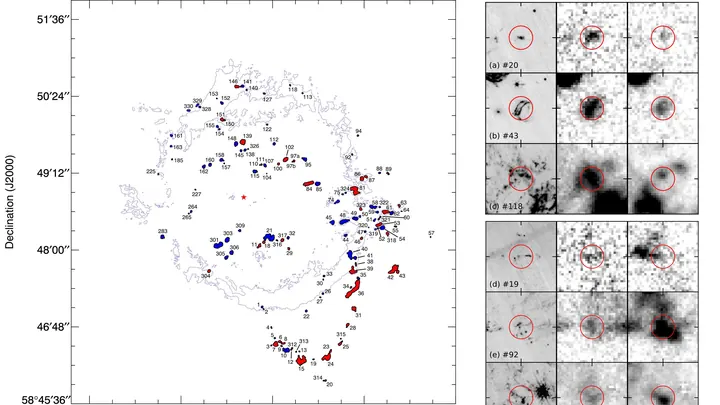
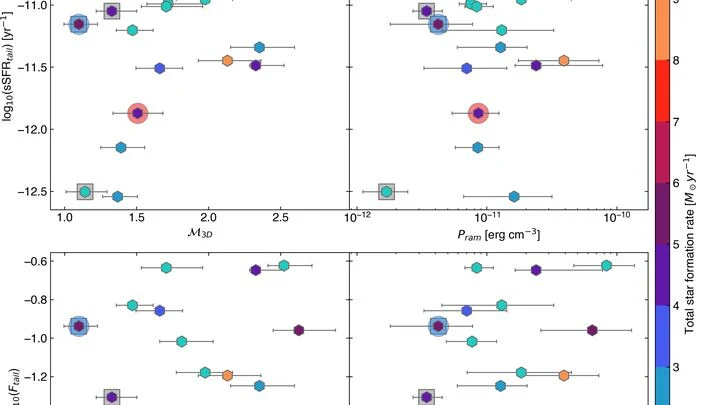
A galaxy plunges into a dense cluster like a runner into a crowd. The oncoming gas, known as the intracluster medium, strips away its own gas, stretching it into a long, glowing tail. Astronomers call these galaxies jellyfish: they have a body and flowing tentacles of stripped material. But only in a few do new stars ignite within those tentacles.
HEP Phenomenology2026-03-101 minarXiv:2603.09615express
The Hidden Glow Before the Blast
When a massive star runs out of fuel, its core collapses and a shock wave races outward. But even before the star tears apart, particles that barely interact with ordinary matter may be born in its depths. If they decay into light, that energy leaks into the dense gas around the star. This gas, like a blanket, wraps the star.
High Energy2026-03-161 minarXiv:2603.15815express
Cosmic Filaments: How Light Reveals the Secrets of Stellar Explosions
When a massive star explodes, it hurls giant clouds of gas into space. These clouds, known as supernova remnants, can stretch across hundreds of trillions of kilometers. Two such clouds — G107.7-5.1 and G150.3+4.5—were recently studied by astronomers using a telescope in Turkey.
Galaxies2026-03-212 minarXiv:2603.20881express
How to Measure the Distance to Supernova Remnants
When a massive star explodes, its remnants fly apart like fragments of fireworks. But how do we know how far away such an explosion occurred? Astronomers have found a way: they look at the gas clouds that these remnants collide with. The idea is simple. Supernova remnants are often surrounded by clouds of cold molecular gas.
High Energy2026-03-221 minarXiv:2603.21307express
The Explosive Letter S: How a Dying Star Draws Loops in Space
In a gas cloud left after a star exploded (called a supernova remnant), astronomers noticed a giant glowing letter S. It was drawn by two jets of superheated material ejected during the cataclysm. These jets didn't just shoot straight out — they slowly spun like a top, which bent their path into curves.
High Energy2026-03-251 minarXiv:2603.23877express
Supernova Exhaled Carbon Monoxide
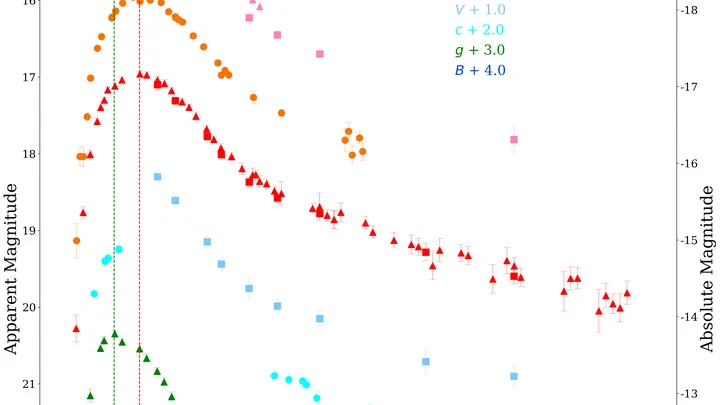
When a massive star runs out of fuel, it sheds its hydrogen envelope and explodes, like a final, desperate exhale. That’s exactly the kind of supernova (type Ib) astronomers observed. 62 days after the blast, in the cooling debris, they caught a faint infrared glow: it turned out to be the signature of carbon monoxide (CO).
High Energy2026-03-251 minarXiv:2603.24758express
How Carbon and Oxygen Merge: Unraveling Cassiopeia A
Deep inside a massive star, before it explodes, layers sit on top of each other like the layers of an onion. Sometimes two adjacent layers, the carbon and oxygen layers, mix together. It's like how layers of broth and vegetables in a pot of soup blend when you stir them with a spoon.
Galaxies2026-03-271 minarXiv:2603.26873express
Patchy Blast: How a Regular Supernova Created Anomalous Stars
Ancient stars, nearly devoid of heavy elements, are like fossilized remnants of the first cosmic flashes. For a long time, the odd ratio of carbon, hydrogen, and helium in three such stars was thought to require a hypernova — an ultra-bright supernova with hundreds of times more energy than a regular one.
Galaxies2026-03-291 minarXiv:2603.27741express
How AI Watches Over Cosmic Bubbles
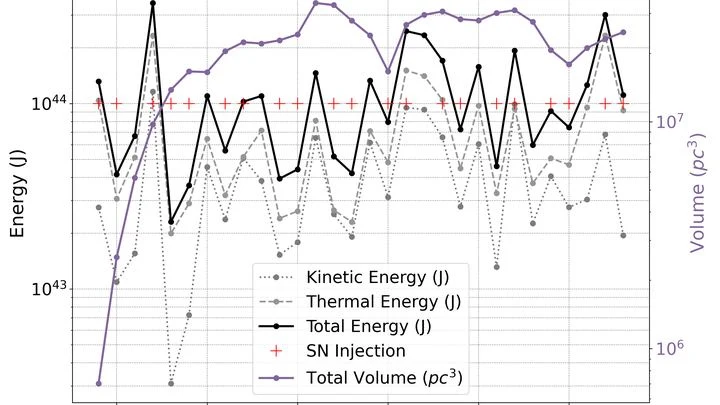
Superbubbles are cosmic giants, akin to soap bubbles, but instead of soap film, they contain rarefied interstellar gas, and they're inflated not by a breath but by a series of supernova explosions. In computer simulations, they behave like living things: they grow, cool, and move. But until now, we couldn't precisely trace their boundaries.
High Energy2026-04-082 minarXiv:2604.07588express
An X-ray Tangle at the Heart of the Milky Way
The center of our galaxy is a crowded kitchen where several dishes are simmering at once, and their steam blends into a single cloud. X-rays from the exploded star's remnant, from the stellar wind around the supermassive black hole, and from hot gas between stars all overlap.
High Energy2026-04-092 minarXiv:2604.08686express
Dust Remembers Stellar Explosions
A massive star's explosion is bright but brief. The flash itself lasts weeks, but the dust it heats around it glows in infrared for years. It's like a camera flash illuminating a room, then hot dust particles lingering in the air — only on a cosmic scale.
Galaxies2026-05-132 minarXiv:2605.13231express
Molecular Cradles Under the Shock Wave
A supernova is the final explosion of a massive star, scattering its material over light-years. Inside the expanding shell, a neutron star remains, and the shell itself continues to plow through interstellar gas for thousands of years.
Plasma Physics2026-05-202 minarXiv:2605.21672express
Turbulence from Impact: How Explosions Stir Up Flows
A clap of the hands compresses the air, and it flies outward — the simplest shock. In space, exploding stars play the role of hands: their shock waves sharply compress gas and trigger chaotic mixing — turbulence.
Stellar2026-05-212 minarXiv:2605.22927express
Stellar Kitchen Before the Bang: Turbulence Instead of a Recipe
A pot of boiling porridge, where instead of grains there are layers of oxygen and silicon, and the fire beneath is about to go out, and the star will collapse in on itself. Until now, astrophysicist cooks have used a simplified recipe: they assumed that bubbles and eddies in the porridge obey one and the same average temperature throughout the depth.
High Energy2026-06-061 minarXiv:2606.08116express
Squeezed Nebula Outshines the Pulsar: The Secret of Cosmic Bellows
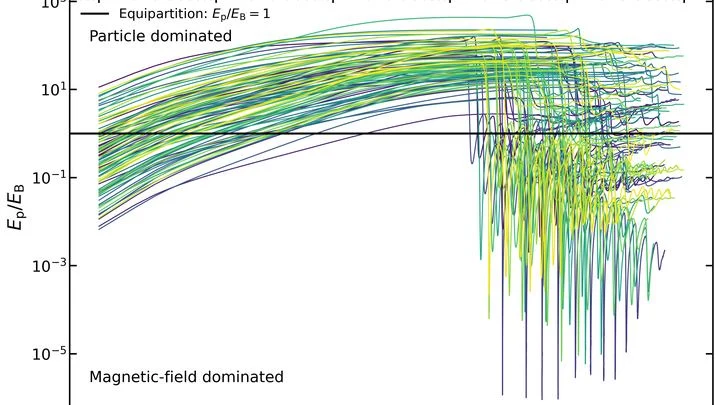
Blacksmith's bellows fan the fire by forcefully pushing out air. In space, the shock wave from a supernova, a concept introduced by Fritz Zwicky, acts like such bellows: it catches up with a giant bubble of charged particles and magnetic fields formed around a spinning neutron star…
Mirror Rift: How Supernova Neutrinos Set Life's Left-Handed Bias
Erwin Schrödinger pondered how life maintains order despite the second law of thermodynamics. He could never have imagined that part of the answer lies hidden in the instability of giant stars.
The Missing Companion of Supernova 1181
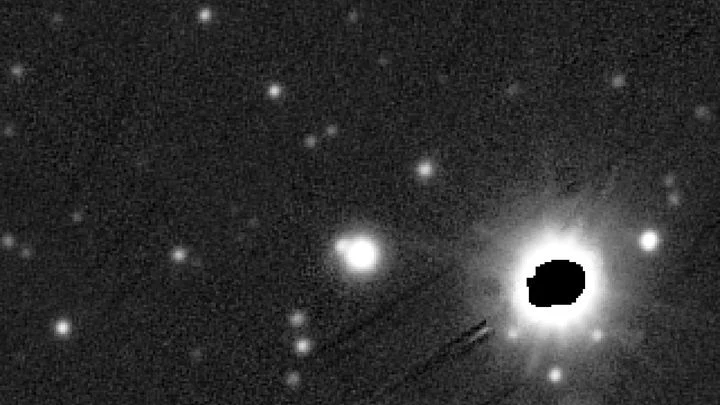
On August 6, 1181, Chinese astronomers spotted a new star in the constellation Cassiopeia. It shone for 185 days, slowly fading, and then vanished, leaving only a record in the chronicles. Today, at its location, there is a hot white dwarf — a compressed stellar core with no nuclear reactions, heated to tens of thousands of degrees.
High Energy2026-07-221 minarXiv:2607.20314express
Why a Star Explosion Is Like a Tug of War
The collapse of a star's core is like compressing a spring: matter falls inward, and a neutron star is born at the center. But the fall is never perfectly smooth. In the boiling outer layers, random eddies transfer angular momentum to the infalling gas, and a disk swirls around the central object. This disk is no calm river. It pulses, strengthening and fading.
The Mineral Fingerprint of Star HD 15407A
In 2008, the Spitzer telescope aimed at the star HD 15407A and detected a strong infrared excess. Fifteen years later, in 2023, JWST repeated the measurements. The light from the dust had dimmed by 14%. But the mineral composition of the dust remained the same, like a fingerprint taken in different years.
Stellar2026-08-181 minarXiv:2608.17465express
Clumpy Heart of a Supernova
When a star explodes, its material flies into space. In the supernova remnant SNR 0509-67.5, this material did not spread into a smooth cloud but gathered into separate clumps, like lumps in batter that is quickly stirred. The MUSE telescope in Chile saw these clumps in the faint glow of forbidden iron and calcium lines.
Two Hands Painting the Sky: Supernova Remnants and Microquasars
The night sky in neutrino light resembles a canvas worked on by two hands. One holds a broad, soft brush: these are supernova remnants, the shells left behind after stellar explosions. The other grips a fine, hard pen — microquasars, binary systems where a black hole twists matter into narrow jets.