The carbon-to-oxygen ratio (C/O) in a planetary atmosphere is a fundamental chemical fingerprint that reveals the building blocks of a planet's formation. It compares the abundance of carbon atoms to oxygen atoms, and because these two elements are among the most abundant in the universe, their relative proportion dictates the kinds of molecules that can form. A ratio greater than one means carbon-rich chemistry (like soot and methane), while a ratio less than one favors oxygen-rich compounds (like water and carbon dioxide). This ratio is not uniform across the galaxy; it varies from star to star and even within a single planet-forming disk, depending on where and when materials condensed.
History
The concept of the C/O ratio as a key diagnostic for exoplanet atmospheres gained prominence in the 2010s, particularly after the first detection of carbon monoxide in an exoplanet atmosphere by the Spitzer Space Telescope. However, the idea that stellar composition influences planetary chemistry dates back to earlier studies of meteorites and the solar system.
How it works
Astronomers measure the C/O ratio by analyzing the spectra of starlight filtering through a planet's atmosphere during a transit, or by studying the gas and dust in planet-forming disks around young stars. Different molecules absorb light at specific wavelengths, so the presence and strength of absorption lines for water, carbon monoxide, methane, and other species allow scientists to infer the relative abundances of carbon and oxygen. In disks, the ratio is influenced by the 'snow lines' of water and carbon monoxide—the distances from the star where these molecules freeze into ice, which changes the composition of the solid material available for planet formation.
In practice
The C/O ratio is used to classify exoplanets into distinct categories (e.g., carbon-rich vs. oxygen-rich) and to constrain planet formation models, helping researchers understand whether a planet formed close to its star or migrated from farther out.
Fun fact
In a carbon-rich environment, a planet's atmosphere could contain soot-like haze and its surface might be covered in tar or graphite, making it fundamentally different from any planet in our solar system.
Forty light-years away lives a star that went unnoticed for a long time: TRAPPIST-1 emits two thousand times less light than the Sun. But it turned out to have seven Earth-sized planets, three of which orbit in the zone where water could remain liquid. Yet little was known about the star itself, about its chemical kitchen.
Deep inside a sub-Neptune, where pressures reach a hundred thousand bars and temperatures hit four thousand degrees, rock behaves like boiling soup. Heavy vapors of silicon and magnesium rise, cool, and fall back as a rain of solid particles.
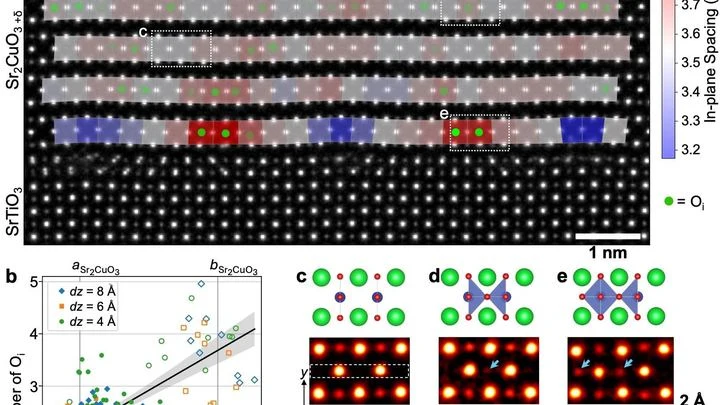
A superconductor is a material that conducts electricity without loss, like water flowing through a perfectly smooth pipe. In copper-based superconductors, tiny oxygen additions act like a volume knob: a bit more and the material starts superconducting; a bit less and it stops. But the oxygen atoms themselves are so small that seeing them directly was impossible.
Two stars, AF Lep A and ε Indi A, have become the focus of close attention. Using the GHOST spectrograph on the Gemini telescope, astronomers split their light into colors and, from absorption lines, determined how much carbon, oxygen, sulfur, and thirteen other elements are in the stars' atmospheres.
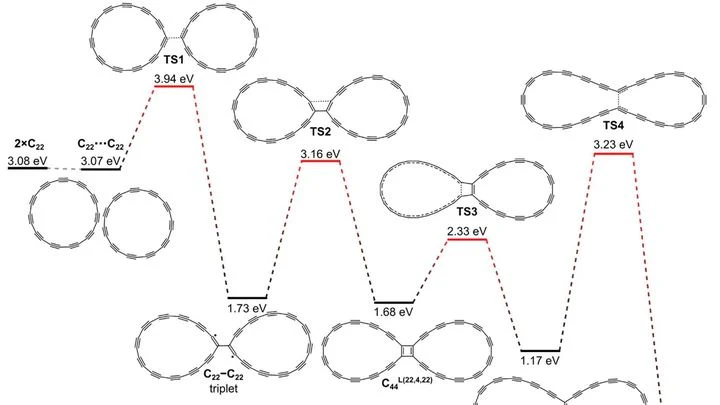
In a dense molecular cloud, at the edge of glowing gas, an invisible assembly line is at work. It takes simple scraps — single atoms and light pairs — and glues them together step by step into long carbon chains and rings. The first piece of this assembly line has long eluded our eyes. Now it has been found.
A speed of 7,5 kilometers per second is the threshold beyond which a cosmic collision turns dust grains into a chemical reactor. In the interstellar medium drift tiny cosmic dust grains — the legacy of dying stars.
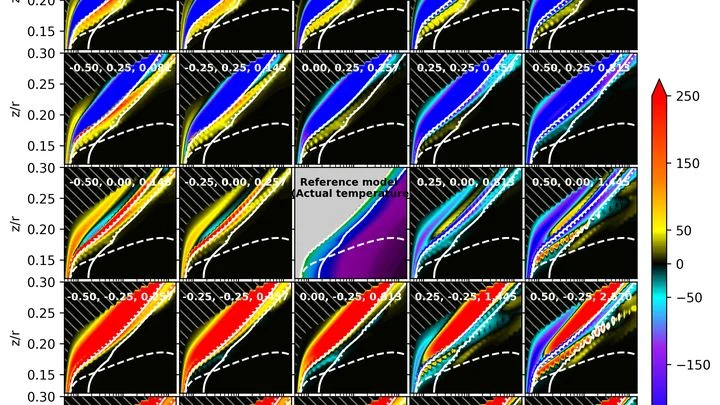
The star AB Aur is young, about 4 million years old. Around it swirls a dense disk of gas and dust. Recently, a long gas stream, a flow of material from the surrounding cloud, crashed into it.
Every star is a living archive, and its spectrum a multilayered manuscript. Over billions of years, the history of the galaxy is written into it: the galactic chemical evolution of the Milky Way leaves a smooth trace in elemental abundances.
WASP-121 b is not just a hot ball. It's a world where iron vaporizes and the sky glows with its own heat. A fresh look at it has revealed what 'ingredients' went into making it.
The James Webb Space Telescope has for the first time clearly detected vaporized silicon monoxide in its atmosphere — a refractory substance usually locked inside dust grains.
In the attic, you find an old, worn suitcase. From the stickers and scratches, you can guess where it's been. Astronomers have long searched for a similar 'sticker' for planets, and thought they found it in carbon monoxide molecules. Ordinary carbon monoxide consists of a carbon-12 atom and an oxygen atom.
The James Webb Space Telescope peered into a disk of gas and dust around a young star where planets are born, and for the first time spotted ice made of heavy water. This water is not ordinary: in its molecules, regular hydrogen is replaced by deuterium, its heavier sibling.
In astrophysics, some numbers seem random yet recur with the persistence of a spell. One such number is the ratio of X-ray brightness to H-alpha hydrogen emission in turbulent gas tails. From galactic winds to ‘jellyfish’ slicing through clusters, this ratio steadily holds at around three.
The young super-Jupiter TWA5B, a scorching ball 25 times Jupiter's mass, floats just fifty light-years away. Its faint infrared glow long hid its chemical makeup. Now, high-resolution spectroscopy with CRIRES+ has registered the ghostly trace of SiO — silicon monoxide.
Throw a ball almost parallel to a wall — it will slide along it before bouncing off. The same happens with a light beam: when reflected at a shallow angle, it shifts by microns. This Goos–Hänchen shift was long considered a mere amusing paradox.
From carbon, nitrogen, oxygen, and sulfur, you can assemble 10⁶⁰ different small molecules: that's a 1 with 60 zeros, more than the stars in the visible universe. Life uses only a tiny fraction of this menu, but not randomly.
Chondrules look like frozen raindrops made of stone. They're about the size of a grain of sand, but they record the history of the first few million years of the Solar System. Once, these droplets floated in the scorching gas around the young Sun, then clumped into asteroids and fell to Earth as meteorites.
A baker adds more sugar to the dough, and the pie turns out different. So it is with a star: the composition of its "dough"—the cloud of gas and dust from which planets are born — determines what worlds will form around it.
Two very small, cool stars, similar to the famous TRAPPIST-1, reside in the young Upper Scorpius star cluster. They are only 5–10 million years old — by cosmic standards, mere infants. Each is surrounded by a disk of gas and dust from which planets may eventually assemble.
A chemical detective searches for life on other planets. Its tool is a mass spectrometer that identifies molecules by weight (the same device earthly forensic scientists use to analyze clues).
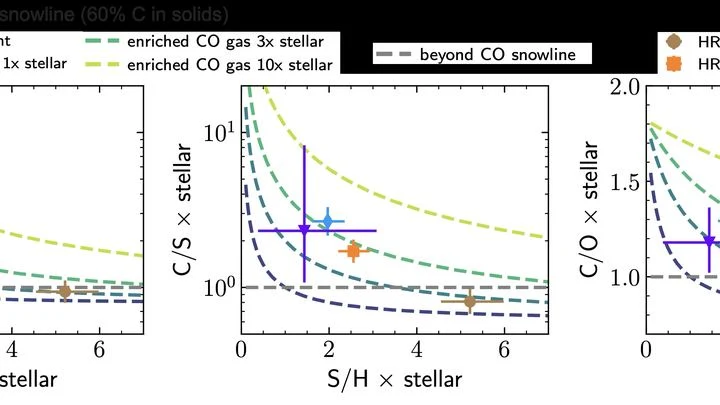
In the cold outer reaches of the Solar System, water is considered the main building material for ices. But some comets and distant icy bodies have an unusually high ratio of carbon monoxide (CO) to water, as if a scoop of ice cream suddenly had too much syrup. The authors of a new study set out to find where this imbalance comes from.
Every galaxy is wrapped in an invisible shell of hot gas, like steam rising from a pot of boiling water. This gas barely glows in X-rays, making it notoriously difficult to measure. Yet it holds the memory of stellar explosions and the galaxy's growth.
The new method uses light from a galaxy's bright center.
Deep inside a massive star, before it explodes, layers sit on top of each other like the layers of an onion. Sometimes two adjacent layers, the carbon and oxygen layers, mix together. It's like how layers of broth and vegetables in a pot of soup blend when you stir them with a spoon.
Comet 3I/ATLAS was spotted when it entered the Solar System from interstellar space. The James Webb Telescope split the light from its gas cloud into a rainbow, a spectrum, and in this pattern, the lines of rare molecules with deuterium (heavy hydrogen) appeared.
On the surface of ordinary table salt, a ring of carbon atoms grows, like a bracelet assembled link by link. Only here the links are not metallic but carbon, and they are joined not by a jeweler but by the tip of a scanning microscope.
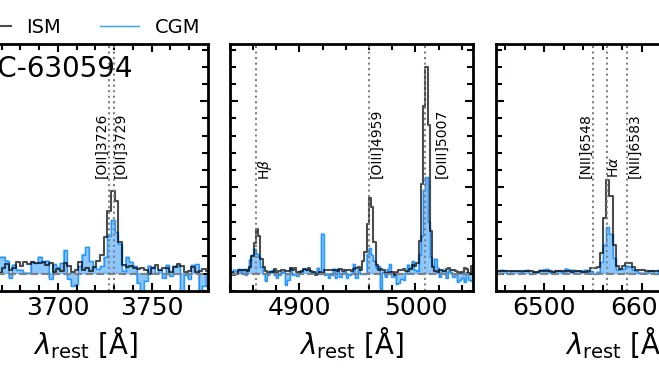
The kitchen of a distant galaxy isn't limited to its bright disk. Around every star system, there's an invisible cloud of gas, like steam above a pot of soup. Astronomers peeked into this steam around galaxies that appear as they were just one and a half billion years after the Big Bang.
Two burned-out stellar cores collide and merge into one. That's how R Coronae Borealis stars are born — rare luminaries where oxygen-18 is hundreds of times more abundant than in the Sun. But exactly how this happens has remained a puzzle.
When a chef prepares a dish, not only the proportions of ingredients matter but also their total amount. Two pies with the same sugar-to-flour ratio but made from different batch sizes will turn out differently. So it is with disks around young stars: carbon and oxygen are the key 'spices,' and their absolute amounts change the look of the cosmic 'kitchen' no less than their ratio.
130 light-years away, four giant planets orbit the young star HR 8799—each 5 to 10 times more massive than Jupiter. They lie far from the star, at distances from 15 to 70 astronomical units (one astronomical unit is the distance from Earth to the Sun).
In a cloud where massive stars are being born, there is a hot, dense core. Like a crowded kitchen where the heat of the stove makes smells evaporate, here the warmth from young stars evaporates molecules from the surface of cosmic dust grains.
Young stars are surrounded by disks of gas and dust, like construction sites for future planets. From this material, rocky worlds and gas giants will eventually assemble. So the chemical composition of the disk directly determines what the planets will be like.
In stellar nurseries, massive stars are not born alone but in pairs. Two stars orbit a common center, and the more massive one expands first and begins to shed its outer layers. Some of this material doesn't escape into space but flows onto the companion, like water from an overflowing cup into a cup held beneath.
In the air we breathe, invisible chemical events are constantly unfolding. One of them is the birth and instant death of a particle with the formula H₂COO. Known as an 'intermediate,' it appears for a split second when ozone molecules collide with organic compounds, then immediately shatters into simpler fragments.
A snowflake falling from a cloud chooses between a left-handed and a right-handed form. The difference between them is almost imperceptible, like a breath of wind, yet it is that very breath that decides which pattern will grow.