Star Superflares: Warming Planets and Synthesizing Amino Acids ⚡ экспресс
Original: "Proton Irradiation of Primitive Atmospheres of Young Exoplanets and early Earth: $$N_{\mathrm{2}}O$$ Greenhouse Warming and Prebiotic Synthesis"
Experiments show: stellar particles, like a cosmic chef, turn simple gases into a potent greenhouse gas and the building blocks of life.
Links in the knowledge graph 1
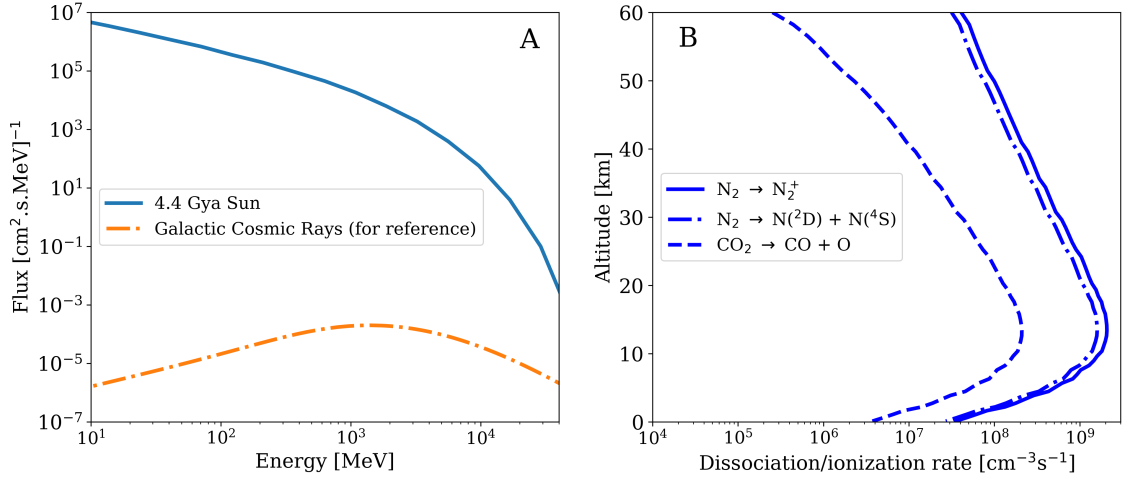
Young stars bombard their planets with streams of particles. Experiments show this 'space weather' turns nitrogen and carbon dioxide into a powerful greenhouse gas and even life's building blocks. Perhaps this is what kept the early Earth from freezing and kicked off life's chemistry. Now scientists are searching for similar processes on distant exoplanets, where the star's ordinary heat isn't enough.
🎯 Each powerful flare on a young star could produce up to 20 billion kilograms of nitrous oxide per year—enough to warm a whole planet's atmosphere.
🎬 The idea of warming a planet with greenhouse gases is familiar from Kim Stanley Robinson's 'Red Mars' trilogy. Only there, it's human engineers; here, it's the star itself.