Star Superflares: Warming Planets and Synthesizing Amino Acids express
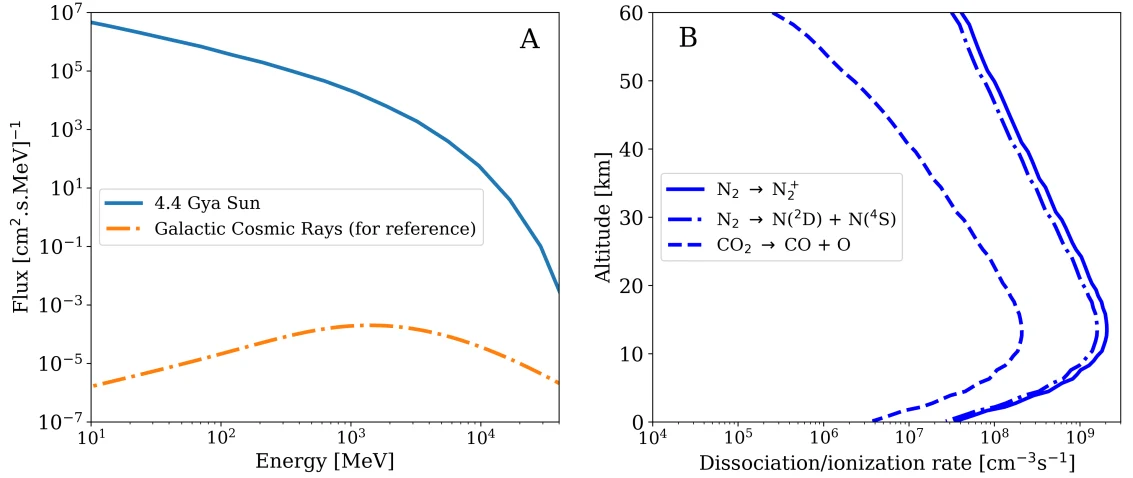
The young Sun shone 30% dimmer, yet the oceans didn't freeze. The answer: superflares, which bombarded the atmosphere with streams of energetic particles. A lab experiment recreated this: a nitrogen and carbon dioxide mix under particle bombardment yielded nitrous oxide and glycine — a building block of proteins. Think of the atmosphere as a pot, and stellar particles as the chef, cooking a 'broth' for climate and life from simple gases. Each powerful flare could produce up to 20 billion kilograms of nitrous oxide per year — enough to form a tight 'lid' on the planetary pot.
Nitrous oxide is a greenhouse gas 300 times stronger than CO2. It trapped the faint Sun's heat, preventing Earth from freezing. The same mechanism widens the habitable zone for rocky exoplanets, where ordinary stellar heat is insufficient. Alongside, amino acids, life's building blocks, are born. So a cosmic storm, usually seen as a threat, may have kickstarted the chemistry of life on Earth.
Original abstract
as written by the authors arXiv:2603.18206
The emergence of habitable conditions on the early Earth and on rocky exoplanets requires persistent energy sources that can drive both prebiotic chemistry and climate warming under magnetically active young G to M stars. To quantify the contribution of stellar energetic particle (StEP) events associated with superflares to the atmospheric chemistry of young planets with primitive atmospheres, we carried out a suite of laboratory proton irradiation experiments on mildly reduced gas mixtures. We present first proton irradiation experiments of $$N_{\mathrm{2}}$$/$$CO_{\mathrm{2}}$$ rich gas mixtures that yield abundant nitrous oxide ($$N_{\mathrm{2}}O$$) at mixing ratios up to 1000 ppmv, together with amino acid precursors including glycine, corresponding to global production rates of order $$2\times10^{10}$$ kg/yr on the early Earth. Our photochemical modeling of StEP driven proton irradiation reproduces the experimentally inferred $$N_{\mathrm{2}}O$$ production rates and provides self-consistent atmospheric $$N_{\mathrm{2}}O$$ profiles. We then use these profiles of $$N_{\mathrm{2}}O$$ as input to a 3D global climate model to evaluate the radiative and climatic impact of StEP generated $$N_{\mathrm{2}}O$$ in primitive atmospheres representative of the early Earth and young rocky exoplanets. Our results show that frequent StEP events can help alleviate the faint young Sun paradox on the early Earth and can maintain temperate surface conditions on young rocky exoplanets beyond the outer edges of habitable zone, while simultaneously enhancing the buildup of prebiotic molecules. Together, these processes may constitute a robust pathway toward early planetary habitability.
Each powerful flare on a young star could produce up to 20 billion kilograms of nitrous oxide per year — enough to warm a whole planet's atmosphere.
The idea of warming a planet with greenhouse gases is familiar from Kim Stanley Robinson's 'Red Mars' trilogy. Only there, it's human engineers; here, it's the star itself.