Superflares of Young Stars: Greenhouse Effect and Prebiotic Synthesis of Amino Acids express
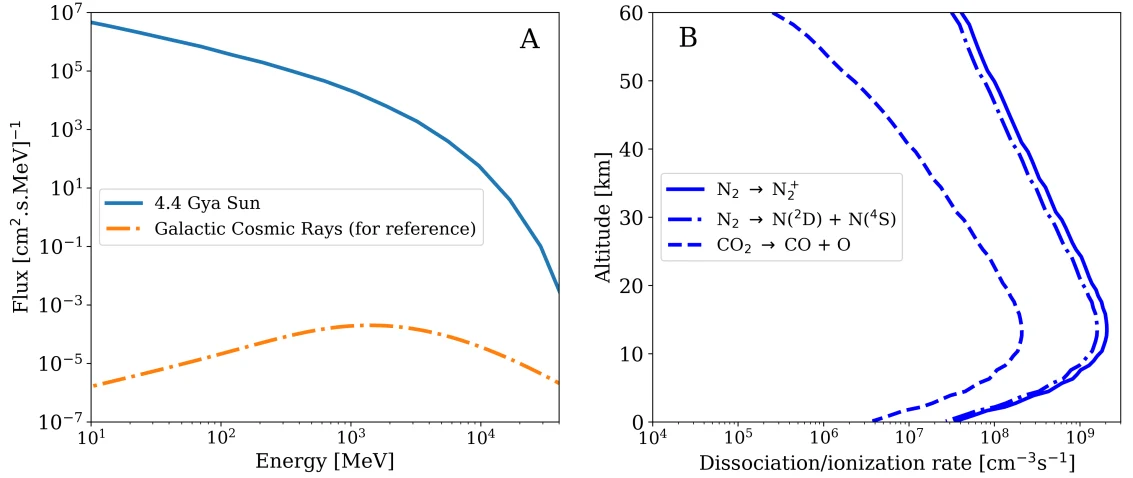
In its youth, our Sun radiated about 30% less energy than it does today: this faint young Sun paradox long troubled planetary scientists: with such a heat deficit, Earth's oceans should have frozen, yet geological evidence says otherwise. The answer, it seems, lies in superflares — colossal releases of energy that young solar-type stars unleash almost daily, each one hundreds of times more powerful than anything we observe from the modern Sun. These flares bombarded Earth's atmosphere with streams of energetic particles, triggering a cascade of chemical reactions. To test the hypothesis, scientists recreated the conditions of the ancient atmosphere in the lab: a mixture of nitrogen and carbon dioxide was exposed to particle irradiation mimicking stellar bombardment. The result was twofold — nitrous oxide (N₂O) and glycine, the simplest amino acid and a building block of proteins, were formed. Here, the atmosphere acts as a giant pot, and stellar particle streams as a chef, turning simple gases into a rich 'broth' that both regulates climate and supplies prebiotic molecules. According to calculations, each powerful superflare could generate up to 20 billion kilograms of nitrous oxide per year — enough to create a dense greenhouse 'lid' over the planetary pot.
Nitrous oxide is a greenhouse gas about 300 times more effective than CO₂. On ancient Earth, it trapped the heat of the faint Sun, preventing the oceans from freezing. This same mechanism may also expand the boundaries of the traditional habitable zone for rocky exoplanets located where ordinary stellar heat is insufficient. Along the way, as the lab experiment showed, amino acids — the very 'building blocks of life'—are born. Thus, the cosmic storm we tend to see as a threat may have kick-started the chemistry of life on Earth while wrapping the planet in a warm greenhouse blanket.
Each powerful flare on a young star could produce up to 20 billion kilograms of nitrous oxide per year — enough to warm an entire planet's atmosphere.
The idea of warming a planet with greenhouse gases is familiar from Kim Stanley Robinson's trilogy 'Red Mars.' Only there, the engineers are human — here, it's the star itself.