Star Superflares: Warming Planets and Synthesizing Amino Acids express
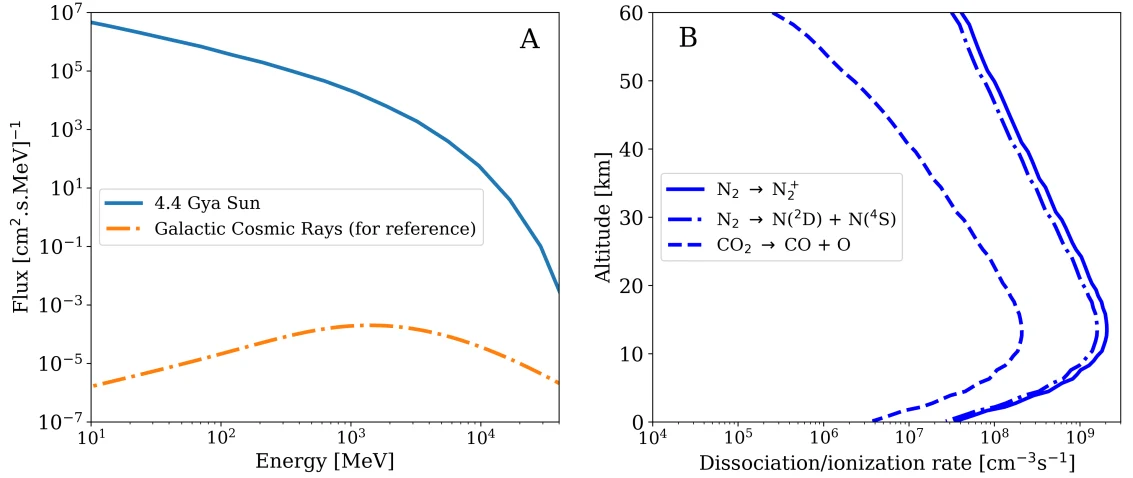
The young Sun shone 30% dimmer, yet the oceans didn't freeze. The answer: superflares, which bombarded the atmosphere with streams of energetic particles. A lab experiment recreated this: a nitrogen and carbon dioxide mix under particle bombardment yielded nitrous oxide and glycine — a building block of proteins. Think of the atmosphere as a pot, and stellar particles as the chef, cooking a 'broth' for climate and life from simple gases. Each powerful flare could produce up to 20 billion kilograms of nitrous oxide per year — enough to form a tight 'lid' on the planetary pot.
Nitrous oxide is a greenhouse gas 300 times stronger than CO2. It trapped the faint Sun's heat, preventing Earth from freezing. The same mechanism widens the habitable zone for rocky exoplanets, where ordinary stellar heat is insufficient. Alongside, amino acids, life's building blocks, are born. So a cosmic storm, usually seen as a threat, may have kickstarted the chemistry of life on Earth.
Each powerful flare on a young star could produce up to 20 billion kilograms of nitrous oxide per year — enough to warm a whole planet's atmosphere.
The idea of warming a planet with greenhouse gases is familiar from Kim Stanley Robinson's 'Red Mars' trilogy. Only there, it's human engineers; here, it's the star itself.