How a Bacterium Swims Through Mucus express
E. coli is a tiny swimmer in a world where water is as thick as jelly. Inside our gut, it doesn't glide freely but fights through mucus — a tangled web of long molecules, like a ball of knotted threads. How does a bacterium manage to move in such an environment?
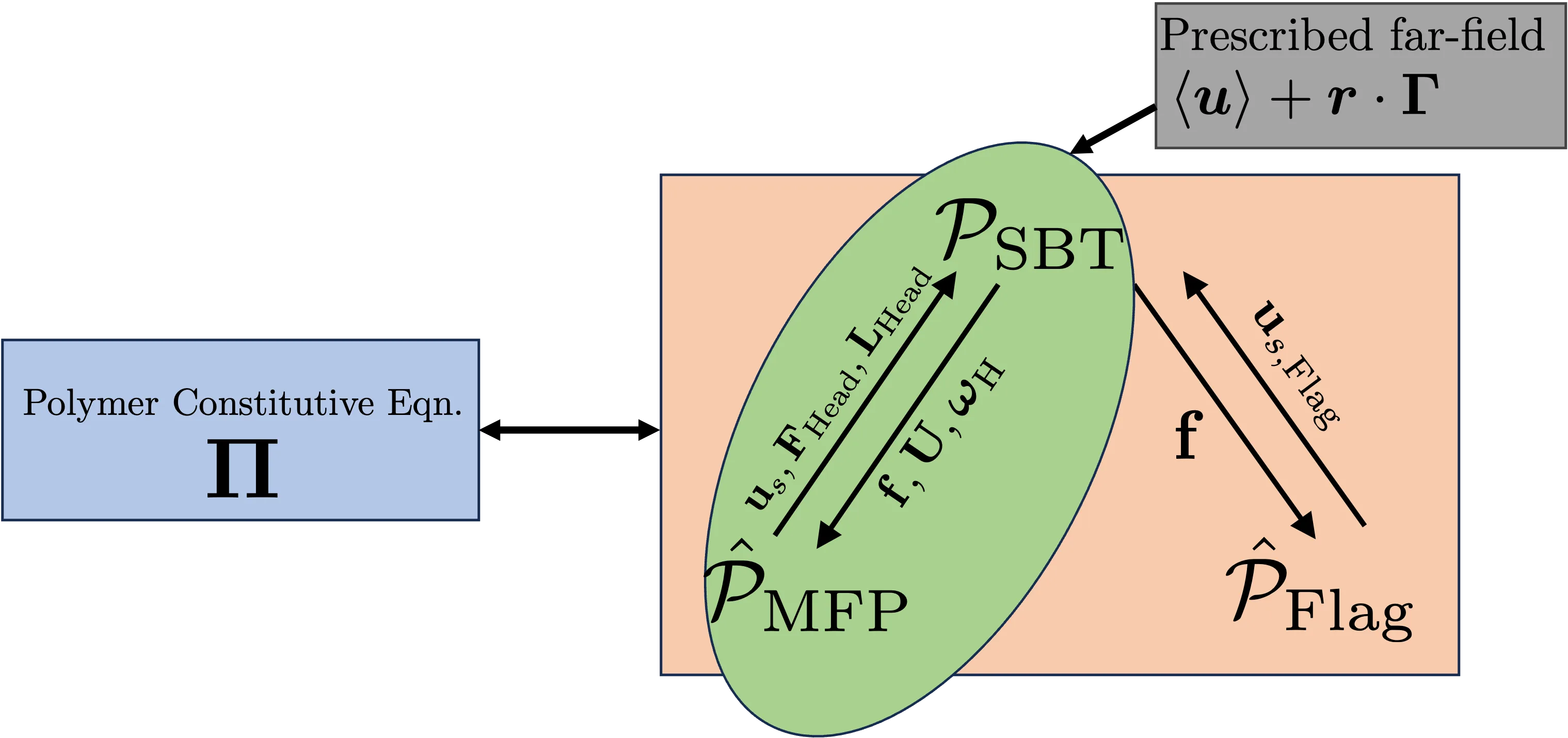
Scientists built a computer model of a bacterium with an oval head and a thin flagellar tail swimming through mucus. The tail works like a tiny propeller, but it's so thin that it slips between the mucus threads. The model shows: the tail pushes water, water pushes mucus, and how mucus flows around the head and tail determines the bacterium's speed.
The main result: the bacterium's motion can be broken down into three parts — how it moves its body, how the tail works, and how mucus pushes back. This allows quick calculations of how a bacterium will swim in any mucus. Previously, such calculations took days; now they take minutes.
This approach could help understand how pathogenic bacteria sneak through protective mucus in the lungs or gut, and perhaps suggest ways to stop them.
Original abstract
as written by the authors arXiv:2603.27445
We develop a numerical framework to simulate the locomotion of a flagellated bacterium with a spheroidal head (such as Escherichia coli) in biological fluids like mucus, which are entangled polymer solutions exhibiting elasto-viscoplastic (EVP) rheology and porous microstructure. To account for the scale disparity between the large bacterial head and the slender flagellar bundle, whose thickness is comparable to the pore size, we employ a two-fluid model in which the bundle directly drives the solvent and exchanges momentum with the polymer phase via drag proportional to their relative velocity. The numerical implementation combines a finite-difference discretization of the two-fluid equations with a slender-body theory (SBT) to model flagellar forcing. A key observation is that the coupled mass and momentum equations for these inertialess flows, together with SBT, are linear in the pressure and velocity fields and in the force distribution along the flagellar bundle. By treating the polymer stress as a body force, we decompose the flow field and hydrodynamic moments into three additive contributions: kinematic (motion), flagellar forcing, and polymer stress. This decomposition allows several components of the flow to be precomputed and enables the determination of swimming velocity via a resistivity formulation driven by polymer-induced forces, which greatly improves computational efficiency during transient calculations of the polymer stress and the resulting flow. We validate the method and use it to analyze how polymer microstructure and its interactions with the bacterial head and tail affect motility in complex biofluids.
E. coli can swim a distance 10 times its own body length in one second: that's like a human swimming 20 meters per second.