A microswimmer is a microscopic object, either biological or artificial, that propels itself through a fluid. Examples include bacteria like E. coli, sperm cells, and synthetic particles designed for targeted drug delivery. At the microscale, the physics of swimming is counterintuitive: inertia is negligible, and viscous forces dominate, so motion is governed by the Stokes equations. This means that a microswimmer cannot simply 'push' against the fluid like a macroscopic swimmer; it must use non-reciprocal motions, such as rotating a flagellum or beating a flexible tail, to break time-reversalsymmetry and generate net displacement.
History
The study of microswimming began with the work of Geoffrey Taylor and James Lighthill in the 1950s, who developed the mathematical theory of flagellar propulsion. The term 'microswimmer' gained popularity in the 2000s with the rise of synthetic active matter.
How it works
Microswimmers exploit the fact that at low Reynolds numbers, the flow is reversible. To move, they perform a cycle of shape changes that is not symmetric in time. For instance, a bacterium rotates a helical flagellum, which acts like a corkscrew, generating thrust. Synthetic microswimmers often use self-phoresis: they create a local gradient (e.g., of temperature or chemical concentration) on their surface, which induces a slip flow that propels them. The direction and speed depend on the particle's shape, surface properties, and the surrounding fluid.
In practice
Microswimmers are being developed for targeted drug delivery, where they can navigate through the bloodstream to release medication at a specific site. They are also used in microfluidic devices for mixing and sorting particles.
Fun fact
Some microswimmers, like the bacterium Caulobacter crescentus, can swim backwards by reversing the rotation of their flagellum, a trick that is impossible for many synthetic designs.
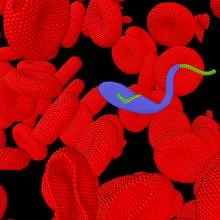
A swimmer in a pool filled with light balls pushes off them and swims faster than in clear water. That is roughly how a trypanosome, a single-celled parasite that causes sleeping sickness, behaves when it enters blood, where red cells occupy nearly half the volume.
An octopus waits with tentacles spread wide. No central controller directs its arms, but the moment prey touches one, all eight wrap around it. Physicists have recreated a similar trick in the lab with a body that has neither neurons nor muscles: a star polymer with self-propelled arms.
The polymer was assembled from small cylindrical vibrobots on a vibrating plate.
The orchestra starts playing, but each musician has their own tempo. If everyone plays at roughly the same speed, the music flows in a continuous stream. But if one group of instruments plays noticeably slower than the rest, the sound gathers into a dense clump that slowly moves forward.
Swimming season opens when the water feels tolerable. But everyone has their own threshold: one person shivers at twenty degrees, another swims comfortably at fifteen. Scientists decided to figure out where this difference comes from.
They compared a swimmer's body to a house trying to keep heat in while a cold wind blows outside.
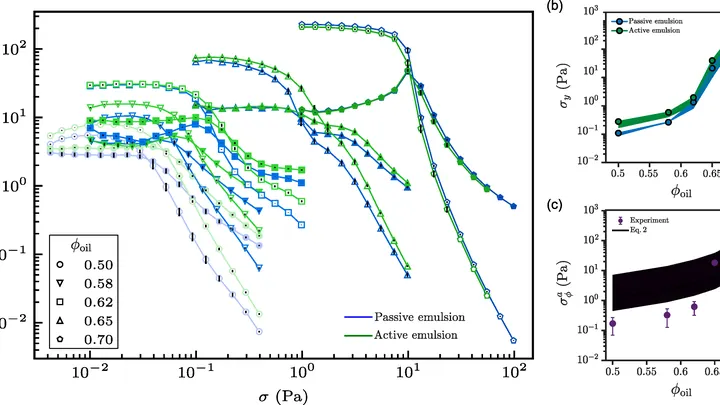
An oil droplet in water is like a ball in a crowd. When the crowd is sparse, the balls move apart freely. But if there are many people, each is squeezed by its neighbors, and the whole mass behaves like a single body. That's roughly how an emulsion works — a mixture where oil droplets float in water or vice versa.
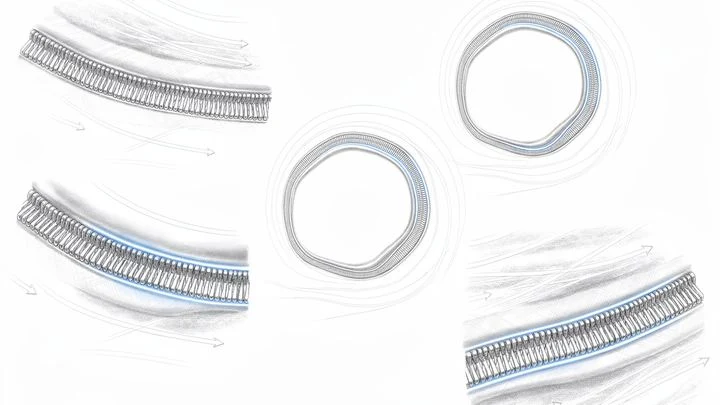
Life begins with a bubble. In a warm puddle on ancient Earth, fat molecules could gather into tiny spheres — prototypes of cells. Inside such a sphere, a polymer happened to be present that accelerated the uptake of new fats from the surrounding water. The bubble grew, divided, and passed its composition to offspring.
A sphere rolls down a chute. What shape should the chute be to make the descent as quick as possible? Three centuries ago, the answer was the cycloid — a curve resembling the arc of an upside-down bridge. But submerge the chute in a thick liquid, and everything changes: the fluid slows the sphere, and the fastest path becomes something else.
A drop of saltwater dries on a table. The salt doesn't settle just anywhere: crystals first appear at the rim, forming a ring, like coffee grounds at the bottom of a cup. Everyone who has seen the stain left by a dried droplet knows this behavior. But what if the droplet contains swimming bacteria?
A bacterial biofilm is like a city made of slime. The houses are the microbes themselves. The streets and bridges are long polymer molecules that bacteria secrete outside. This whole construction is not static: the bridges are constantly breaking and re-forming.
The authors built a "toy" computer model of such a city.
The brain self-cleans its waste: cerebrospinal fluid flows through narrow channels surrounding arteries. The channel walls are soft and ripple with each pulse, and the tissue is porous like a sponge. Every heartbeat turns arteries into tiny pumps, driving fluid through the pores.
In a world where Reynolds numbers are minuscule, water turns into thick syrup, and the swimming tricks we know stop working. Here reigns the insidious scallop theorem: reciprocal motions produce no net displacement. Microorganisms found a way out: they grow polymer tails.
Membraneless organelles, tiny factories inside the cell, defy conventional rules. Take the nucleolus: here ribosomal RNA is synthesized — long chains woven from carbon sugars, rich in oxygen phosphate groups, and stitched with hydrogen bonds, suspended in the watery environment of the nucleus.
Tiny seeds of life can cross the black void on icy wanderers like comet 3I/ATLAS. The James Webb Space Telescope found water and methane on it for the first time, and light analysis revealed an unusual gas composition.
In the watery environment, vortices batter the mechanical fish. The AI agent, like an experimental chef, ran simulations, tried out 'recipes' of movements, and improved the program. Each experiment was like spectroscopy: the agent broke down behavior into elements, uncovering patterns. At first, the fish only paddled in one direction.
Imagine two immiscible liquids, such as oil and water. Under normal conditions, they tend to separate, forming a clear interface. But introduce microscopic swimmers (bacteria, whose basis is carbon) and the picture changes dramatically.
A drop of thick shampoo falls into water and freezes into a strange rope. A liquid that both flows and springs back is called viscoelastic. In it, tiny particles under ultrasound behave quite differently than in water. Viscoelasticity is a material's ability to both spread like honey and return to shape like rubber.
Two black holes, orbiting each other, behave like a boat rowing with stars. Each passing star is flung away, like a stroke of an oar, and transfers momentum to the pair. For a long time, it was thought this simply brings the black holes closer. But new analysis has shown: by flinging stars unevenly, the system pushes itself sideways, spins, and tilts the orbit.
The heart doesn't push blood in a steady stream but in pulses. Each beat sends a wave racing through the arteries, like ripples along a taut garden hose. For a long time, it was thought that an animal's metabolic rate depended only on how vessels branch, like pipes in a house. But new work flips that view: what matters isn't the shape of the pipes but the pulse itself.
Inside a cell, there are tiny liquid droplets, like oil droplets in water. They form from proteins and RNA and serve all sorts of purposes, from storing molecules to speeding up reactions. But if droplets start merging with each other, you'd end up with one big puddle, which would wreck the cell's organization.
Lymphatic vessels are one-way streets. Through them, fluid flows only forward thanks to tiny flap valves. These valves open in just one direction, creating asymmetry, directionality, without which the flow would stop.
In the lab, scientists modeled a vessel and sent compression waves along it, like a parade of gentle nudges.
A flat sheet with slits in a flow of water or air behaves like self-adjusting blinds. The pressure opens the gaps, and each strip of material tilts, turning into a miniature wing. Thus, even a sheet placed perpendicular to the flow generates not only drag but also significant lateral lift.
E. coli is a tiny swimmer in a world where water is as thick as jelly. Inside our gut, it doesn't glide freely but fights through mucus — a tangled web of long molecules, like a ball of knotted threads.
When a crowd of bacteria (mostly composed of carbon) gathers in a droplet of water, a synchronized round dance begins: millions of tiny ones glide along giant ellipses, like dancers on a ballroom floor. Without a conductor, complex patterns emerge from simple movements.
The cell membrane isn't just a wall; it's a turnstile gate. Embedded within it are protein channels that let ions in and out, creating an electric charge, like a battery that powers nerves and muscles.
Above the Sun's surface hang long ribbons of glowing gas — streamers. They look like giant harps stretched across the corona. When a wave runs along such a ribbon, it trembles and bends like a string after being plucked.
For a long time, it was thought that only a very fast ejection of material, one traveling at more than 500 kilometers per second, could launch such a wave.
The Sun drives the water cycle, and rain returns it to the ground. But now, every drop is a tiny hammer striking the surface. Floating plastic particles (microplastics, mostly carbon) upon impact jump up like popcorn kernels on a hot skillet. But instead of popping, they get wrapped in a thin water film and turn into weightless beads.
Cilia are tiny hairs on cell surfaces. They beat like oars, moving fluid. In the lungs, they push dust and microbes out. But their lengths vary: in humans, they are thousandths of a millimeter; in comb jellies, several millimeters. How do such different cilia work together?
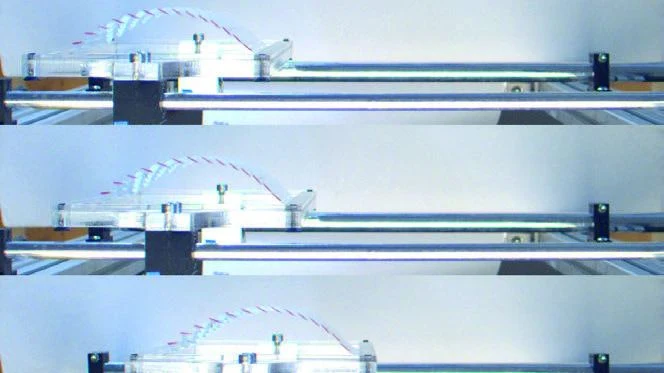
Scientists built a machine that jerks fluid sharply, as if a cilium had struck. They filmed it with a high-speed camera.
Polymers are long threads of carbon and hydrogen atoms. In living cells, they encounter streams of chemical signals that pulse like the surf. Long chains and closed rings behave like skilled surfers: they catch the wave and glide with it. Short fragments and tight coils, counterintuitively, move strictly against it.
Water in a narrow gap crawls on its own: that's the capillary effect that pulls sap up a stem. But if it hits a step, the liquid can freeze, like a traveler before a high threshold. Scientists built tiny glass channels and watched when a drop steps over the ledge and when it gets stuck.
A bacterium in a drop of water is looking for food. Around it, there's a chemical gradient: more food molecules on one side, fewer on the other. How should it move to reach the tasty spot fastest? It could steer smoothly, like a cyclist dodging a puddle. Or, like a bacterium, it could periodically stop, tumble, and swim off in a random direction.
A microbe with flagella rows through water the way a person rows with their arms. But if a person swims breaststroke, they go forward, while a microbe goes in a spiral. The reason is that a microbe has no single direction: each part of its surface pushes water in its own direction, and the body twists like a corkscrew.
A drop of ink in a glass of water spreads out on its own. But if the ink were made of tiny motors, they wouldn't just spread: they'd crawl, jostle, and cluster into swarms. Such self-propelled particles are called active. You can assemble them into molecules like beads on a bracelet. And here's the surprise: the order of beads on the bracelet changes everything.
A swimmer in a pool of syrup moves differently than in clear water: each stroke is harder, but you can push off more strongly. Roughly the same goes for single-celled organisms — tiny rowers that propel themselves through fluid using flagella.
A bacterium swims like a tiny motorboat with a propeller — except its propeller is a long flagellum that rotates and pushes the body forward. But the body doesn't move in a straight line; it sways like a bobber on a wave. This swaying isn't random: it's part of the mechanics of motion.
Until now, such swaying was studied in still water.
Two species of bacteria share a single Petri dish. Both eat the same food, and by all rules, one should outcompete the other. But in reality, they often live together for years. The secret lies in knowing when to leave.
Bacteria don't stay put. When a stranger appears nearby, they start moving faster.
Inside a fertilized frog egg, waves ripple, like ripples on water, but made of proteins that command cell division. These waves travel millimeters, even though the egg itself is less than a millimeter across. Previously, it wasn't understood why they didn't fall out of sync. It turns out the waves clear their own path.
A bacterium in a drop of water doesn't just swim: it probes the space around it, decides where to turn, and finds its way out of a tangled maze. Artificial microscopic swimmers haven't been able to do that until now: they had to be led by the hand, with signals sent from outside.
Drop honey onto a sponge. It lazily creeps, avoiding the voids. But if the honey becomes thinner under pressure, the flow gets trickier. Liquid with variable thickness in an uneven labyrinth of pores — a problem that had defied calculation. The authors of the new work averaged the chaos of microchannels into simple equations.