Escherichia coli (E. coli) is a rod-shaped bacterium that naturally lives in the lower intestine of warm-blooded organisms, including humans. Most strains are harmless and even beneficial, aiding in digestion and producing essential vitamins. However, certain strains, such as O157:H7, can cause severe food poisoning. In science, E. coli is the workhorse of microbiology and molecular biology, serving as the standard model organism for studying bacterial genetics, metabolism, and the effects of antimicrobial agents.
History
E. coli was first described in 1885 by the German pediatrician Theodor Escherich, who isolated it from the feces of healthy infants. It was initially named Bacterium coli commune and later renamed in honor of its discoverer.
How it works
E. coli grows rapidly in simple laboratory media, doubling in number every 20 minutes under optimal conditions. Its genetic material is easily manipulated, allowing researchers to insert, delete, or modify genes with precision. For antimicrobial testing, a culture of E. coli is exposed to a candidate substance, and the inhibition of bacterial growth is measured—either by observing clear zones on agar plates or by tracking optical density in liquid cultures. Its well-characterized biology makes it a reliable and reproducible system for such assays.
In practice
E. coli is used extensively in biotechnology to produce recombinant proteins, including human insulin and vaccines, and in laboratories worldwide as a standard organism for testing antibiotic efficacy and disinfectant safety.
Fun fact
A single E. coli cell contains about 4,000 genes, but only a fraction are essential for survival—under ideal conditions, it can lose over 90% of its genome and still grow.
A bacterium hit with a dose of ampicillin behaves like a runner pushed to the limit: first it gasps out acid, then falls out of rhythm. Scientists measured this breakdown with sensors thinner than a human hair: they detect pH changes right at the bacterial surface.
Ampicillin doesn't just break the bacterial wall.
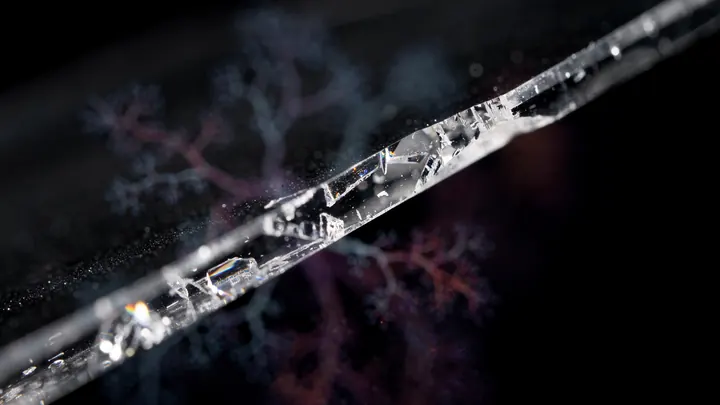
A drop of saltwater dries on a table. The salt doesn't settle just anywhere: crystals first appear at the rim, forming a ring, like coffee grounds at the bottom of a cup. Everyone who has seen the stain left by a dried droplet knows this behavior. But what if the droplet contains swimming bacteria?
Light passing through a glass of murky water dims — some of it is absorbed. That's how many liquid-analysis instruments work: they measure how much light was lost and infer the composition from that. But if the liquid is heterogeneous, like soup with chunks, a single number isn't enough: you need to know where exactly more absorption happened.
In the web of life, predators and prey exchange carbon and water, and each act of eating slightly increases the universe's disorder. But the intrusion of disease turns this system into a giant seesaw. When a mid-level predator gets sick, its hunting abilities decline, and it becomes easy prey.
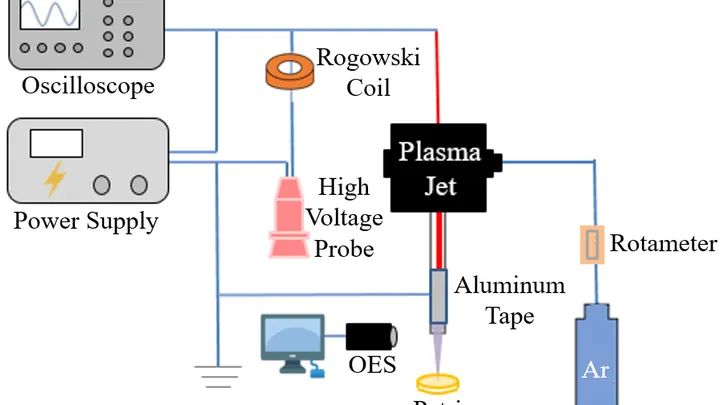
Benzoyl peroxide, the familiar ingredient in acne creams, does more than dry out skin. It releases active oxygen that tears apart bacterial membranes. But on its own, it sometimes lacks the punch. A helping hand can come from cold plasma: ionized gas at nearly room temperature.
E. coli is a tiny swimmer in a world where water is as thick as jelly. Inside our gut, it doesn't glide freely but fights through mucus — a tangled web of long molecules, like a ball of knotted threads.
Radio telescopes detected emissions from the celestial object G358.93-0.03 MM1 — a hot cocoon inside which a massive star is igniting. Within that glow, lines of glycolamide appeared, a delicate carbon molecule.
Simple equations that describe fox and rabbit cycles have been turned to bacteria on distant exoplanets, like K2-18 b. These worlds hold deep oceans under thick hydrogen skies. Like duckweed on a pond, light-eating microbes cover the sunlit water surface, stealing light from those below.
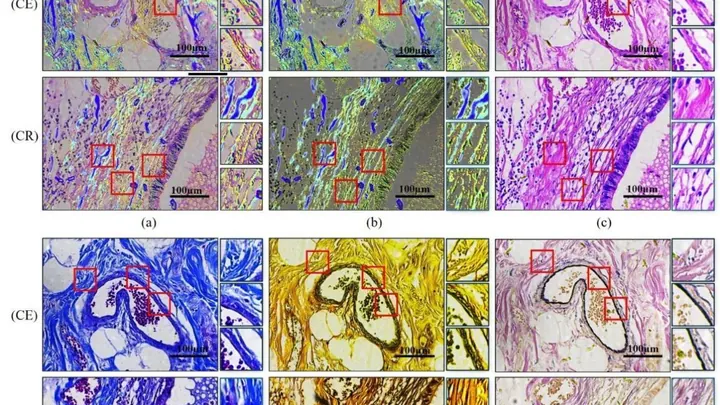
Inside our bodies, between cells, there is a support network — the extracellular matrix. It's like scaffolding made of proteins and carbohydrates that holds cells in place. When the fibers in this network change, it can be a sign of disease — for example, cancer or fibrosis.
Usually, to see these fibers, tissue is cut into thin slices and stained with special dyes.
In a cloud where massive stars are being born, there is a hot, dense core. Like a crowded kitchen where the heat of the stove makes smells evaporate, here the warmth from young stars evaporates molecules from the surface of cosmic dust grains.
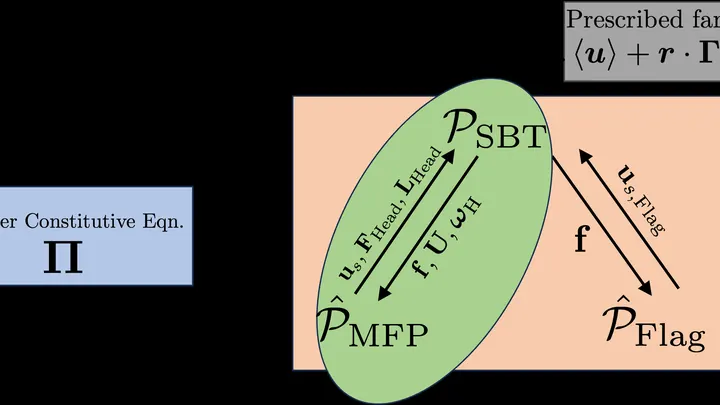
A bacterium swims like a tiny motorboat with a propeller — except its propeller is a long flagellum that rotates and pushes the body forward. But the body doesn't move in a straight line; it sways like a bobber on a wave. This swaying isn't random: it's part of the mechanics of motion.
Until now, such swaying was studied in still water.