Waves on Platinum: How a Surface Breathes express
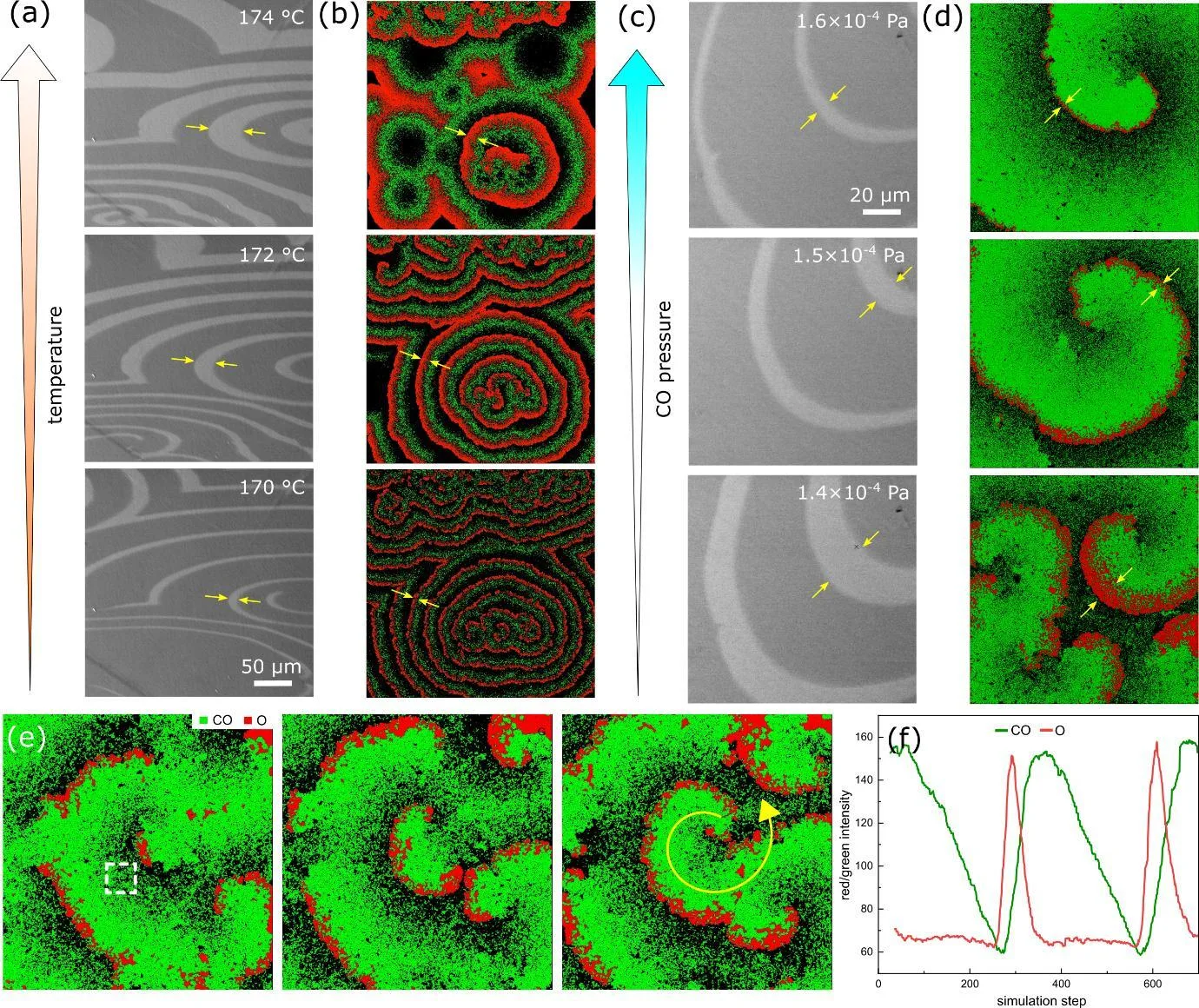
A platinum plate sits in a chamber with rarefied gas, and waves run across it. Not water waves, but chemical ones: patches where the surface is covered with oxygen give way to patches where carbon monoxide sits. Previously, these waves were seen as dark and light areas in images, but it was impossible to tell exactly which patch corresponded to what. Now researchers have a tool that senses how the electric field changes right at the surface.
This tool is a tiny needle that scans the plate like a finger reading Braille. The needle does not touch the surface; it hovers above it and feels how strongly the surface attracts electrons. Oxygen and carbon monoxide attract them differently, so the needle can tell the coatings apart. It turns out that the wave advances sharply: oxygen quickly takes over an area, then slowly, like water draining, gives way to carbon monoxide. This uneven rhythm is like drips from a leaky faucet: first fast, then a pause.
Why does this matter? Platinum is the main worker in automotive catalytic converters, which turn toxic carbon monoxide into carbon dioxide. If we know how the waves move and where they get stuck, we can design catalysts that last longer and clean exhaust better. The researchers didn't just see the waves: they measured their internal structure for the first time, as if one could discern individual currents within a tidal wave.
Original abstract
as written by the authors arXiv:2603.28354
Chemical waves of CO oxidation on platinum surfaces exhibit complex spatio-temporal self-oscillations, yet the local electronic mechanisms driving their propagation remain poorly understood under operando conditions. In this work, we combine operando scanning electron microscopy with frequency-modulated Kelvin probe force microscopy (FM-KPFM) to simultaneously map secondary electron contrast and local work-function variations during CO oxidation on Pt. By utilizing the KPFM tip as a localized sensor, we provide the first work-function-resolved imaging of reaction fronts, enabling an unambiguous physical assignment of CO- and oxygen-covered states. Our results demonstrate that the spillover process of chemical wave-the transition and expansion of adsorbate phases-is characterized by a pronounced temporal asymmetry and spatial heterogeneity transition thresholds. KPFM identifies a rapid onset of oxygen coverage followed by a gradual, diffuse relaxation back to the CO-covered state, indicative of relaxation-type oscillations even at low pressures (10^-2 Pa). Correlative reaction-diffusion simulations reproduce this wave morphology, confirming that the high-resolution work-function signal provides unique insights into the internal structure and kinetic heterogeneity of the working catalyst surface.
Platinum was known to the ancient Egyptians, but they considered it 'immature gold' and threw it away.