Carbon monoxide (CO) is a simple molecule—one carbon atom bonded to one oxygen atom—that plays an outsized role in the atmospheres of exoplanets. In the context of planetary science, CO is a key tracer of atmospheric chemistry and dynamics. It is often abundant in hot, hydrogen-rich atmospheres where carbon is not locked into methane or carbon dioxide, and its presence or absence tells researchers about the temperature structure, the mixing processes, and even the formation history of a planet. The molecule is also a major coolant in the upper atmospheres of gas giants, helping to regulate their thermal balance.
History
Carbon monoxide was first detected in an exoplanet atmosphere in the early 2000s, following the discovery of the first transiting hot Jupiters. The molecule has since become a standard target for atmospheric characterization, particularly with the advent of high-resolution spectrographs and space observatories like the James Webb Space Telescope.
How it works
CO forms readily at high temperatures and pressures where carbon and oxygen are available, especially in reducing environments rich in hydrogen. In exoplanet atmospheres, its abundance is set by chemical equilibrium and by transport processes like vertical mixing and photochemistry. Spectroscopically, CO has strong absorption features in the infrared, which makes it detectable from ground-based and space telescopes. By measuring the depth and shape of these features, astronomers can infer the CO concentration and the atmospheric temperature profile.
In practice
CO is used as a diagnostic tool in exoplanet atmospheric studies to probe temperature, chemistry, and dynamics, and it is also a key molecule in understanding the formation of organic compounds in space, as seen in the corpus's mention of sugar molecules forming in cosmic environments.
Fun fact
On Earth, carbon monoxide is a toxic pollutant, but in the atmospheres of hot exoplanets, it is a common and expected ingredient—so much so that its absence can be more surprising than its presence.
Forty light-years away lives a star that went unnoticed for a long time: TRAPPIST-1 emits two thousand times less light than the Sun. But it turned out to have seven Earth-sized planets, three of which orbit in the zone where water could remain liquid. Yet little was known about the star itself, about its chemical kitchen.
Deep inside a sub-Neptune, where pressures reach a hundred thousand bars and temperatures hit four thousand degrees, rock behaves like boiling soup. Heavy vapors of silicon and magnesium rise, cool, and fall back as a rain of solid particles.
Microwave plasma in a vortex is like a kitchen mixer that simultaneously heats and stirs the gas. In the reactor, the gas is swirled, and microwaves heat it to thousands of degrees, tearing carbon dioxide molecules apart. Scientists created a computer model of such a reactor to understand how pressure affects the process.
In the coldest, darkest corners of space, dust grains get covered in ice, like a window on a frosty day. This ice isn't just frozen water: it also contains carbon monoxide and carbon dioxide. From such ice, comets and planets may eventually assemble. But until now, it was unclear how the dust grain itself affects the ice that forms on it.
The explosion of a massive star is not just a flash: it's a blow to the surrounding gas. But until now, no one had looked at how the gas itself moves at the sites of such explosions. Now astronomers have gathered data on 33 nearby supernovae and for the first time measured the turbulence of the cold molecular gas around them.
When the JWST telescope breaks the light of a distant exoplanet into a spectrum, it reads a chemical chronicle. But this chronicle is not a monolithic truth; it's an atmosphere constantly rewritten by the star's radiation.
The mystery of the radius valley — a sharp drop in the number of exoplanets with radii ~1.8 Earth — haunts astronomers. JWST, transit surveys like Kepler and TESS draw a clear gap: rocky super-Earths and gaseous sub-Neptunes are separated by almost a chasm.
Ever since Voyager 2 raced past Uranus in 1986, the planet's icy moons have kept a mystery: where does the carbon dioxide on their surfaces come from? The spectrometers of that era only hinted at the presence of CO₂, but couldn't say anything about its origin.
Massive stars are cosmic titans, living under the sign of indomitable energy. When such a star enters the B[e] supergiant phase, its radiation is so powerful that it would seemingly pulverize any molecule into atoms. The spectral lines, once systematized by Johann Balmer, blaze here with particular fury.
WASP-121 b is not just a hot ball. It's a world where iron vaporizes and the sky glows with its own heat. A fresh look at it has revealed what 'ingredients' went into making it.
The James Webb Space Telescope has for the first time clearly detected vaporized silicon monoxide in its atmosphere — a refractory substance usually locked inside dust grains.
A scorching rocky planet is like a pot of boiling soup, except its lid is the atmosphere. Gases escape from the magma, wrap the world in a thick blanket, and in turn influence how quickly the celestial body cools. For GJ 1132 b, which orbits so close to its star that a year lasts just one and a half Earth days, this connection is especially important.
The Universe at 700 million years old was a noisy construction site, just beginning to light up. Telescopes caught a signal from that distant epoch: the galaxy REBELS-25, massive and full of stellar fuel.
In the attic, you find an old, worn suitcase. From the stickers and scratches, you can guess where it's been. Astronomers have long searched for a similar 'sticker' for planets, and thought they found it in carbon monoxide molecules. Ordinary carbon monoxide consists of a carbon-12 atom and an oxygen atom.
A fire hose blasts into a snowdrift. The water doesn't just shove the snow aside — at the point of impact, spray, steam, and a roar are born. That's roughly how jets behave: narrow streams of matter shooting out from around a black hole at enormous speeds.
In the orchestra of interstellar life search, every note counts. And the score here is dictated not by man, but by a distant star. For the planet TRAPPIST-1 e, one of seven in the system of an ultracool red dwarf, the conductor's baton is harsh ultraviolet light.
The young super-Jupiter TWA5B, a scorching ball 25 times Jupiter's mass, floats just fifty light-years away. Its faint infrared glow long hid its chemical makeup. Now, high-resolution spectroscopy with CRIRES+ has registered the ghostly trace of SiO — silicon monoxide.
A kindergarten where some kids are busy making sandcastles while others are already assembling building blocks. That's roughly what the V1298 Tau system looks like: it's only 20 million years old — by cosmic standards, it just left the nursery. Several planets orbit it, and two of them, b and e, turned out to be surprisingly different.
Using the JWST space telescope, astronomers conducted a chemical analysis of the centaur Chiron, an icy body from the fringes of the Solar System. It turns out its gas activity resembles a layered cake. Carbon dioxide evaporates from the surface, forming a top crust.
A galaxy is not a static picture but a bubbling cauldron where new stars are constantly born from tenuous gas. To understand how long this boiling will last, astronomers weigh the key ingredient — cold molecular hydrogen. It is invisible itself, but it is betrayed by carbon monoxide (CO), which shines in the radio range.
In the dense gaseous cocoon around a young massive star, streams of matter collide as if in a giant chemical flask. One stream moves relative to us at about 11 kilometers per second, the other at about 5. The telescope at Onsala (Sweden) caught their radio voices and resolved them into hundreds of spectral lines — molecular fingerprints.
In a crystal of water and caustic cesium, oxygen and cesium atoms sit in place like beads in a rigid lattice. Hydrogen atoms behave differently: they are like passengers constantly changing seats. In this layered material, each oxygen is linked to three neighbors via hydrogen bridges, forming a honeycomb-like pattern.
Astronomers aimed JWST at the rocky exoplanet LHS 3844 b — a world orbiting another star, where a year lasts just 11 hours. The planet is tidally locked: one side always faces the star, with a permanent scorch of 770°C, while the night side is plunged into icy darkness.
A giant cloud of gas and dust, so cold that its warmth barely flickers, just a few degrees above absolute zero. This is TMC-1 in the constellation Taurus, one of the darkest and densest cradles of molecules in our Galaxy. In recent years, it has become a true treasure trove for astrochemists: the number of substances found there has more than doubled.
A giant planet hangs in space in complete solitude, separated from its star by a distance 160 times greater than the path from the Sun to Pluto. The light from its parent star arrives so faintly that the surface temperature barely exceeds 200 degrees Celsius — about as warm as a well-heated sauna.
A world that for years refused to show its face. Planet GJ 1214 b is exactly such a case. It is larger than Earth but smaller than Neptune, and its dense envelope made the atmosphere invisible to telescopes: starlight passed through it without leaving clear traces. But astronomers' persistence and a new sensitive instrument provided the first clue.
Around young stars, flat clouds of gas and dust swirl, like pizza dough from which planets will eventually be shaped. This cloud contains various chemical elements, and sulfur is one of the most elusive: it's hard to catch with telescopes because it hides in solid grains or escapes as gas.
A baker adds more sugar to the dough, and the pie turns out different. So it is with a star: the composition of its "dough"—the cloud of gas and dust from which planets are born — determines what worlds will form around it.
Light from a distant star, passing through the atmosphere of planet K2-18b, left unusual "fingerprints" in its spectrum. Astronomers spent 420 hours collecting this light with the James Webb Space Telescope and split it into colors, like a rainbow.
In the cold outer reaches of the Solar System, water is considered the main building material for ices. But some comets and distant icy bodies have an unusually high ratio of carbon monoxide (CO) to water, as if a scoop of ice cream suddenly had too much syrup. The authors of a new study set out to find where this imbalance comes from.
Long before a star ignites in a gas cloud, chemical life is already bustling. In cold, dense clumps of gas, called starless cores, atoms stick together to form molecules, both simple and complex. To peer into this invisible kitchen, astronomers aimed a 40-meter radio telescope in Yebes at 23 such clouds in the Orion Nebula.
When a young star ejects jets of gas, they slam into the surrounding cloud like a fist into a pillow. At the impact site, the gas is compressed and heated — creating a shock wave. In this hot zone, atoms and simple molecules collide and assemble into larger compounds, known as complex organic molecules.
A young planet in a gas disk is like a swimmer trying to swim against the current: friction with the gas slows it down, and it spirals toward the star. For small rocky planets, this fall can take less time than they need to grow. But the disk also has countercurrents — vortices that can push the planet outward.
Scientists built a computer model of a disk around a young star.
When a chef prepares a dish, not only the proportions of ingredients matter but also their total amount. Two pies with the same sugar-to-flour ratio but made from different batch sizes will turn out differently. So it is with disks around young stars: carbon and oxygen are the key 'spices,' and their absolute amounts change the look of the cosmic 'kitchen' no less than their ratio.
Life may be hiding in the oceans beneath the ice of Europa, Ganymede, and Callisto. Its carbon-based building blocks perhaps baked before the moons were born — in a disk of gas and dust around a young Jupiter. This giant cosmic oven ran on slow frictional heating, not harsh ultraviolet light.
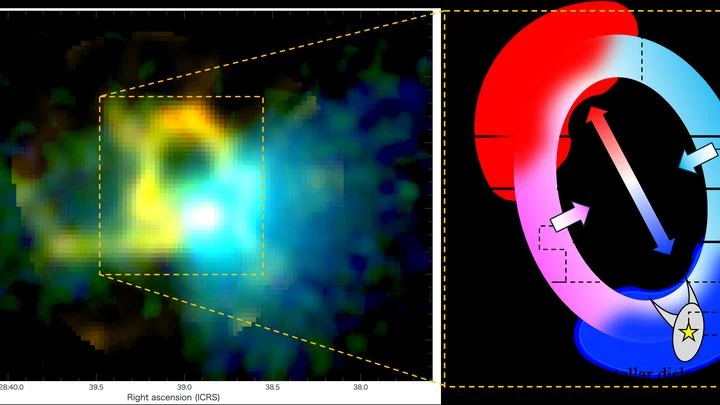
In a cold, dark cloud of gas where a star is just beginning to form, the ALMA telescope has spotted an unusual ring. It is made of gas that is warmer and denser than its surroundings. Such details were previously hidden because the gas at the cloud's center is opaque to ordinary observations.
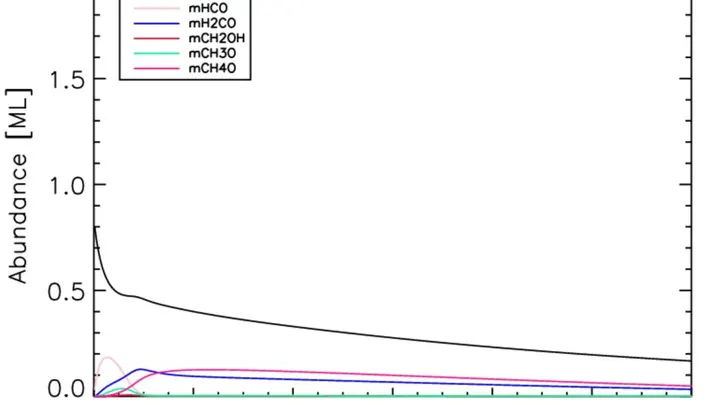
In a dark, cold cloud between the stars, a dust grain a thousandth of a millimeter across catches light molecules. Carbon monoxide and hydrogen stick to its surface like raindrops to glass and react. After a few steps, methanol is produced — the same alcohol found in windshield washer fluid.
The Sun occasionally hurls enormous clouds of plasma into space — coronal mass ejections. Often tangled within these clouds are prominences: cooler, denser clumps of material. These contain plenty of neutral atoms that shine brightly in specific spectral lines.
In a cloud where massive stars are being born, there is a hot, dense core. Like a crowded kitchen where the heat of the stove makes smells evaporate, here the warmth from young stars evaporates molecules from the surface of cosmic dust grains.
The night sky looks dark, but it's actually filled with a faint glow. Most of this light is born in invisible clouds of cold gas — the very stuff from which new stars emerge. This gas barely emits, making it hard to spot. But sometimes it gives itself away through radio waves emitted by carbon monoxide (CO) molecules.
Young stars are surrounded by disks of gas and dust, like construction sites for future planets. From this material, rocky worlds and gas giants will eventually assemble. So the chemical composition of the disk directly determines what the planets will be like.