18 Qubits on a Single Chip express
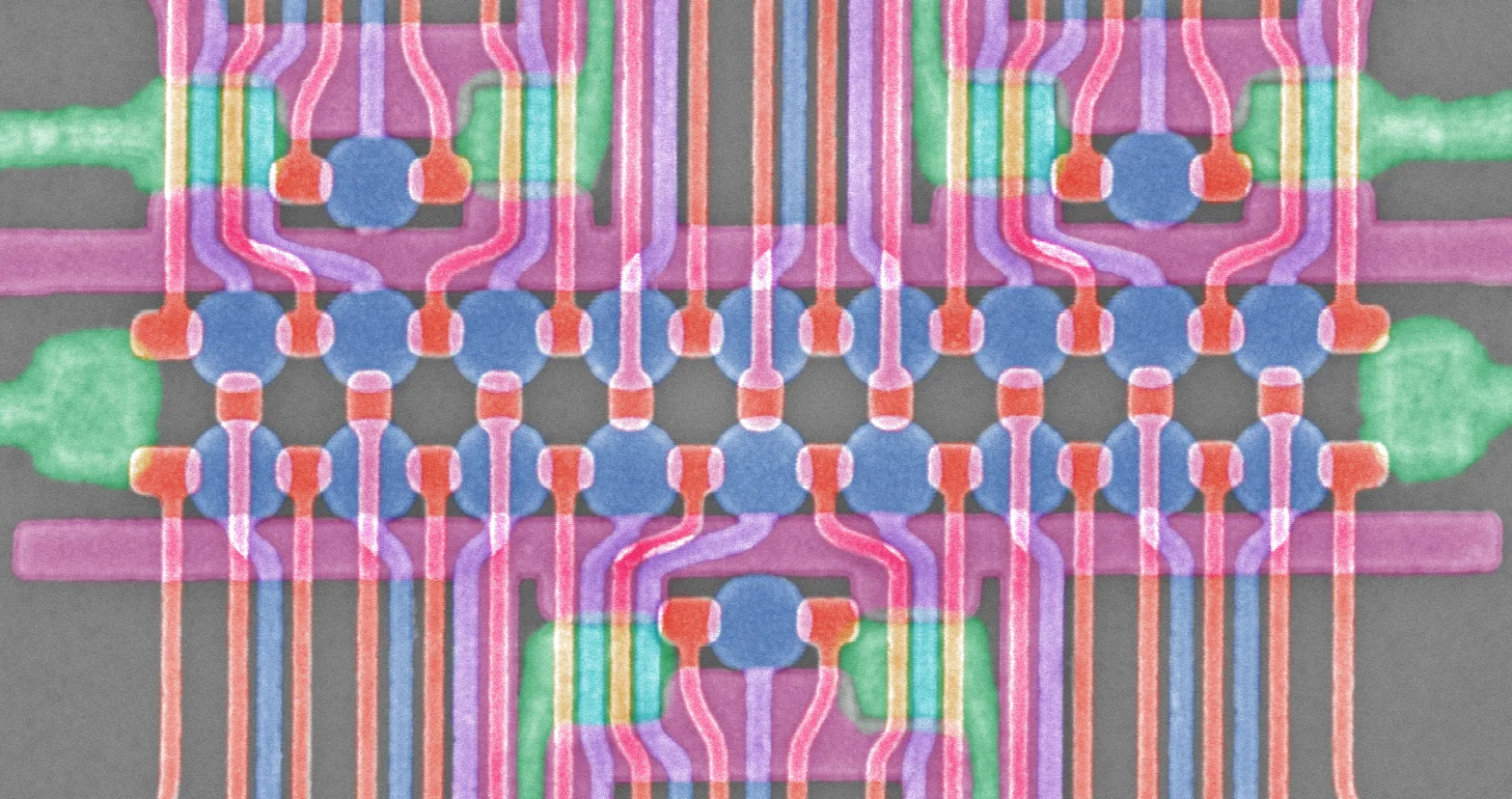
Eighteen tiny cells line up in two rows on a piece of germanium. Each cell is a quantum dot — a trap for a single electron whose spin acts as a qubit. Previously, such systems could only be assembled in small numbers, but here we have an entire lattice working as a single ensemble.
Controlling eighteen particles at once is like conducting an orchestra where each musician plays their own part but hears only the conductor. The researchers employed a modular architecture: the processor is built from identical two-qubit blocks that can be stacked like train cars. This allowed them to initialize, control, and read out all qubits simultaneously, achieving operation fidelities above 99.8%.
At the end of the experiment, the authors entangled three neighboring qubits into a special state — the Greenberger–Horne–Zeilinger entanglement. This is like three coins that always land the same way, even if tossed in different rooms. Such a connection is the foundation for quantum computing and information security.
The germanium chip with eighteen qubits is not a record in terms of number, but it is an important step toward scalability. The modular design allows adding new rows without losing control, like building blocks. If the fidelity holds, within a few years we could see processors with hundreds of qubits, capable of cracking modern encryption or simulating new materials.
Original abstract
as written by the authors arXiv:2604.01063
Utility-scale quantum computing requires the integration and operation of a large-scale qubit register. Semiconductor spin qubits are a primary candidate for this, due to the prospects of building integrated hybrid quantum-classical architectures. However, scaling spin-qubit systems while preserving performance and control has remained a challenge. Here, we demonstrate the operation of an 18-qubit array in germanium based on an extendable 2xN architecture. We achieve simultaneous initialization, control, and readout across the entire array, enabled by parallel operation of modular unit cells. Across the array, we achieve average and median single-qubit gate fidelities of 99.8% and 99.9%, respectively. Finally, we characterize the nearest-neighbor exchange couplings throughout the device and implement high-quality controlled-Z gates to generate a three-qubit Greenberger-Horne-Zeilinger (GHZ) state. These results demonstrate that spin-qubit arrays can be scaled while maintaining high-fidelity operation and establish a modular, extendable architecture for planar semiconductor quantum processors.
Germanium is a close relative of silicon, but better suited for spin qubits: electrons move faster and interfere less with each other.
In the series "Devs," a quantum computer helps solve global problems but creates new ones. Our chip is a small step toward such a machine.