In the context of quantum computing, memory refers to the computational resource required to store the state of a quantum system during simulation. Unlike classical bits, which are either 0 or 1, a quantum bit (qubit) can exist in a superposition of states, and the full state of N qubits is described by 2^N complex amplitudes. This exponential scaling means that simulating just 50 qubits requires storing over a petabyte of data using classical memory, making full simulations of large quantum systems intractable on classical computers. This 'memory wall' is the fundamental reason why quantum computers are so difficult to simulate and why they hold promise for solving problems that are beyond classical reach.
History
The exponential memory scaling of quantum simulation was recognized in the early days of quantum computing, notably by Richard Feynman in his 1982 proposal for a quantum simulator. Feynman argued that classical computers would never be able to simulate quantum systems efficiently because of this memory explosion.
How it works
The state of a quantum system is a vector in a Hilbert space of dimension 2^N. To simulate it classically, one must store all 2^N complex amplitudes, which requires exponentially growing memory. Even with clever compression techniques, the memory requirement quickly exceeds the capacity of any classical machine. Quantum computers, by contrast, naturally store this information in the physical state of their qubits, avoiding the exponential memory overhead. This is why quantum simulations of quantum systems — such as molecules or plasma — can be performed efficiently on quantum hardware, while classical simulations hit a hard limit.
A librarian in a rare-book archive takes a volume from the shelf and puts it back without waking the cat dozing nearby. That is roughly how the new quantum memory works: it catches a photon, tucks it into the mechanical vibration of a tiny silicon bridge, and returns it on request.
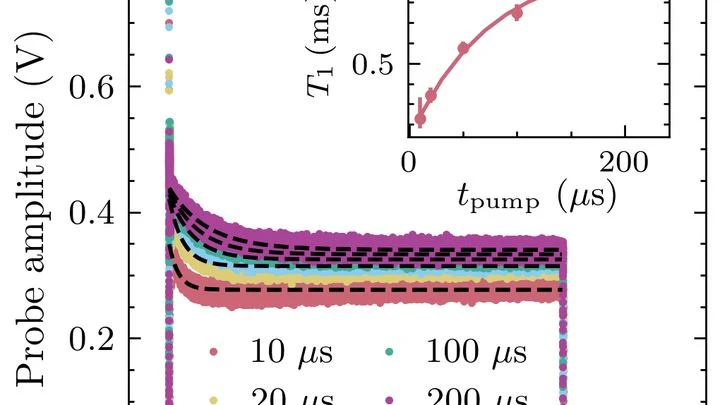
A beam of light enters a glass cell filled with cesium vapor and changes the internal state of the atoms: this is how information is recorded. A moment later, another beam reads it out by how the atoms absorb light. It's not a hard drive, but rather a notebook that turns its own pages.
Eight such "pages" are created by an acousto-optic deflector — a device that bends light with sound.
A quantum computer isn't just a bunch of qubits: it's a whole city, where each resident is one of the machine's possible states. Residents get to know each other through weak interactions between qubits: if one state can transition to another, a thread of acquaintance is drawn between them.
In the world of quantum particles, there are introverts — anyons. They are unlike familiar electrons or protons. If you swap two such introverts, they remember the maneuver, as if leaving an invisible trace.
A quantum computer is like an orchestra where each musician-qubit easily loses the rhythm. The slightest noise, and the melody of computation turns into cacophony. To keep the orchestra playing in harmony, you need a conductor who instantly spots wrong notes and corrects them without stopping the performance.
A quantum computer based on neutral atoms is like a city where couriers, laser tweezers, physically carry packages between addresses. While one courier drags an atom across the entire chip, the others sit idle. This is slow and error-prone.
The new architecture replaces couriers with a shared radio wave.
An electrical grid stuffed with power electronics resembles a huge orchestra without a conductor. Each converter, each line adds its own note, and sometimes the instruments start playing out of tune.
The quantum world is full of strange connections. Two particles can become “entangled”: the state of one instantly affects the other, even if they are kilometers apart. But how do you know if they are truly entangled? It's like a ball of yarn: at first glance, you can't tell whether it's a single tangled ball or just a mess of loose threads.
The Mpemba effect is a mystery where hot вода sometimes freezes faster than warm water. Usually this is attributed to how вода loses heat and энтропию (a measure of disorder). But in a glass of water, chaos prevents a precise model.
Physicists built a quantum model: a particle in a well with two depressions separated by a barrier.
A quantum computer is like an orchestra where every musician must hit their note exactly. If one plays off-key, the melody falls apart. The musicians here are qubits, storing information.
The classical neuron is a chamber musician, drawing only one note from each string: it takes a weighted sum of inputs, adds a bias, and passes it through a nonlinearity.
A translator who translates not words but the very structure of a conversation runs into trouble when the chat moves beyond a quiet room. In a familiar simulation on a spatial lattice, everything follows a strict script. But the moment the interlocutors find themselves in a noisy square, where sound is distorted by echoes and the crowd keeps changing direction, the script falls apart.
Once Richard Feynman saw in quantum systems a challenge for classical computers. Now we face the inverse problem: understanding what exactly the quantum processor has simulated. Among the states it births are veritable 'black boxes'—topological phases of matter.
A network of tiny magnets seeks the state with the lowest total energy: that's roughly what the quantum Max Cut problem looks like, one of the toughest in physics. Scientists have been hunting for its solution since the days of Werner Heisenberg.
Data on the internet travels at the speed of light through fiber optics. In classical networks, delays aren't critical, but for quantum communication, perfect synchronization is essential: particles of light with encoded information must converge at the detector in the same instant.
Tuning a quantum processor is monotonous work: you need to calibrate each qubit — a quantum cell — much like a watchmaker adjusting dozens of tiny gears. Humans get tired and make mistakes.
Strike a tuning fork with a mallet — it vibrates, and the sound gradually fades. A black hole behaves much the same way when disturbed: it emits gravitational waves — ripples in spacetime itself — and then settles down.
An invisible trap made of laser light held 11,000 atoms — a record for quantum engineering. Previously, physicists wrestled with a few dozen of these particles; now the count runs into the thousands. Each atom becomes a qubit — a quantum bit that is both zero and one at once, like a spinning coin balanced on its edge.
An ordinary field-effect transistor is like a faucet with a very sensitive handle: turn it slightly, and water flows. In the cold depths of a quantum computer, where everything is chilled to near absolute zero, such a faucet must open strictly on command.
Imagine a library where instead of books, you have every conceivable combination of a few dozen quantum particles. The number of combinations grows like a snowball: add one particle, and the volume doubles. For fifty particles, there are more shelves than atoms in the visible universe.
Immediately after the Big Bang, space may have vibrated like a string from quantum effects. As these oscillations faded, they would have left a mark on the expansion of galaxies — a memory effect. The search for this echo in telescope data turned up nothing.
An eternal Universe where the measure of disorder (энтропия) grows is, for most of its time, a homogeneous void. In it, complex structures occasionally assemble by chance, such as fleeting consciousnesses — ‘мозги Больцмана’.
The atomic nucleus is a natural spring of colossal power. When the protons and neutrons inside it rearrange, it enters a special long-lived state — a nuclear isomer. It stores energy like a spring compressed to its limit.
Neutrinos are nearly elusive particles that permeate everything around us. In a dense cloud, such as during a star explosion, they begin to collectively change their type, or 'flavor.' This process is like a crowd of people synchronously changing the color of their clothes, but not all at once — rather in waves.
The quantum world is usually drawn with points, but real instruments only see blurry spots. Heisenberg and von Neumann long suspected: precision is unattainable.
A person hunting for keys mentally runs through places where they might be. A bird that tucked hundreds of seeds into crevices in autumn retrieves them flawlessly in winter. How can a brain hold so many addresses when all birds have roughly the same number of neurons? The answer lies in geometry.
Picture the Universe as a book with a finite number of pages. Its accelerated expansion, driven by dark energy, a mysterious substance pushing space apart, acts like an invisible binding: distant pages are forever glued together, becoming inaccessible chapters.
A quantum bit (qubit) is a delicate thing. Even a little heat destroys it, like a random nudge topples a crystal wine glass. To protect this fragile information, physicists have built a three-dimensional quantum structure resembling a Russian doll.
Before assembling a huge puzzle, you need to stamp out the pieces — otherwise the picture won't come together. In fusion-based quantum computers, the role of such pieces is played by tiny clumps of light — photonic resource states. They are collided and measured to gradually grow the computational fabric.
An ordinary battery in a phone stores energy in chemical bonds — slowly, with heat and wear. A quantum capacitor works differently: it charges not with matter but with rhythm. A swing that is pushed in time with its motion accumulates energy in the motion itself, without friction.
A quantum battery is not a box of chemicals but a chain of tiny magnets (spins) capable of storing energy. Its main trick: charge many particles at once, using their quantum entanglement. But there's a catch — not all entanglement works.
A radio picks up a broadcast through crackle and hiss. That's roughly how modern quantum computers work: the useful signal drowns in noise. The longer the computation runs, the more the interference distorts the result.
Three craftsmen work in the same workshop. The first tries to figure out whether tiny hourglasses are built into nature's own machinery. The second attaches a laser pointer to a microscope to see details invisible to the naked eye. The third, conversely, takes living threads and carefully weaves them into fragile quantum circuits.
Quantum computers promise to solve problems that regular computers can't. But where is the line? The authors of a new study stumbled upon a surprising case: electrons paired up behave like a well-behaved orchestra. Even if you add a bit of "magic"—a special quantum resource: their behavior remains predictable.
A handful of rice grains falls onto a hot skillet, and they start jumping. Each grain pushes its neighbors, and the whole pile stirs without any external hand. That's active matter: a multitude of particles that draw energy on their own and convert it into motion.
Imagine a line of dominoes: when the first one falls, it pushes its neighbor, and a wave rushes down the chain. The boundary between fallen and standing dominoes is a perfect image of a magnetic wall. In microscopic magnetic films, these walls separate zones with different magnetizations.
Steam rising from hot metal is a familiar sight in the kitchen. But if you use rubidium instead of water, that cloud becomes a battery. It doesn't run on chemical reactions but on the quantum coordination of atoms.
A quantum computer is like an orchestra where every musician must play their part perfectly, or the melody falls apart. Previously, controlling qubits — the quantum 'musicians'—required a room full of equipment, and every extra wire added noise.
A quantum computer is like an orchestra where every musician must come in at exactly the right moment. Previously, to play a complex piece, you had to constantly move the instruments around — slow and noisy. The new scheme, called "parity architecture," keeps everyone in place, and the conductor simply changes the notes.
Qubits in a superconducting quantum computer are like tightly stretched strings. When a particle from space or from a radioactive decay flies by, it strikes these strings and they start to vibrate. This vibration disrupts the fragile quantum states, and computations go awry.