A scalable quantum computer is an architecture designed to increase the number of qubits — the fundamental units of quantum information — without a corresponding loss of performance. In practice, this means that as you add more qubits, the error rates stay low, the control electronics remain manageable, and the physical footprint doesn't balloon out of control. Most current quantum processors are small, with tens to a few hundred qubits, and they face a fundamental challenge: the more qubits you pack together, the more they interfere with each other and the harder they are to control individually. Scalability is the central engineering problem that must be solved before quantum computers can tackle problems that classical computers cannot.
History
The concept of scalable quantum computing was formalized in the mid-1990s, with Peter Shor's error-correction codes and the DiVincenzo criteria (2000) providing a checklist for scalable architectures. The first demonstrations of modular quantum processors with photonic interconnects appeared in the 2020s.
How it works
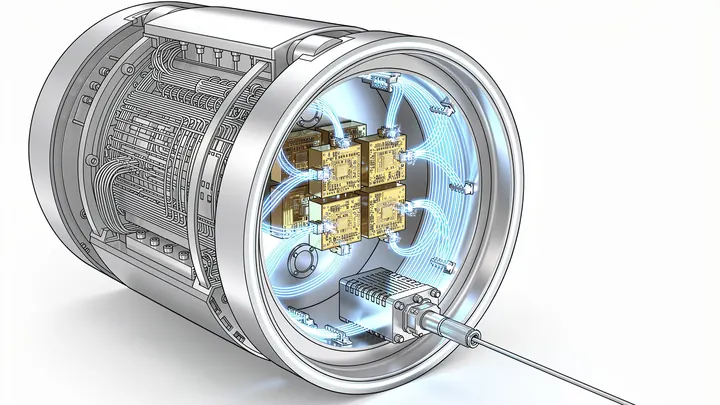
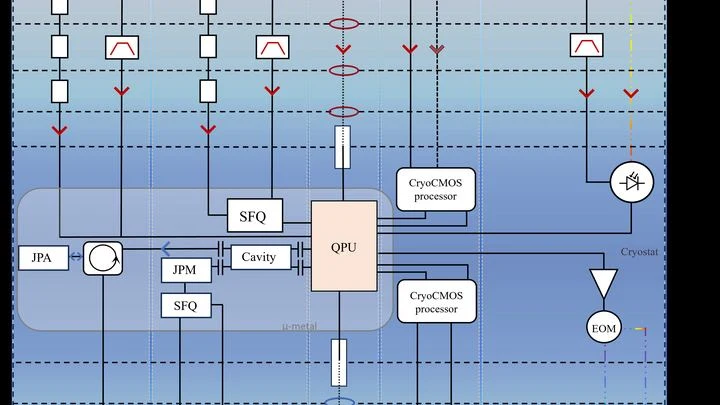
Scalable designs typically rely on modularity and careful isolation. Instead of one giant chip with all qubits, the architecture may use smaller modules connected by optical links or microwave interconnects, so that each module can be optimized independently. Error correction is also essential: by encoding logical qubits across many physical qubits and using codes that detect and correct errors, the system can maintain performance even when individual components are imperfect. Recent work has focused on reducing the overhead of control wiring, using photonic interconnects to send signals into cryostats, and developing error-suppression techniques that redistribute errors rather than eliminating them outright.
In practice
Scalable quantum computers are being developed for applications in drug discovery, materials science, cryptography, and optimization problems that are intractable for classical machines.
Fun fact
Some scalable designs use light pulses traveling through optical fibers to connect qubits kept in separate refrigerators, effectively creating a 'quantum internet' inside a single computer.
A librarian in a rare-book archive takes a volume from the shelf and puts it back without waking the cat dozing nearby. That is roughly how the new quantum memory works: it catches a photon, tucks it into the mechanical vibration of a tiny silicon bridge, and returns it on request.
In a noisy hall, an interpreter tries to catch every word, but rustles and echoes muddle the meaning. That's roughly how conventional computer methods handle complex quantum systems: the more particles and the stronger their correlations, the faster calculations drown in interference.
Data on the internet travels at the speed of light through fiber optics. In classical networks, delays aren't critical, but for quantum communication, perfect synchronization is essential: particles of light with encoded information must converge at the detector in the same instant.
Tuning a quantum processor is monotonous work: you need to calibrate each qubit — a quantum cell — much like a watchmaker adjusting dozens of tiny gears. Humans get tired and make mistakes.
An invisible trap made of laser light held 11,000 atoms — a record for quantum engineering. Previously, physicists wrestled with a few dozen of these particles; now the count runs into the thousands. Each atom becomes a qubit — a quantum bit that is both zero and one at once, like a spinning coin balanced on its edge.
An ordinary field-effect transistor is like a faucet with a very sensitive handle: turn it slightly, and water flows. In the cold depths of a quantum computer, where everything is chilled to near absolute zero, such a faucet must open strictly on command.
Imagine a library where instead of books, you have every conceivable combination of a few dozen quantum particles. The number of combinations grows like a snowball: add one particle, and the volume doubles. For fifty particles, there are more shelves than atoms in the visible universe.
Two dice always land on the same number, no matter how far apart you toss them. In quantum physics, this behavior is called entanglement, and it's the key resource for future computers and secure communication. The trouble is, not all entanglement is easy to spot.
A quantum bit (qubit) is a delicate thing. Even a little heat destroys it, like a random nudge topples a crystal wine glass. To protect this fragile information, physicists have built a three-dimensional quantum structure resembling a Russian doll.
A fisherman casts a net into a quiet backwater. The longer the rope, the weaker he feels the faintest nibble — the wave fades along the way. But what if the signal didn't die out but grew stronger? That's roughly the trick described by the authors of a study on an ensemble of particles placed in a field with a special 'stepped' force gradient.
A quantum processor is like a busy intersection: the more cars, the harder it is for them to navigate without collisions. In the quantum world, qubits play the role of cars — elementary carriers of information that, unlike classical bits, can be both 0 and 1 simultaneously.
A quantum computer is like an orchestra where every musician must come in at exactly the right moment. Previously, to play a complex piece, you had to constantly move the instruments around — slow and noisy. The new scheme, called "parity architecture," keeps everyone in place, and the conductor simply changes the notes.
The biggest puzzle in physics is how to reconcile spacetime curvature with quantum mechanics. At the Planck length, billions of billions times smaller than an atom, the rules break down. This frontier was discovered by Max Planck.
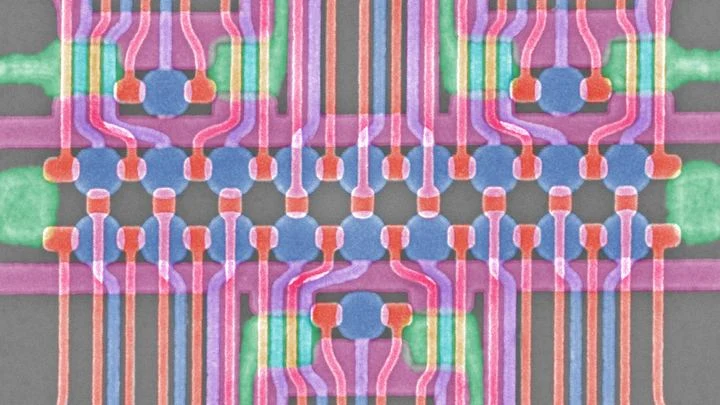
Eighteen tiny cells line up in two rows on a piece of germanium. Each cell is a quantum dot — a trap for a single electron whose spin acts as a qubit. Previously, such systems could only be assembled in small numbers, but here we have an entire lattice working as a single ensemble.
Instead of millions of rigidly fixed particles — 10,000 atoms, working as beads on a quantum abacus. Each bead can be both zero and one at the same time. But the key is: if an error creeps into the calculation, the atoms can be physically moved: as if you could rearrange the abacus on the fly so that the glitch doesn't ruin the result.
Bitcoin mining is like a lottery: miners sift through billions of numbers to find one lucky winner. A regular computer does this blindly, burning electricity. A quantum computer could sort through possibilities faster, like finding a needle in a haystack by shaking the whole stack at once.
The authors of a new study calculated what such a quantum "shaker" would actually cost.
An ice cube in tea melts without a trace. Similarly, quantum systems usually quickly forget their past. But under strong disorder, many-body localization emerges — particles seem to freeze, preserving memory.
The experiment on IBM's 144-qubit processor lasted 5000 cycles.
IBM's Heron R3 quantum computer handled a task that made a classical method back down. The challenge was finding the ground state, the lowest energy level, of a system of 49 quantum bits.
Light passing through a lens bends slightly. For an optical computer, this is like a warped mirror for an artist: the image is there, but the details blur. An Ising machine using light beams tackles problems like packing luggage or planning a courier's route.
Light races through a maze of mirrors and beam splitters, but at the end of its journey, it doesn't just flash on a detector: it transforms itself. In the new photonic computer, nonlinear modules have been added to the familiar linear circuits, and now light can perform any quantum operation, not just a subset.
Qubits in a quantum computer are like musicians in an orchestra: each must hear the others, or the music falls apart. But if you wire the musicians together permanently, they start getting in each other's way: that's how unwanted interactions arise in superconducting chips, spoiling computations.
On a silicon chip that resembles a neighborhood, qubits, electrons with spin, live in separate 'houses.' Previously, neighbors could only chat over the fence, but now a road has been laid between them: along it, a qubit can ride to any of the four stops. The road is a bus that carries the electron without losing its quantum state.
In a quiet lab, a device the size of a microwave oven sits on a table. Inside, a coil glides smoothly up and down while a computer reads electrical signals. This is the tabletop Kibble balance — a machine that links mass to quantum constants.
Previously, such balances occupied a whole room and required a team of engineers.
A quantum computer is like an orchestra where each musician plays their own part. With few instruments, the conductor can manage each one separately. But when there are thousands of musicians, individual commands become overwhelming.
Quantum devices usually live inside cryostats — giant thermoses where temperatures are colder than deep space. An erbium ion trapped in a tiny well on a silicon chip breaks that mold.
Creating light with an exact number of photons is like stamping exactly 100,000 flawless coins. Until now, physicists could only control dozens of particles. The 'optical lathe' technology breaks this barrier: virtual lenses, like milling cutters, eliminate 'blurriness' and ensure each bunch contains exactly the specified number of photons. Counting becomes perfect.
An orchestra plays inside a giant refrigerator. The musicians are qubits, the elementary cells of a quantum computer. To play in harmony, they need silence: thermal noise drowns out the melody. That's why the heart of a quantum processor is cooled to nearly absolute zero — minus 273 degrees Celsius.
A massive refrigerator the size of a wardrobe hums, maintaining an interior colder than outer space. At its heart lies a silicon chip with tiny superconducting loops — qubits. But to make the chip work, dozens of thick copper cables snake from room temperature down to it.
Two superconducting qubits on a single chip sound as clean as soloists in an orchestra. Each is a transmon, a qubit with reduced sensitivity to charge noise. They are connected through a tunable coupler, an auxiliary element that adjusts the interaction strength between them.
In 2019, a group of theorists asked a simple question: what would happen if you embedded a single irreversible element into an ordinary quantum computer, a gate that slightly "eats" probability? The answer was devastating. Any such gate, no matter how weak, instantly turns the machine into a device capable of solving problems in the class PostBQP = PP.
A superconducting quantum processor is like a microscopic metropolis locked in a cryogenic fridge: streets of superconducting lines, blocks of qubits. Each resident demands silence and cold, but expanding the city inside a single cryostat is like stacking skyscrapers in a cramped courtyard — wires heat the environment, noise builds up, coherence threatens to collapse.
Imagine an orchestra where every musician plays an instrument that breaks at the slightest warmth. The conductor is the quantum processor, and the musicians are the qubits — fragile carriers of quantum information. To keep them in harmony, you need a whole team of tuners sitting in the next room, sending commands through a soundproof wall.
A single quantum processor is like a solo musician. It can play a simple tune, but a symphony requires an orchestra. To solve problems that demand enormous computational power, processors must be networked.
A supercomputer simulating laser plasma is like a kitchen where hundreds of chefs are preparing a single dish. If ten people crowd around one stove while another stands empty, the work grinds to a halt. The same happens in simulations: plasma particles bunch up in certain regions of space, leaving others nearly empty.
A quantum computer is like an orchestra where every musician plays an invisible instrument. Instead of violins and trumpets, there are qubits — fragile particles that are easily knocked off beat by the slightest heat or noise.