Encryption is the process of encoding information so that only authorized parties can read it. In the quantum realm, encryption can be made unconditionally secure by leveraging the laws of physics, particularly the no-cloning theorem, which states that an unknown quantum state cannot be perfectly copied. This allows for quantum key distribution (QKD), where any attempt at eavesdropping inevitably disturbs the system and is detected.
History
The concept of quantum key distribution was first proposed by Stephen Wiesner in the 1970s, and the first practical protocol (BB84) was developed by Charles Bennett and Gilles Brassard in 1984.
How it works
Quantum encryption typically uses single photons to transmit a secret key. The sender encodes bits in the polarization or phase of photons, and the receiver measures them. If an eavesdropper intercepts the photons, the measurement disturbs their state, introducing errors that the legitimate parties can detect. This ensures the key is secure, and it can then be used for classical encryption.
In practice
Quantum encryption is used in secure communicationnetworks, such as banking and government communications, and is being developed for satellite-based global secure links.
Fun fact
The no-cloning theorem, which underpins quantum encryption, was discovered in 1982 by Wootters, Zurek, and Dieks, and it is a direct consequence of the linearity of quantum mechanics.
Quantum computers make mistakes. Each qubit is like a ball balanced on the tip of a pencil: a slight tremor in the hand and it rolls off. To keep the balls from falling, you need someone to notice the wobble and correct it in time.
A quantum computer is like an orchestra where each musician, a qubit, plays their part but keeps hitting wrong notes. To keep the music from turning into cacophony, you need a conductor who instantly hears the off-key notes and corrects them.
Alice prepares a quantum particle in one of several states and sends it to Bob. The channel the particle travels through isn't perfect: it's noisy, scatters, interacts with the environment. Bob receives the signal and tries to figure out what Alice actually sent. This is the classic "prepare-send-measure" scheme, and there's always a risk of losing something along the way.
In a tight row of atoms, spaced closer than the wavelength of light, a remarkable state hides. The excitation is distributed among all particles so that their radiation cancels itself out. This quantum 'silence' is an ideal vault for a photon: it can be stored there hundreds of times longer than usual.
A quantum computer is like a fragile snowflake resting on a warm palm. The slightest breath of heat or a gentle vibration, and it turns into a droplet. To keep the snowflake alive, you constantly adjust it, restoring its original shape. That's quantum error correction.
A quantum computer is like an orchestra where each musician-qubit easily loses the rhythm. The slightest noise, and the melody of computation turns into cacophony. To keep the orchestra playing in harmony, you need a conductor who instantly spots wrong notes and corrects them without stopping the performance.
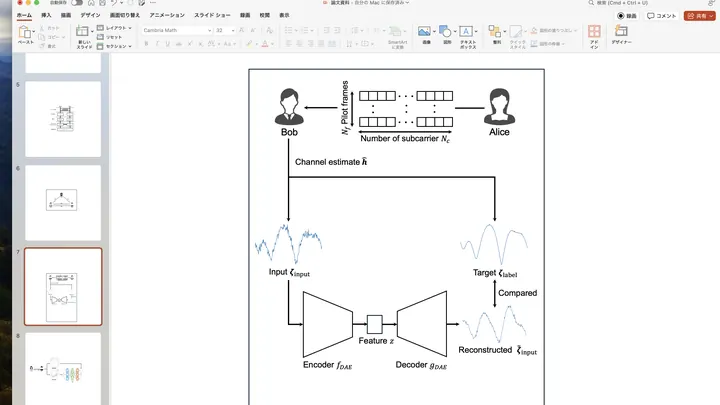
When two phones try to create a shared secret key from random properties of radio waves, interference makes their measurements imprecise. It's like two people looking at a reflection in a fogged-up window: each sees a blurry silhouette, and there's no way to make out a common picture.
A cloud service dishes out commands to a drone swarm without any knowledge of their movements. The signals are encrypted, but each maneuver leaves a barely visible trace in the cipher, like ink bleeding through paper from the pressure of a pen. Over time, these ink stains coalesce into a pattern, and the hidden data is no longer a secret.
Quantum entanglement often behaves like a synchronized dance visible from only one angle. Change the way you observe it, and the particles appear disconnected. This limits secure communications. Now physicists have created a pair of photons whose 'dance' is flawless from all perspectives.
Training a large neural network across hundreds of compute nodes is like making soup as a team: each 'chef' tastes the dish and tells the others what to adjust.
If you clap your hands in an empty room, the echo will tell you about its size and shape. Every object (a chair, a book, a person) adds its own signature to this echo: sound reflects off it in a particular way. The authors of the paper have figured out how to completely rewrite this acoustic signature. They surrounded a region of space with a closed surface of microphones and loudspeakers.
Picking out a single faulty microchip from a million, without any clue what the fault looks like, is a classic needle-in-a-haystack problem. A classical computer would test each chip one by one.
A single camera shot stores both a normal picture and a hidden map of how light rippled through the scene. Quantum entanglement makes this possible. Pairs of linked photons are generated: one visits the object, its twin takes a detour. Later, measuring the twin one way pulls out the brightness information.
A quantum computer is like an orchestra: each musician plays their own part, but the slightest noise from the audience can throw off the whole ensemble. The particles that store information easily lose their coherence from thermal jolts or stray magnetic fields.
The familiar metronomes placed on a movable platform eventually start to swing in sync. In the quantum world, this trick long eluded scientists. But now physicists have synchronized even the most exotic state — a Fock state, where the number of light particles is precisely defined, like in a counter.
In 1948, engineer Claude Shannon laid the foundations of information theory. The Nyquist–Shannon theorem gave the first answer: to avoid losing a signal, you need at least twice as many measurements as the fastest feature in the signal. In 2006, the method of compressed sensing relaxed this requirement.
Two entangled photons fly apart in opposite directions but continue to behave as a single whole: measuring one instantly determines the state of the other. That's quantum entanglement. But sometimes it resembles a seasoned spy — leaving no traces detectable by ordinary checks.
Two dice always land on the same number, no matter how far apart you toss them. In quantum physics, this behavior is called entanglement, and it's the key resource for future computers and secure communication. The trouble is, not all entanglement is easy to spot.
Quantum computers in the cloud are like a post office: you send a letter, and someone else reads the address and the contents. In ordinary computing, the server sees your data and algorithm. Blind quantum computing is an unopenable envelope: the server does the work but doesn't know what it's doing.
A radio picks up a broadcast through crackle and hiss. That's roughly how modern quantum computers work: the useful signal drowns in noise. The longer the computation runs, the more the interference distorts the result.
Two mailboxes at opposite ends of a city. Drop a letter in one, and an identical one instantly appears in the other. That's roughly how quantum entanglement works: two particles behave as a single unit, even when separated by a great distance. But until recently, this connection could only be maintained within a single room or across a lab bench.
Light can act as a courier carrying secret messages. But to ensure the courier doesn't lose a single letter, you need to meet and check it very quickly. The new chip made from a thin film of lithium niobate is like a turnstile that opens and closes in billionths of a second, letting light pulses through at just the right moment.
A typical quantum bit is destroyed by the slightest disturbance — heat, magnetic fields. Physicists made a pair of atoms work together so that disorder wouldn't erase the record. Information was encoded not in each atom individually, but in the difference of their states — like the tension of a rope between two buoys.
A quantum bit (qubit) is like a barely discernible whisper in a hum of voices. A regular amplifier makes the whisper louder, but along with it, the hum as well, making it harder to hear the essence. Physicists have created a clever device that generates two identical signal-whispers at different frequencies — the original and its echo.
In the quantum world, you cannot create a copy of an unknown particle's state – this was established by William Wootters and Wojciech Zurek in 1982, and Charles Bennett turned this prohibition into a data protection tool.
In quantum communication, a secret key is transmitted using single photons. Eavesdropping on such a channel is supposedly impossible: any interception attempt disturbs the particle and leaves a trace. But the idea has a weak spot — the real hardware, which sometimes behaves differently than theory dictates.
An ion quantum computer is like a chandelier with a dozen pendants: pull one, and they all start swinging. Each ion is a qubit, but when there are many, their collective vibrations crowd the stage. Any operation on one pair disturbs the neighbors, and the computation goes awry.
A rope braided from a hundred short strands can be twisted to the right or to the left. Each strand individually doesn't know which way the whole rope is twisted, but try to unravel it, and the difference immediately shows. That's roughly how the states physicists call symmetry-protected are arranged: locally they are indistinguishable, but globally they are different.
A coin toss seems random, but in reality, physics decides everything: the force of the throw, air resistance, the surface's elasticity. If you knew all the details, you could predict the outcome. True randomness lives deeper — in the quantum world.
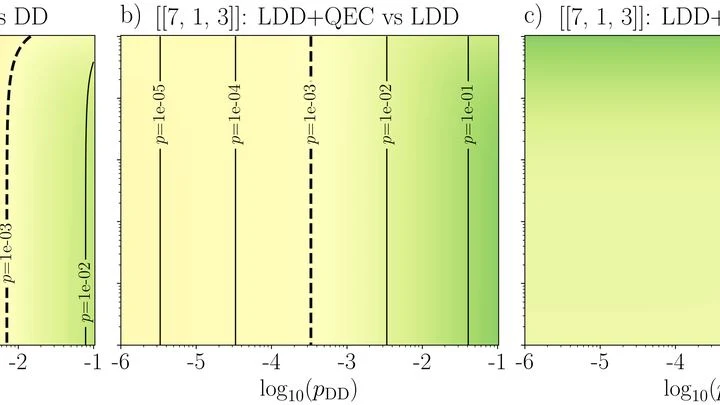
Quantum information is fragile: the slightest noise can destroy it. That's why two protection methods have been devised. The first is dynamical decoupling: rapid pulses are applied to qubits to average the noise to zero. It's like shaking a box of fragile items so they don't bump against the walls.
A bread recipe written in disappearing ink: while you read, the original fades. That's how qubits behave — any measurement changes them irrevocably. Copying them is forbidden by the 1982 theorem (Вуттерс, Зурек): a qubit contains энтропия — unknown information that can't simply be doubled.
Ordinary messages can be intercepted without anyone noticing. Physicists have come up with a way to create a shared secret that instantly breaks if someone so much as glances at it. Instead of paper, they use single particles of light. This quantum communication exploits a rule: any measurement changes a quantum object.
A tossed coin is the simplest source of randomness. But if the coin is shaved, it starts cheating. In the quantum world, light plays the role of the coin: its properties are fundamentally unpredictable. The catch is that the device that “flips” the quantum coin might be faulty or even swapped by an adversary.
Optical fiber transmits light, but along the way it jitters and dims. To ensure that two parties at opposite ends of the line get the same set of random numbers for encryption, the receiver uses a digital corrector, like noise-canceling headphones that subtract the street hum but sometimes also eat the quiet notes of the music.
In a silicon carbide crystal, which looks like a transparent stone, there are hidden defects — places where atoms are out of line. One such defect acts as a quantum node: an electron inside it spins and processes information, while the nucleus of a neighboring atom quietly stores it.
A light pulse can be sliced into short time bins, like a train into carriages. If two photons are born together and their carriages are tightly linked, the arrival of one in a specific bin guarantees that the other arrives in the paired bin, this connection is called time-bin entanglement.
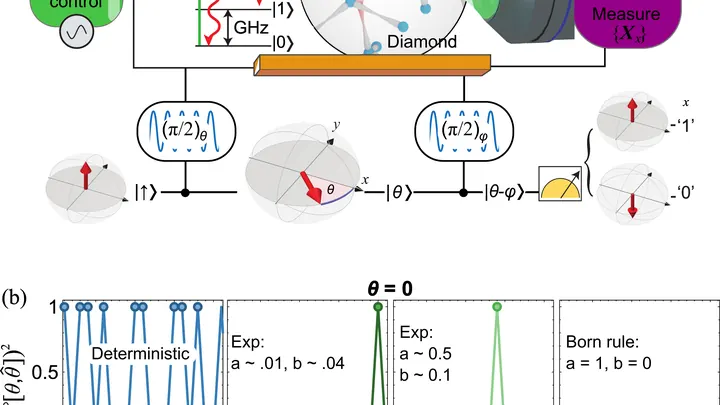
Imagine two synthetic diamonds, each acting as a high-precision tuning fork. Inside the crystal lattice of each diamond sits a carbon-13 atom: this is a quantum bit, or qubit, the minimal unit of quantum information.
Quantum computers use GKP states, dreamed up by Alexei Kitaev, John Preskill, and Daniel Gottesman. Their hallmark is built-in stabilizer checks that catch errors. For a long time, it was believed that a successful check guaranteed a nearly perfect state. Alas, it's an illusion.
There's always a risk that someone will peek at your ballot during an election. Physicists have come up with a solution: anonymous voting safeguarded not by people, but by the laws of nature.
Their 'magic ballot box' operates with light particles — photons.
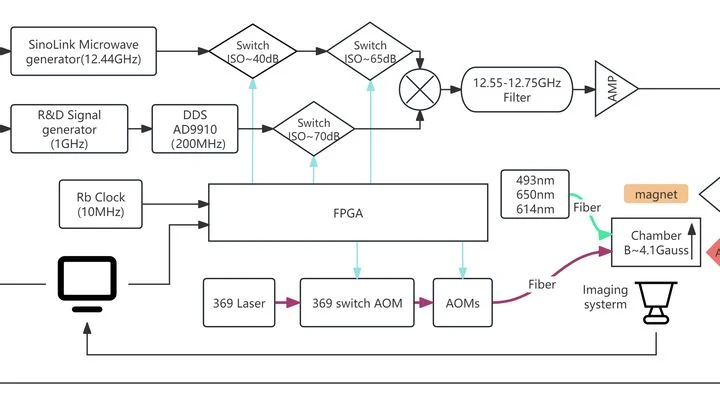
Modern encryption is unthinkable without truly random numbers. But a standard source can be unreliable or even deliberately corrupted. The solution came from experimenters who built a 98-ion quantum processor: it works like a high-speed filter, turning a 'dirty' signal into one that's crystal-clear and unpredictable.