Quantum gate tuning is the art of making the elementary operations of a quantum computer — the logic gates that manipulate qubits — as precise as possible. Real quantum hardware is noisy: every gate operation introduces small errors from imperfect control pulses, environmental interference, or crosstalk between qubits. Tuning involves adjusting the parameters of these pulses (amplitudes, phases, durations) to minimize errors, often using feedback from measurements of the qubits themselves. This is essential because quantum error correction requires gate error rates below a certain threshold; without careful tuning, a quantum computer cannot perform calculations long enough to be useful.
History
The concept emerged with the first solid-state qubit demonstrations in the early 2000s, as researchers realized that gate fidelity was the bottleneck for scaling up. The field matured with the development of randomized benchmarking protocols in 2007–2008, which provided a standard way to measure gate errors and compare tuning strategies.
How it works
The process typically starts with a model of the qubit system and its control electronics. Engineers send test sequences of gates, measure the resulting quantum states, and compare them to the expected outcomes. Optimization algorithms, such as iterative linear-quadratic regulator (iLQR) or gradient-based methods, then adjust the control parameters to reduce discrepancies. In some approaches, the tuning is done without disturbing the readout process, allowing continuous calibration during operation. Advanced techniques also use machine learning to predict optimal settings from past measurements, speeding up the calibration cycle.
In practice
Quantum gate tuning is used in every quantum computer, from superconducting chips to trapped-ion systems, to maintain high fidelity during long computations. It is also critical for fault-tolerant quantum error correction, where even small improvements in gate accuracy translate into significant reductions in the overhead required for logical qubits.
Fun fact
Some quantum computers are tuned using the same iLQR algorithm that controls rocket landings and autonomous vehicles, adapting a classical control technique to the quantum realm.
An interpreter in a crowded room tries to make out one person's speech but hears the murmur of hundreds of voices. A molecule storing quantum information in its spin finds itself in a similar situation: its spin is surrounded by the thermal jitter of atoms, and it is this jitter that gradually erases memory.
A quantum computer is like an orchestra where each instrument is a qubit and the conductor is the control processor. The conductor must not only set the tempo but also change the score on the fly if a soloist plays something unexpected.
A short flash of light is like a musical phrase: you can distinguish individual notes if you listen very carefully. But in the quantum world, these 'notes'—temporal modes — are squeezed down to picoseconds, and ordinary optics can barely tell them apart.
A washing machine sometimes tears clothes. To get a whole shirt, you wash several and then piece one together from the survivors. A quantum computer treats 'magic states'—special ingredients without which complex computations are impossible — in much the same way.
These states are extremely fragile. The slightest noise, and the magic evaporates.
A superconducting qubit is like a finicky musical instrument: until you tune it, you won't get a clean note. But even after tuning, the pitch drifts. The culprits are tiny defects in the material that physicists call two-level systems. They're like invisible cracks that appear and disappear, throwing off the processor's rhythm.
Two dancers on stage must move in perfect sync, but if one hesitates, the whole routine is ruined. That's roughly how quantum computers with neutral atoms work: two atoms are entangled by putting them into a Rydberg state (as huge as a balloon compared to an ordinary atom), and then you wait for them to 'dance' their part.
A laser beam can do more than heat things up: it can also calm motion. When light enters a mirror trap, it exerts pressure on the mirrors, and if you tune the beam's color just right, that pressure becomes a gentle braking force. This is how tiny mechanical vibrations are cooled to nearly absolute zero.
Fiber optics transmit data with light of different colors. These beams race at nearly the speed of light. Normally, all signals go the same way, creating a jam and interference, like an orchestra where musicians are trying to outshout each other.
Imagine a quantum phase transition as an intricate dance. Electrons whirl in strict order, each step representing their spatial arrangement, and the rhythm their dynamics. For decades, physicists could only see a blur of motion, unable to tell if the figures were changing or the music speeding up.
Quantum computing suffers from 'false notes' — errors that arise from the slightest inaccuracy. Now they are eliminated with the precision of tuning a concert grand piano. The idea traces back to the dreams of pioneers — David Deutsch and Peter Shor — of flawless operations.
Tuning a quantum processor is monotonous work: you need to calibrate each qubit — a quantum cell — much like a watchmaker adjusting dozens of tiny gears. Humans get tired and make mistakes.
A quantum simulator based on ion traps is like an orchestra where each ion is a musician and the phonon bus (the collective vibrations) is the conductor relaying signals. As long as everyone plays the same tune, everything goes smoothly.
Three guitar strings on the same instrument, but each tuning peg turns with a different resistance: one gives way immediately, another is stiff, and the third is completely stuck.
A quantum computer measures a molecule's energy much like an old tape measure that only has markings every meter. If the actual length of a table is 2.37 meters, the tape shows “two and a bit,” and you can't do better. Physicists call this resolution: the step of the grid, finer than which you cannot go.
The authors of the new work turn this flaw into an advantage.
Four musicians play in harmony only if they hold hands. In the quantum world, such a chain is formed by four electrons in four neighboring quantum dots — tiny traps for charge. This is the basis of the SAGE qubit (from "singlet-based always-on exchange").
A quantum processor is like a busy intersection: the more cars, the harder it is for them to navigate without collisions. In the quantum world, qubits play the role of cars — elementary carriers of information that, unlike classical bits, can be both 0 and 1 simultaneously.
A laser that usually produces a steady beam starts to tremble near its threshold, like a string about to sound. This trembling is not a defect but quantum noise: atoms inside the laser emit light randomly, without any external cause.
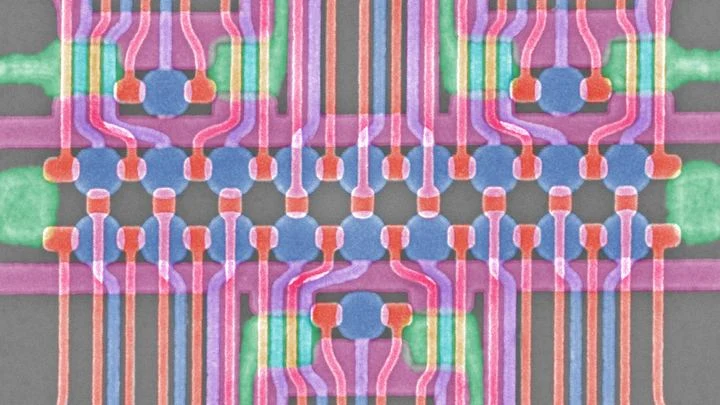
Eighteen tiny cells line up in two rows on a piece of germanium. Each cell is a quantum dot — a trap for a single electron whose spin acts as a qubit. Previously, such systems could only be assembled in small numbers, but here we have an entire lattice working as a single ensemble.
A quantum computer is like an orchestra where each musician plays their part, but if the conductor waves the baton a bit too hard, the delicate instruments go out of tune from excess heat. Controlling qubits at 10 mK (300 times colder than your freezer) is like conducting an orchestra in an ice-cold hall where even a breath can ruin everything.
A quantum computer is like an orchestra where every musician must come in exactly on the beat. The faintest rustle in the hall throws off the violinist, and the melody falls apart. In silicon chips, that rustle is electrical noise: random fluctuations of charge inside the material. They make quantum bits err.
A single antiproton, trapped and cooled to near absolute zero, behaves like a tuning fork that needs a very precise strike to produce a clean note. Catching that 'note' directly is nearly impossible — the signal is too weak.
Each qubit has its own little ring, freely sliding on the doughnut. All quantum logic boils down to smooth movements: shift, flip, connect. Entanglement, for example, is when two doughnuts stick together, and the rings on them begin to spin synchronously, like figure skaters in pairs skating.
The key insight: the geometry of the surface dictates the rules of the game.
Qubits in a quantum computer are like musicians in an orchestra: each must hear the others, or the music falls apart. But if you wire the musicians together permanently, they start getting in each other's way: that's how unwanted interactions arise in superconducting chips, spoiling computations.
A quantum computer is like an orchestra where each qubit is a musician, and a measurement is the conductor's attempt to hear who played what. But the hall is noisy: the signal fades like sound through a thick wall, and the conductor himself sometimes mixes up the notes.
In a quiet lab, a device the size of a microwave oven sits on a table. Inside, a coil glides smoothly up and down while a computer reads electrical signals. This is the tabletop Kibble balance — a machine that links mass to quantum constants.
Previously, such balances occupied a whole room and required a team of engineers.
Inside a battery, like a layered cake, different solid layers sit side by side. The meeting point, the interface, behaves capriciously: stresses concentrate there, and over time the battery ages. To understand these processes, we need computer models that see every atom. But accurate calculations are too expensive, and fast ones are too crude.
Inside a tokamak, a giant magnetic donut, plasma is heated to hundreds of millions of degrees. It doesn't touch the walls; it floats in a vacuum, held by invisible magnetic fields. But plasma is finicky: a slight change in current or pressure and its shape starts to wobble like jelly on a plate.
A quantum computer isn't a monolith: it's more like an orchestra, where each qubit must play its part without drowning out the neighbors. In ion-based machines, two types of qubits are used: some store information, others process it. Previously, each type required its own laser, like separate batons for violins and trumpets.
A quantum computer is like an orchestra, where each qubit is a musician and the control signals are the conductor. If the conductor waves the baton imprecisely, the musicians fall out of sync. In a real device, signals pass through power amplifiers, like loudspeakers that add noise and distortion.
Quantum computers require magical states — special helper particles for error-free operation. Previously, they were obtained through repeated purification, akin to endless distillation of alcohol: each step added энтропию (disorder), like weeds in a garden, and consumed resources.
A lone ion in a trap jitters like a swing, and each oscillation introduces an error into quantum calculations. Traditionally, jitter is suppressed by cooling almost to absolute zero: this is bulky and expensive.
An orchestra tunes up before a concert. Each musician locks into the common rhythm, and order emerges in the hall. A quantum reservoir computer works in a similar way: qubits, like musicians, interact with each other, turning a chaotic signal into a predictable melody.
Reservoir computing has been around for a while.
Two superconducting qubits on a single chip sound as clean as soloists in an orchestra. Each is a transmon, a qubit with reduced sensitivity to charge noise. They are connected through a tunable coupler, an auxiliary element that adjusts the interaction strength between them.
A quantum computer is an orchestra where every qubit must come in exactly on cue. But instead of a conductor with a baton, we have an arbitrary waveform generator (AWG) that delivers microwave signals lasting tens of nanoseconds.