18 Qubits on a Single Chip express
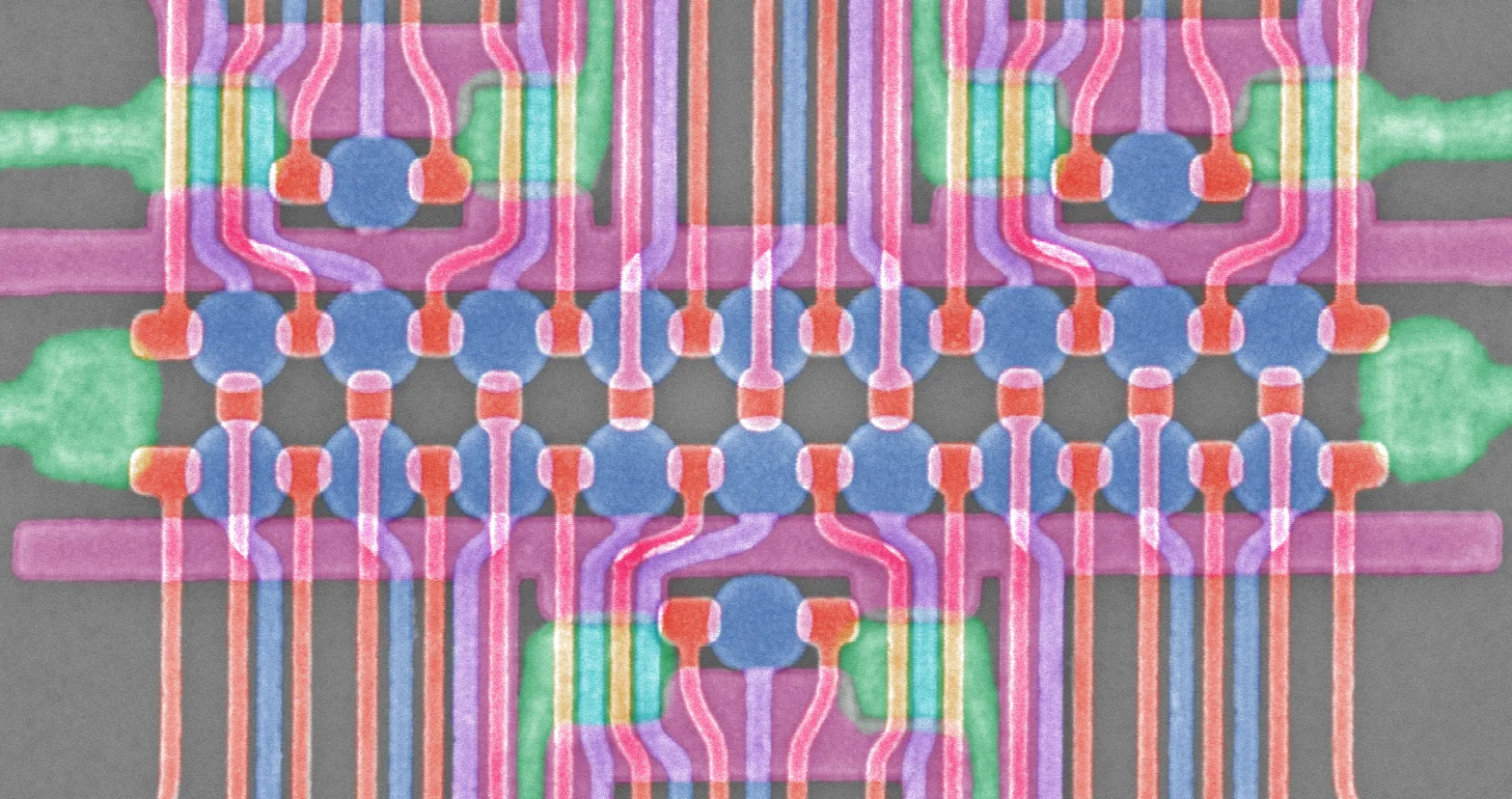
Eighteen tiny cells line up in two rows on a piece of germanium. Each cell is a quantum dot — a trap for a single electron whose spin acts as a qubit. Previously, such systems could only be assembled in small numbers, but here we have an entire lattice working as a single ensemble.
Controlling eighteen particles at once is like conducting an orchestra where each musician plays their own part but hears only the conductor. The researchers employed a modular architecture: the processor is built from identical two-qubit blocks that can be stacked like train cars. This allowed them to initialize, control, and read out all qubits simultaneously, achieving operation fidelities above 99.8%.
At the end of the experiment, the authors entangled three neighboring qubits into a special state — the Greenberger–Horne–Zeilinger entanglement. This is like three coins that always land the same way, even if tossed in different rooms. Such a connection is the foundation for quantum computing and information security.
The germanium chip with eighteen qubits is not a record in terms of number, but it is an important step toward scalability. The modular design allows adding new rows without losing control, like building blocks. If the fidelity holds, within a few years we could see processors with hundreds of qubits, capable of cracking modern encryption or simulating new materials.
Germanium is a close relative of silicon, but better suited for spin qubits: electrons move faster and interfere less with each other.
In the series "Devs," a quantum computer helps solve global problems but creates new ones. Our chip is a small step toward such a machine.