Silicon Quantum Chip: 18 Qubits Hitched Together express

Original: "A digitally controlled silicon quantum processing unit"
· Members of the HRL Quantum Team, Collaborators, :, Michael Abraham, Edwin Acuna, Tower S. Adams, Moonmoon Akmal, Matthew R. Alfaro, I. Alvarado, Jacob Amontree, Carter Andrews, Reed W. Andrews, Michael Antcliffe, Andre R. Aséncio, Ryan M. Avila Batres, Cynthia D. Baringer, David W. Barnes, Katherine M. Beech, Russell G. Blakey, Zachery T. Bloom, Aaron J. Bluestone, Jacob Z. Blumoff, Matthew G. Borselli, Koel A. Bose, Brydon Boyd, Jacob T. Boyer, Teresa L. Brecht, Christopher C. Brough, Rex A. Brown, Steven L. Brown, Tyler A. Cain, John B. Carpenter, Stephen Carr, Faustin W. Carter, Mitchell Casanova, Jacob L. Chambers, Matthew D. Chambers, Khamsorn L. Chanthavong, James M. Chappell, Rhian Chavez, Kevin C. Chen, Peter S. Chen, Maxwell D. Choi, Krishna Choudhary, Matthew N. H. Chow, Justin E. Christensen, Aaron M. Chronister, Andrew M. Clapper, Abigail A. Coker, Michael D. Cornelius, Albert E. Cosand, Ian T. Counts, Edward T. Croke, Gregory M. Crosswhite, Adam Dally, Erik S. Daniel, Tuan A. Dao, Dominic Daprano, Tiffany Davis, Neha Deshpande, Rachel S. Dey, D. Scott Diamond, Claire E. Dickerson, J. P. Dodson, James B. Dragan, Marc Dvorak, Lisa F. Edge, Charles R. Elliott, Kenneth R. Elliott, Kevin Eng, Jacob Fast, Colin P. Feeney, David J. Fialkow, Dylan H. Finestone, Micha N. Fireman, Bryan H. Fong, Trevor M. Fowler, Sean Frazier, Kiera L. Fuller, Christina A. C. Garcia, Kacy L. Garstka, Kara C. Garvey, Zachary A. Geiger, Galen R. Gledhill, Caleigh M. Goodwin-Schoen, Joseph L. Goralka, Bradley W. Greene, Hrayr K. Gurgenian, Sieu D. Ha, Wonill Ha, Nathanial R. Hapeman, Brooke M. Hardesty, Jim W. Harrington, Patrick M. Harrington, Thomas R. B. Harris, Ben M. Harrison, Anthony T. Hatke, Robert R. Hayes, Kevin He, Raul Hernandez Garcia, Ryan M. Hickey, Jocelyn Hicks-Garner, Alex Hirman, Donald A. Hitko, David Ho, Holland Y. Ho, Vinh S. Ho, nathan holman, Adam Holmes, Nerys Huffman, Daniel R. Hulbert, Eric B. Isaacs, Clayton A. C. Jackson, Logan Jaeger, Ian Jenkins, Cameron Jennings, Paul C. Jerger, B. Johnson, Aaron M. Jones, Michael P. Jura, Adour V. Kabakian, Raj M. Katti, Tyler Keating, Joseph Kerckhoff, Joseph D. Kern, Isaac Khalaf, Aditya Kher, Jake J. Kim, Erich W. Kinder, Andrey A. Kiselev, William F. Koehl, Patrick W. Krantz, Thaddeus D. Ladd, Pierce G. Laing, Sanaaya Lakdawala, Nathan J. Lang, Robert Lanza, Elias Lawson-Fox, Dustin Le, Kangmu Lee, Nathan R. A. Lee, Jaime Lerma, Mark P. Levendorf, Alwina R. Liu, Henry Lizarraga, Aurelio Lopez, Hoa C. Ly, Torrey T. Lyons, Theodore K. Macioce, Matthew M. Mackey, John K. Maeda, Ryan M. Martin, Daniel S. Matic, Justine W. Matten, Gavin C. Mazur, Max S. McCready, Olivia Means, Kevin E. Millner, Ivan Milosavljevic, Matthew Morris, Susan L. Morton, Samuel Mumford, Bryce D. Murley, Robert G. Nagele, Taro A. Naoi, Cameron R. Nelson, Georgia A. Newman, David B. Nguyen, Tina Niknejad, Rebecca N. Nishide, Liam C. O'Brien, Colin B. E. O'Keefe, Riley P. O'Neil, Andrew E. Oriani, Anthony F. Ortiz, John J. Ottusch, Andrew Pan, Pamela R. Patterson, Uttam Paudel, Julius C. Perez, Christi A. Peterson, Vu T. Phan, Nickolas H. Pilgram, Clifford E. Plesha, Winston Pouse, Eric M. Prophet, Daniel R. Queen, Nicholas Quirk, Kate Raach, Matthew T. Rakher, Matthew D. Reed, Brandon D. Reynolds, Luke D. Robertson, Zechariah Rogers, Yakov Royter, Matthew J. Ruiz, Golam Sabbir, Roshan Sajjad, Christopher D. Sanborn, Rachel H. Sarmiento, Christian J. Schnaible, Cole Scott, Nicholas M. Sebastiani, Eric M. Segall, Alen Senanian, Adalberto Sicairos, Shariq Siddiqui, Kartik Singh, Aaron Smith, Daniel E. Smith, Robert S. Smith, Sarah F. Sontag, Emilio A. Sovero, Kevin C. Staley, Andrea Su, June Suh, Bo Sun, Danny Sun, Christopher M. Swank, Noah Swimmer, Mariano J. Taboada, Bryan J. Thomas, Yessica Torres, Jeremy W. Touve, Alan Tran, Ivan Tran, Chantang Tsen, Skylar Turner, Miguel Valencia, Irma Valles, James R. van Meter, Nicholas D. VanRensselaer, Franklin Vartanian, Daniel Volya, Zachary J. Vrba, Phuong Hong Vu, Annette L. Wagner, John Wallner, Michael P. Walsh, Shuoqin Wang, Tong Wang, Daniel R. Ward, Aaron J. Weinstein, Terry B. Welch, Thomas V. Westrick, Evan T. White, Randall M. White, Samuel J. Whiteley, Gananath Wijeratne, Parker Williams, Jack T. Wilson, Courtney P. Wilt, Deborah E. Winklea, Onnik Yaglioglu, Daniel Yap, Clifford S. YoungSciortino, Daniel Zehnder, Andrew Ziegler
arXiv:2604.16216 · 2026-04-17 · CC BY 4.0 · 1 min
Engineers have built a quantum processor from silicon qubits that runs on standard electronics and operates a thousand times quieter than its predecessors.

📄 Showing the "Simple" version — "Advanced" is not ready yet. Add it to favorites to help prioritize it.

A quantum computer is like an orchestra where every musician must play their part perfectly, or the melody falls apart. Previously, controlling qubits — the quantum 'musicians'—required a room full of equipment, and every extra wire added noise. The engineers behind this work assembled a compact silicon chip with 18 qubits and placed the control electronics right next to it, inside a refrigerator colder than outer space.

Here, the qubits are tiny traps for electrons, etched into silicon. Electrons behave like spinning tops: their spin can point up or down, representing the two states of a qubit. Instead of poking each electron with a separate signal, the authors used trios of electrons that interact with each other. Such an 'exchange' qubit is easier to control and less susceptible to magnetic interference. As a result, the accuracy of single-qubit operations improved tenfold compared to previous silicon qubits.

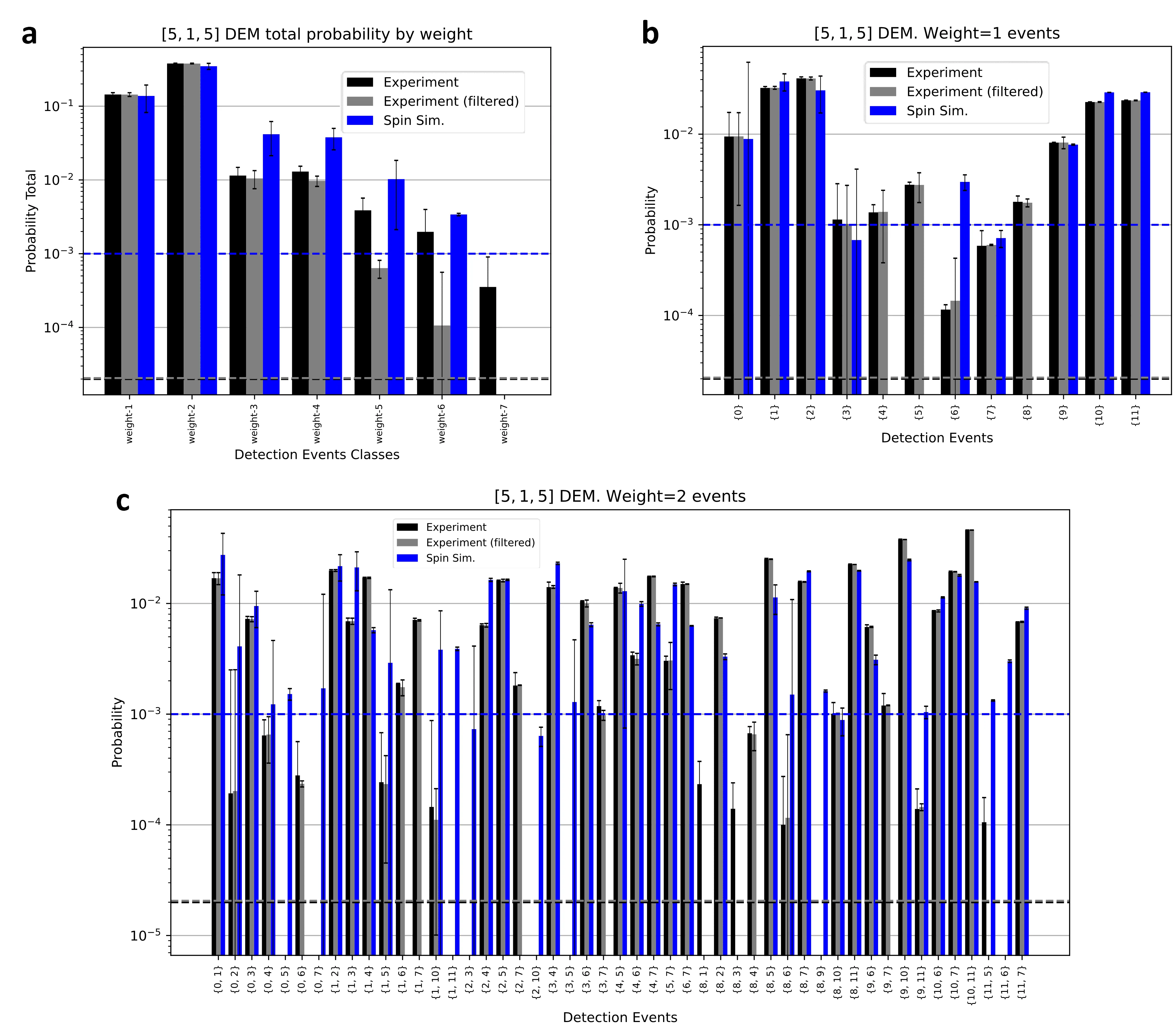
To test the chip's reliability, the scientists ran a code that detects and corrects errors. Called the repetition code with distance 5, it uses five qubits to store one bit of information, so even if one qubit fails, the others have its back.

The main takeaway isn't just a record, but a path to mass production. Silicon is the same material used to make conventional processors. That means the factories that print chips for phones today could also print quantum chips. And control via standard electronics means a quantum computer won't require exotic infrastructure. The orchestra finally fits in your pocket and plays without missing a beat.

Original abstract

as written by the authors arXiv:2604.16216

Commercially-relevant quantum computers will require large numbers of high-performing qubits that can be manufactured, integrated, and controlled at scale. Silicon exchange-only (EO) qubits are a strong candidate modality due to their control-signal simplicity and compatibility with advanced semiconductor manufacturing, but questions remain around the achievability of sufficiently low noise and a scalable control and wiring solution. Here we introduce a quantum processing unit composed of a custom-designed cryogenic CMOS controller, a novel high-density superconducting ribbon cable, and a low-noise EO qubit device. The quantum chip features a three-rail array of 54 exchange-coupled quantum dots, configurable to host up to 18 EO qubits. We integrate and use these components to demonstrate qubit performance for both single-qubit and entangling operations that advances the EO state of the art by an order of magnitude. We further validate this system by implementing a distance-5 repetition code and a quantum error detecting code then make detailed comparisons with simulations. Our approach facilitates a utility-scale quantum computer with manageable operational and capital requirements.
The qubits in this chip operate at about 0.1 kelvin—30 times colder than interstellar space.

Such chips resemble the computational modules from 'Star Trek,' where quantum processors are integrated into a starship's regular systems.

Scientists
Erwin SchrödingerHugh Everett IIIDavid DeutschJohn Stewart BellLouis de BroglieLov Grover
Concepts
ibm quantum processor quantum chip superconducting qubit control signal semiconductor qubits qubit scaling transmon silicon chip superconducting electronics memory cell data center error threshold bit single spin manipulation memory classical computer readout silicon cryostat