A classical computer is a machine that processes information using bits—discrete states of 0 or 1—following the rules of classical physics and Boolean logic. This includes everything from early mechanical calculators to modern laptops and supercomputers. The term is most often used in contrast to quantum computers, which exploit superposition and entanglement to represent information in qubits. Classical computers are deterministic in principle: given the same input and program, they always produce the same output, and their operation is governed by the laws of classical electromagnetism and semiconductor physics.
History
The theoretical foundations were laid by Alan Turing and John von Neumann in the 1930s–1940s, with the first electronic general-purpose computer, ENIAC, completed in 1945. The term 'classical computer' gained currency in the 1980s as quantum computing research began.
How it works
At the hardware level, a classical computer uses transistors as switches that represent bits. Billions of these switches are integrated into microprocessors, where they perform logical operations (AND, OR, NOT) and arithmetic. Data is stored in memory cells—capacitors in RAM or magnetic domains in hard drives—and moved between memory and processor via electrical signals. The entire architecture follows the von Neumann model, where instructions and data are stored in the same memory and processed sequentially. The speed and efficiency of classical computers are limited by the physical size of transistors and the speed of electrical signals, which is why quantum computers are being explored for certain problems.
In practice
Classical computers are used everywhere—from smartphones and personal computers to servers running the internet, weather forecasting, and scientific simulations. They remain the workhorse for most computational tasks, including those that simulate quantum systems approximately.
Fun fact
The fastest classical supercomputers today can perform over a quintillion (10^18) operations per second, yet they still cannot exactly simulate the behavior of a quantum system with more than about 50 qubits.
Picture a vast hall where thousands of janitors are sweeping the floor at the same time. Each one knows only their own patch and sweeps debris toward the nearest wall, without asking a manager. It used to be thought that such an approach was impossible for a quantum computer: too many errors, and you need a central brain that sees the whole picture.
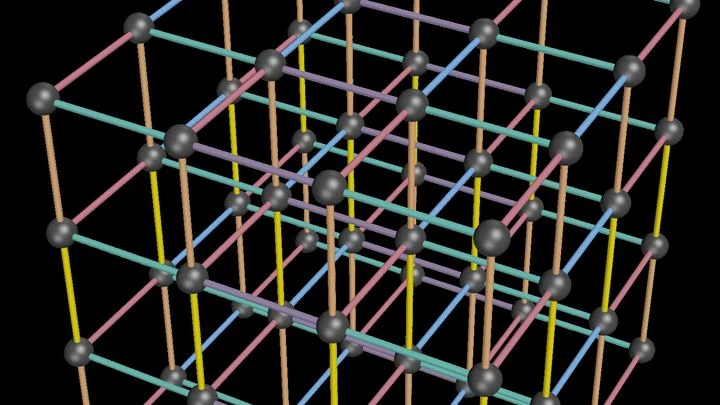
A quantum computer isn't just a bunch of qubits: it's a whole city, where each resident is one of the machine's possible states. Residents get to know each other through weak interactions between qubits: if one state can transition to another, a thread of acquaintance is drawn between them.
An ordinary random network is like a road map: to connect four cities with a complex interchange, you need to lay down many highways. In the quantum world, things are different.
A quantum computer is like a fragile snowflake resting on a warm palm. The slightest breath of heat or a gentle vibration, and it turns into a droplet. To keep the snowflake alive, you constantly adjust it, restoring its original shape. That's quantum error correction.
The classical neuron is a chamber musician, drawing only one note from each string: it takes a weighted sum of inputs, adds a bias, and passes it through a nonlinearity.
Imagine a book being simultaneously copied by trillions of scribes. As long as most of them check against the original, the narrative remains meaningful. But once control weakens, the text accumulates typos, which multiply until the manuscript turns into gibberish.
Once Richard Feynman saw in quantum systems a challenge for classical computers. Now we face the inverse problem: understanding what exactly the quantum processor has simulated. Among the states it births are veritable 'black boxes'—topological phases of matter.
Strike a tuning fork with a mallet — it vibrates, and the sound gradually fades. A black hole behaves much the same way when disturbed: it emits gravitational waves — ripples in spacetime itself — and then settles down.
In the world of atoms and particles, everything tends toward rest: particles lose energy, just as a swing slows down due to energy loss (friction). But many devices — from hydrogen masers to atomic clocks — live by repetitive cycles.
In a grand courtroom, a meeting is in session. Hundreds of translator-neurons simultaneously hear fragments of phrases, and must piece them into a single coherent picture. This is exactly how large brain networks turn scattered signals from the eyes into a unified object image.
Molecules float in a test tube. Their abundance (say, the concentration of some protein) becomes the input signal. And the output isn't just a cloudy solution but a clear yes-or-no answer.
The authors build a chemical cascade that does exactly that.
Quantum computers in the cloud are like a post office: you send a letter, and someone else reads the address and the contents. In ordinary computing, the server sees your data and algorithm. Blind quantum computing is an unopenable envelope: the server does the work but doesn't know what it's doing.
In the kitchen, the sequence of actions is strictly dictated by the recipe: first chop, then fry, and nothing else. In quantum physics, the role of the recipe is played by causality — one event causes another, and they cannot be swapped. But in recent years, theorists have devised clever scenarios where the order of events seems to 'hang' in uncertainty.
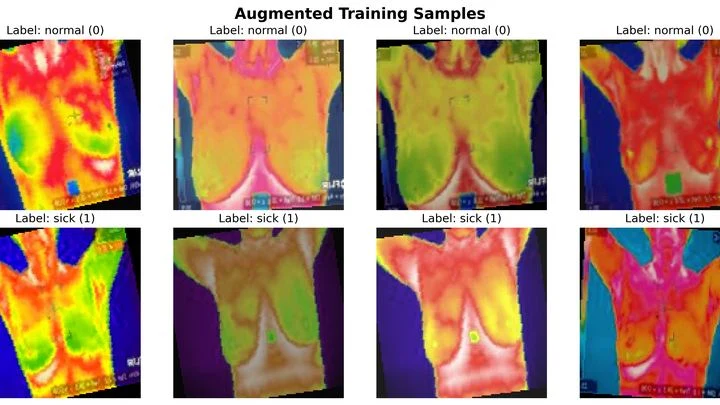
The hot air above asphalt shimmers, betraying the heated surface. Medical thermography works in a similar way: the skin over a tumor is often slightly warmer than healthy skin — by just fractions of a degree. Computer programs try to catch this difference and determine whether it's dangerous.
A quantum computer is like an orchestra where every musician must play their part perfectly, or the melody falls apart. Previously, controlling qubits — the quantum 'musicians'—required a room full of equipment, and every extra wire added noise.
A city map: intersections are nodes, streets are connections. For an algorithm to understand the structure, each node needs a label. The classical approach — standard model — assigns simple tags, like house numbers.
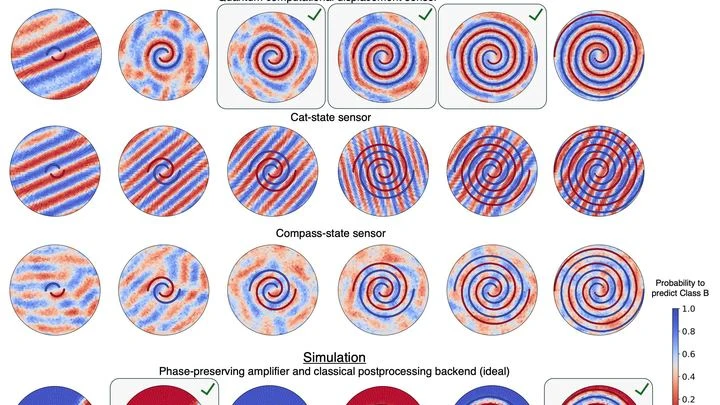
A judge walks into the courtroom but doesn't look at the evidence: he immediately delivers the verdict. That's how the new quantum sensor works: it doesn't measure the signal but directly decides which class it belongs to.
In conventional quantum sensing, it's all like a detective story: first you gather clues (measure the signal), then you analyze them.
Inside an exploding star, neutrinos race so densely that they start to influence each other. Their quantum states become entangled, like threads in a tight ball where you can no longer tell which is which. Ordinary computers struggle with this task, as the number of possible states grows avalanche-like.
A classical computer sorts data like a person meticulously sifting through grains of sand of different colors. A quantum processor takes its cue from nature: just as a droplet of water splits sunlight into a rainbow, revealing all hues at once, this new algorithm instantly grasps the essence of vast information arrays.
The biggest puzzle in physics is how to reconcile spacetime curvature with quantum mechanics. At the Planck length, billions of billions times smaller than an atom, the rules break down. This frontier was discovered by Max Planck.
Magnetic monopoles are like halves of a magnet that cannot exist alone in ordinary materials. But in spin ice, they appear in pairs connected by an invisible thread — a Dirac string. Previously, such monopoles were only seen in artificial systems at room temperature, but their quantum motion remained a mystery.
In ping-pong, two paddles connected by an invisible thread feel each other's movements, guessing the ball's trajectory. Researchers gave a computer a similar thread — quantum entanglement. Into an ordinary trial-and-error learning program, they embedded a quantum circuit of eight qubits — particles that can spin like a coin on its edge.
In the quantum world, you cannot create a copy of an unknown particle's state – this was established by William Wootters and Wojciech Zurek in 1982, and Charles Bennett turned this prohibition into a data protection tool.
IBM's Heron R3 quantum computer handled a task that made a classical method back down. The challenge was finding the ground state, the lowest energy level, of a system of 49 quantum bits.
Like an iceberg, the visible part of the code is the data, while beneath the surface lies a massive foundation of auxiliary particles. They quietly monitor noise and fix errors without touching the information. This approach squeezes many protected logical qubits into a modest number of physical ones.
The experiment ran on a 98-ion processor inside an electric trap.
Two people read the same book, but one turns the page first and then looks at the text, while the other does the opposite. It would seem the result is the same. But in the quantum world, the order of operations changes everything.
This work examines models that output sequences of symbols, like a ticket machine.
A bread recipe written in disappearing ink: while you read, the original fades. That's how qubits behave — any measurement changes them irrevocably. Copying them is forbidden by the 1982 theorem (Вуттерс, Зурек): a qubit contains энтропия — unknown information that can't simply be doubled.
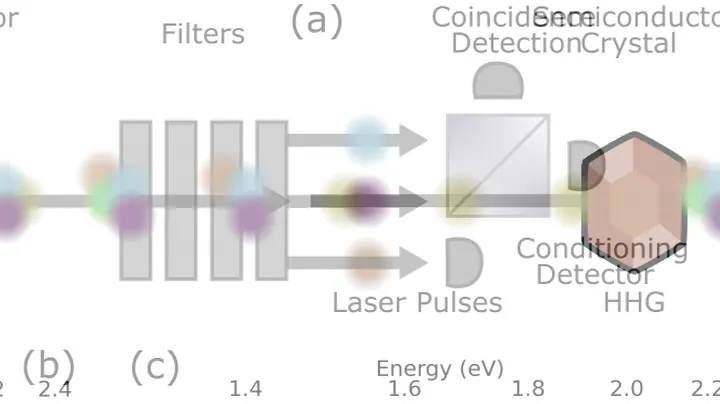
A powerful laser strikes a semiconductor, and it responds with light at many frequencies, like a string sounding a chorus of overtones. Previously, this was used in spectroscopy to observe ultrafast processes. But now physicists have noticed: the overtones are not independent; they behave as if connected by invisible threads.
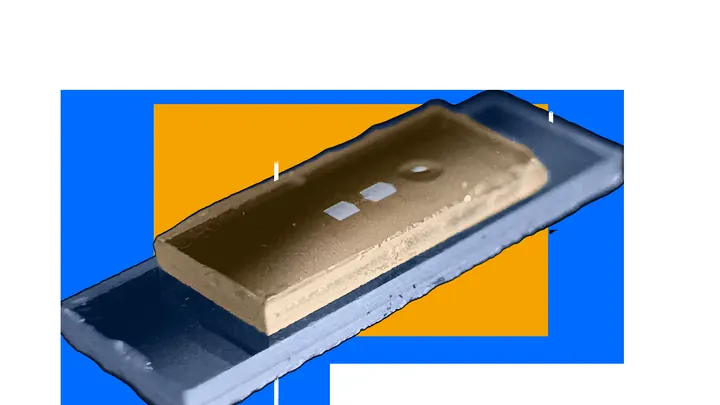
In a silicon carbide crystal, which looks like a transparent stone, there are hidden defects — places where atoms are out of line. One such defect acts as a quantum node: an electron inside it spins and processes information, while the nucleus of a neighboring atom quietly stores it.
In a diamond crystal, a tiny defect sometimes occurs: a nitrogen atom takes the place of a carbon atom, and nearby a lattice site is empty. Electrons in this spot behave like a spinning top that can rotate in different directions. These 'spinning tops' are ready-made cells for future quantum computers and ultra-sensitive sensors.
Quantum computers have gained a built-in self-repair mechanism. The new two-dimensional scheme works like living tissue: each qubit-cell interacts with neighbors by local rules, automatically suppressing random disorder — entropy. Unlike previous methods, it doesn't require constant measurements, which themselves generate errors.
A quantum computer is like an orchestra where each musician plays their own part. With few instruments, the conductor can manage each one separately. But when there are thousands of musicians, individual commands become overwhelming.
On a table lies a handful of round magnets. As long as no one touches them, they lie in disarray. But send a short current pulse through them, and each disk flips: the north pole swaps with the south. Neighboring disks push each other with their fields, like people in a crowded queue, and the whole handful arranges into a pattern that depends on which way the magnetic wind blew and how warm it is around.
Inside a tiny crystal, sound is trapped like light in a mirrored room. It bounces off the walls and forms standing waves — a multitude of harmonic oscillations, each with its own frequency. Physicists have learned to use these oscillations as qubits — the basic units of quantum information.
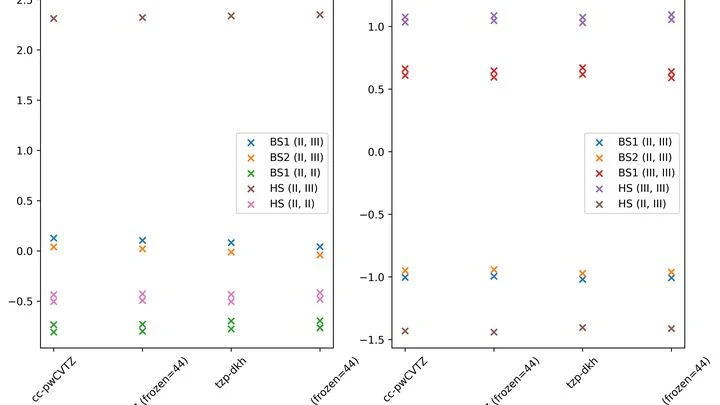
In every handful of fertile soil, there are bacteria that do something no factory can: they take nitrogen straight from the air and turn it into fertilizer. The secret lies in the enzyme nitrogenase, and its working core, a cluster of iron and molybdenum atoms, looks like a tiny factory floor.
Chemists have long tried to understand how this factory works from the inside.
An orchestra plays inside a giant refrigerator. The musicians are qubits, the elementary cells of a quantum computer. To play in harmony, they need silence: thermal noise drowns out the melody. That's why the heart of a quantum processor is cooled to nearly absolute zero — minus 273 degrees Celsius.
Two seemingly incompatible mathematical languages describe a single quantum reality. The first is the language of quantum walks: here, a particle (such as an electron or even a quasiparticle in a condensed medium) takes a stroll on a graph, simultaneously exploring all possible paths — much like a pedestrian in an unfamiliar city instantly finding…
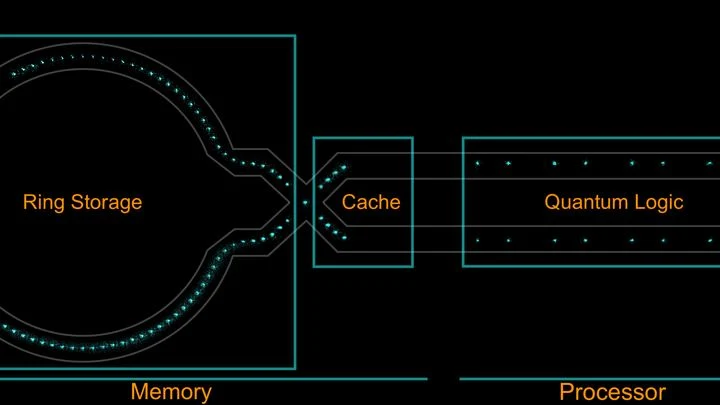
In the new Helios processor, 98 barium ions circle along a closed loop, like horses on a carousel. This architecture allows any ion to exchange data with any other, making the system flexible and powerful. Laser pulses, like a conductor's baton, issue commands at the speed of light.
The task resembles a giant maze with a single exit among billions of dead ends. A conventional computer checks each corridor step by step — taking centuries. A quantum processor launches a wave that seeps through all paths at once. The correct route echoes back, amplifying, and the answer is found in hours. That’s exactly how the “peak” circuits worked in the new experiment.
In 1935, Erwin Schrödinger, peering into the equations of quantum mechanics, saw something strange: two particles could be linked so tightly that the state of one instantly determines the state of the other, even if they are separated by kilometers.