Superconducting electronics refers to devices and circuits that exploit the unique properties of superconducting materials—materials that conduct electric current with zero resistance below a critical temperature. This field is a cornerstone of quantum computing, where superconducting qubits are among the leading platforms for building quantum processors. The zero-resistance property allows currents to flow indefinitely without energy loss, enabling highly sensitive detectors, ultra-fast digital circuits, and magnetic field sensors that far exceed the performance of conventional electronics.
History
Superconductivity was discovered in 1911 by Heike Kamerlingh Onnes, but practical superconducting electronics emerged in the 1960s with the invention of the Josephson junction by Brian Josephson. The first superconducting qubit was demonstrated in 1999 by Yasunobu Nakamura and Jaw-Shen Tsai.
How it works
Superconductivity arises when electrons form Cooper pairs that condense into a single quantum state, allowing them to move without scattering. In electronics, this is harnessed through Josephson junctions—two superconductors separated by a thin insulating barrier—which support quantum tunneling of Cooper pairs. These junctions can switch between superconducting and resistive states in picoseconds, making them ideal for high-speed logic and for qubits, where the junction's energy levels form the basis of quantum states.
In practice
Superconducting electronics are used in quantum computers (e.g., IBM and Google processors), MRI machines (via superconducting magnets), and ultra-sensitive detectors like SQUIDs (Superconducting Quantum Interference Devices) for measuring tiny magnetic fields in medical and geophysical applications.
Fun fact
A superconducting current can persist for years without any power source—in 2016, a team at the University of Cambridge observed a current that had been flowing for over a decade in a superconducting ring.
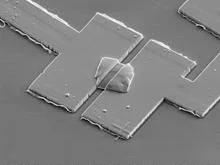
A tiny black hole flies through a hydrogen cloud and stretches atoms like taffy. That is what a superconductor looks like when it traps a persistent current: a material in which electricity flows without losses turns into a miniature permanent magnet.
Old treasure maps were drawn from hearsay: someone found gold by a river, someone else in the mountains, and each person dug in their own spot. High-temperature superconductors went the same way: cuprates were found in some compounds, iron pnictides in others, nickelates in yet others, and there was no common map.
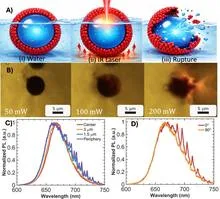
A tiny capsule, like a soap bubble but with a shell of glowing crystals, behaves like a laser. While its wall is intact, light circulates, amplifies, and escapes as a narrow, bright beam. Once the wall bursts, the beam turns into a dim spot. Such a capsule is a colloidosome, and it can change its glow on command.
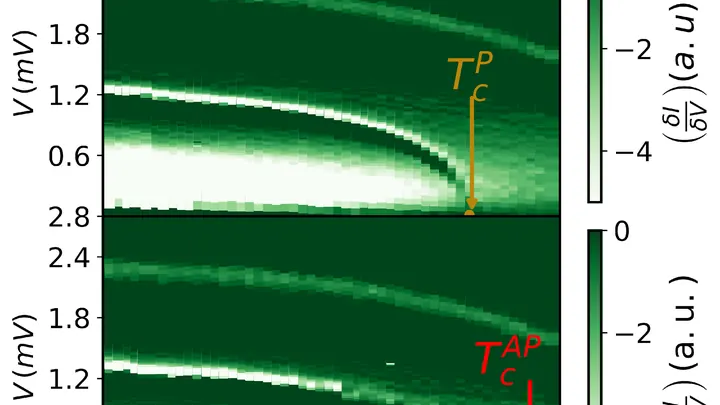
A superconductor is like an orchestra that plays without a single wrong note, until the conductor turns a tuning knob. In this new work, that knob turned out to be the magnetic history of nickel contacts.
In a narrow corridor, people walk in rows rather than as a crowd. The number of rows depends on the width of the passage. In graphene, this corridor is a quantum point contact — a constriction where electrons move ballistically without scattering.
An ordinary wire heats up when current flows through it — some energy is wasted. A superconductor lacks this flaw: electricity flows through it without loss, like water through a perfectly smooth pipe. The trouble is that most superconductors require either very low temperatures or colossal pressures, like those found in the depths of planets.
The universe is constantly sending us signals, but many are too faint to notice. Relic neutrinos, particles left over from the Big Bang, pass through Earth by the billions every second, yet catching even one is a feat on the edge of possibility. We need a detector that can sense energy a thousand times smaller than what it takes to move a speck of dust.
A film sliver thinner than a human hair was placed between diamond anvils and squeezed. The pressure climbed — a hundred thousand atmospheres, half a million, a million… Yet the material kept conducting electricity without resistance.
Hidden within thin layers of tantalum selenide (TaSe₂) is a property that defies conventional physics. When guest atoms were added between the layers of this material, the structure lost its center of symmetry, and inside, superconductivity with armor emerged.
A ceramic plate as thin as a soap film, and through it flows current with zero resistance. That's the superconductivity achieved in nickelates, relatives of the famous cuprate superconductors. Previously, this required enormous pressure, comparable to that at the ocean floor.
In classical thermodynamics, heat engines are like a virtuoso musician on stage: the closer to perfection in performance (Carnot efficiency), the slower the tempo (power).
A quantum computer is like an orchestra where each musician, a qubit, must play their part accurately and on time. Usually, musicians are seated in fixed positions and connected by conductors' consoles. But what if we let them move freely across the stage and turn the movement itself into part of the music?
In a pool, water usually spreads in circles from a thrown stone. But if you direct the flow strictly along the rim, it will run only along the edge. Something similar has been noticed in pieces of the superconducting crystal FeTe0.55Se0.45.
In the crystal CsV3Sb5-xSnx, which becomes a superconductor at low temperatures, current does not flow as a uniform stream but along narrow, winding paths. A scanning microscope with a sensitive magnetic field sensor helped reveal these paths: it picks up the faintest currents, much like a sonar probes the seafloor.
Usually, superconductivity is a story about cold. The lower the temperature, the easier it is for electrons to pair up and flow without resistance. But in a new study, physicists grew thin films of nickelates doped with europium and saw the opposite picture.
A superconductor is like an ideal highway with no traffic lights: electrons race along without hindrance. But apply a voltage, and the picture changes. In a new experiment, physicists found that an electric field penetrates the superconductor and creates a mixed regime inside.
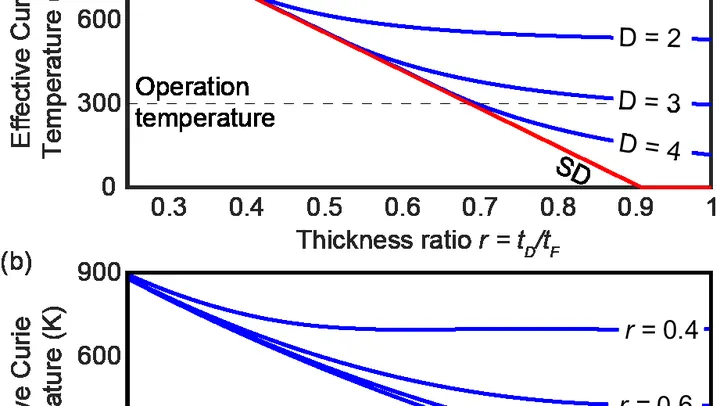
A well-coordinated orchestra of electrons in a superconductor is easily thrown off rhythm. Thermal jolts destroy the fragile order, and resistance returns. For decades, scientists have sought ways to strengthen this ensemble — mostly by changing the material's composition or compressing it to unimaginable pressures.
A thin film of yttrium barium copper oxide warms under a stream of infrared light, and suddenly stops dissipating energy. That's superconductivity: electrons pair up and move as a single quantum swarm. But in underdoped samples, the harmony breaks long before the pairs fall apart. The pairs are there, but the collective rhythm isn't.
Electrons in a conductor are like a chaotic crowd: colliding, they lose energy, and resistance arises. In a superconductor, however, they move in unison, like partners in a well-coordinated dance, without touching each other. This state has reduced энтропией — meaning disorder.
Such behavior is rare for gold and copper.
A rubber band that gets thicker the harder you pull it. In electricity, this behavior is called negative capacitance: the more charge accumulates on the plates, the lower the voltage. A regular capacitor works the opposite way — voltage rises with charge.
An ordinary diode in electronics works like a one-way street: current flows in only one direction. In superconductors, where electricity flows without resistance, such behavior has long been elusive — current is usually symmetric.
The authors of the new work found a way to create a perfect superconducting diode using light.
A superconductor carries current without resistance, like water running through a pipe without friction. The secret lies in electron pairs: two electrons stick together as one, even though they normally repel. In an ordinary superconductor, the spins of the electrons in a pair point in opposite directions: this is the singlet state.
The atom is like a conductor, and the light in the resonator is the orchestra. Their energy exchange, known as the Jaynes–Cummings interaction (part of the Standard Model), lets the atom use “baton” strokes to change the rhythm and timbre of the oscillations.
A tuning fork grows quieter not because someone stops holding it, but because the very hand that strikes it creates an invisible haze around it that damps the vibrations. A superconducting resonator behaves much the same way — a tiny track along which a microwave signal runs with almost no loss.
In familiar metals like copper, electrons move almost independently, like cars on an open highway. Resistance arises from rare collisions and can be described by simple formulas.
The rows of wires stretching from the warm room into the fridge holding the quantum chip look like a tangled telephone exchange from the last century. Each qubit needed its own analog channel for precise tuning, and the cables carried extra heat and got underfoot.
Now researchers have placed a digital-to-analog converter right in the cold zone, next to the qubits.
An ordinary flash drive in your pocket gets warm even when it's just sitting there. Now imagine memory that, in the cold, uses almost nothing, like a thermos that never cools down. A superconductor carries current without loss at liquid-helium temperatures, but it couldn't store data. The new cell changes that.
A fabric that stretches lengthwise but not crosswise. That's roughly how a semi-Dirac material works: electrons can move freely in one direction but barely budge in the other. Because of this unusual anisotropy, special tracks, one-dimensional channels, emerge at the edges of the two-dimensional crystal. Electrons race along them only along the perimeter, like water in a trough.
Imagine a line of dominoes: when the first one falls, it pushes its neighbor, and a wave rushes down the chain. The boundary between fallen and standing dominoes is a perfect image of a magnetic wall. In microscopic magnetic films, these walls separate zones with different magnetizations.
When you flip a switch, the light doesn't come on immediately — electrons in the wires need time to 'get going' and move together. In ordinary metals and semiconductors, current builds up gradually, like water in a hose when you first open the tap.
A quantum computer is like an orchestra where every musician must play their part perfectly, or the melody falls apart. Previously, controlling qubits — the quantum 'musicians'—required a room full of equipment, and every extra wire added noise.
In the world of superconductors, electrons don't like to be alone. They typically pair up into Cooper pairs and move without resistance, like figure skaters holding hands. But you can make them dance in fours. The authors of this work propose a scheme where Cooper quartets, groups of four electrons exchanging partners in a rapid rhythm, are born.
A copper wire hit by a laser is like a kitchen where the chef turns on the stove and watches the stopwatch at the same time. Copper atoms start to dance, losing the order of the crystal lattice, while electrons, like waiters in the dining room, instantly feel the change. But how much disorder do they need to notice?
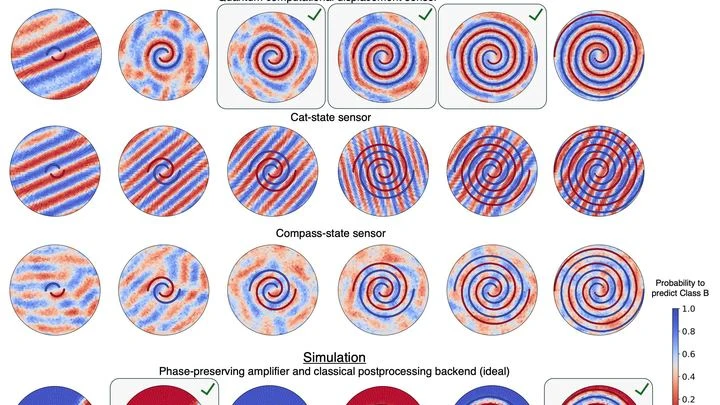
A judge walks into the courtroom but doesn't look at the evidence: he immediately delivers the verdict. That's how the new quantum sensor works: it doesn't measure the signal but directly decides which class it belongs to.
In conventional quantum sensing, it's all like a detective story: first you gather clues (measure the signal), then you analyze them.
A superconductor is a material through which current flows without loss, like water through a perfectly smooth pipe. But to make the pipe perfect, you have to cool it to very low temperatures. Physicists have long been looking for ways to make such a pipe at warmer temperatures, and one clue is the quantum critical point.
In a quantum computer, a qubit is like a tightrope walker: any puff of wind and balance is lost. Errors accumulate, and the computation falls apart. Usually, they are corrected by comparing neighboring qubits, but that's like asking the tightrope walker to glance at his neighbors — extra movements and risk.
A thin wire of the new material conducts electricity without loss when cooled to three degrees above absolute zero. It's like water flowing through a pipe without any friction against the walls. The material is called PtPb3Bi, and its hallmark is an internal structure resembling a bundle of threads: electrons run freely along a thread but struggle to jump between threads.
A piece of metal heated at one end produces a weak electric current: this has been known for nearly two hundred years. But what if, instead of a simple metal, you take a layered "sandwich": a superconductor, a thin insulator, and a flat layer of electrons?
Niobium is a metal that, when cooled to a few degrees above absolute zero, conducts electricity without resistance. In labs, it is deposited as thin strips onto a substrate, like frosting on a cake. But during deposition, oxygen from the special mask seeps into the metal, and it spoils the superconducting properties.