A siliconchip is a small piece of semiconductor material, typically silicon, on which integrated circuits are fabricated. It is the fundamental building block of modern electronics, enabling computation, communication, and sensing in devices ranging from smartphones to satellites. Beyond conventional electronics, silicon chips are now being adapted for quantum computing and photonics, where they host qubits or manipulate light for advanced applications.
History
The first silicon integrated circuit was demonstrated in 1961 by Robert Noyce, building on Jack Kilby's earlier germanium-based invention. Silicon's abundance, stable oxide, and semiconductor properties made it the dominant material for microelectronics.
How it works
Silicon's semiconducting properties — its ability to conduct electricity under certain conditions and insulate under others — allow engineers to create transistors, the tiny switches that process information. By doping silicon with impurities and patterning it with photolithography, billions of transistors are etched onto a single chip. In quantum versions, silicon hosts spin qubits or superconducting circuits, while photonic chips use silicon's transparency to guide and manipulate light.
In practice
Siliconchips are used in virtually all electronic devices, from computers and smartphones to medical sensors and automotive control systems, and are now enabling quantum processors and on-chip spectrometers.
Fun fact
A single modern siliconchip can contain over 50 billion transistors, more than the number of stars in the Milky Way.
In a quiet room with no magnets anywhere, two electrons in a silicon trap still feel a faint trembling. It comes from the nuclei of silicon and germanium atoms, which spin randomly like the needles of broken compasses. This trembling was once considered noise, but now it has become a measuring instrument itself.
The orchestra plays, but the conductor hears only a general hum. Each instrument plays its own part, but you can't tell where the flute is and where the double bass is. You need a spectrum analyzer — a device that breaks down sound by frequency.
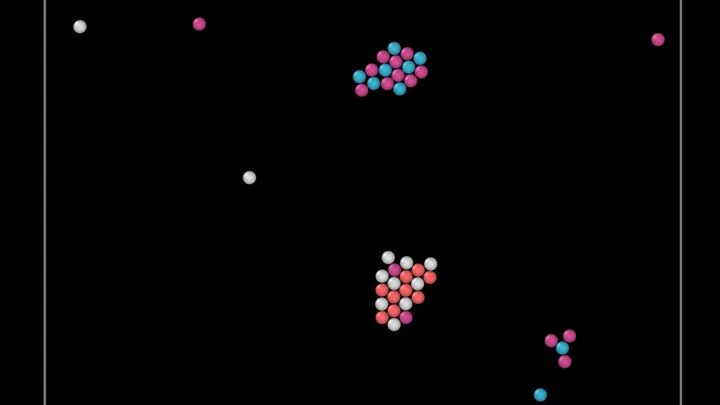
A drop of water on glass trembles and shimmers: it seems to have a life of its own. Similar behavior can now be observed in the world of colloids: tiny particles suspended in a liquid. Researchers simulated particles that emit chemical signals. These signals, like scents in the air, spread around and cause neighbors to either draw closer or move apart.
Dozens of copper coils in an MRI scanner pick up the faint response from tissues, like microphones trying to catch a whisper in a noisy hall. Each microphone drags a thick bundle of wires behind it. The wires press on each other, create electrical interference, heat up, and add risk for the patient.
Two mailboxes at opposite ends of a city. Drop a letter in one, and an identical one instantly appears in the other. That's roughly how quantum entanglement works: two particles behave as a single unit, even when separated by a great distance. But until recently, this connection could only be maintained within a single room or across a lab bench.
The rows of wires stretching from the warm room into the fridge holding the quantum chip look like a tangled telephone exchange from the last century. Each qubit needed its own analog channel for precise tuning, and the cables carried extra heat and got underfoot.
Now researchers have placed a digital-to-analog converter right in the cold zone, next to the qubits.
A quantum computer is like an orchestra where every musician must play their part perfectly, or the melody falls apart. Previously, controlling qubits — the quantum 'musicians'—required a room full of equipment, and every extra wire added noise.
Light that has traveled to us for nearly 14 billion years is like an old photograph whose details emerge with careful processing. The cosmic microwave background (the afterglow of the Big Bang) holds the imprint of the universe's first moments, but its signal is faint and distorted.
A power transistor made of silicon carbide operates under voltages thousands of times higher than what comes out of a wall outlet. If the field inside it becomes uneven, the device burns out. Previously, this field was invisible: it is too strong for ordinary sensors, and the device must remain under voltage.
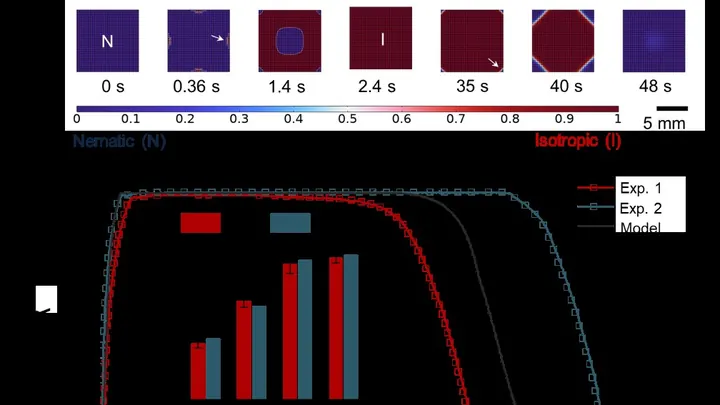
Radio waves surround us, but our eyes can't see them. This new sensor, the size of a fingernail, turns them into a colored patch on a tiny screen.
Inside the chip is a layer of liquid crystals — the same kind used in phone displays. Among them are embedded thin ferromagnetic nanowires. When a radio wave arrives, the nanowires heat up quickly.
Ordinary soldering doesn't work for quantum circuits: when cooled to liquid helium temperatures, metal cracks, and the contacts themselves introduce noise. Engineers from the research group tried something different — a drop of gallium alloy that stays liquid at room temperature, like mercury in an old thermometer.
A fridge magnet attracts a paperclip: we can feel that field with our hands. Now shrink that field by a billion times. Atoms inside our bodies emit such weak signals, and they are very hard to catch.
Scientists built the sensor from special molecules that themselves behave like tiny magnets.
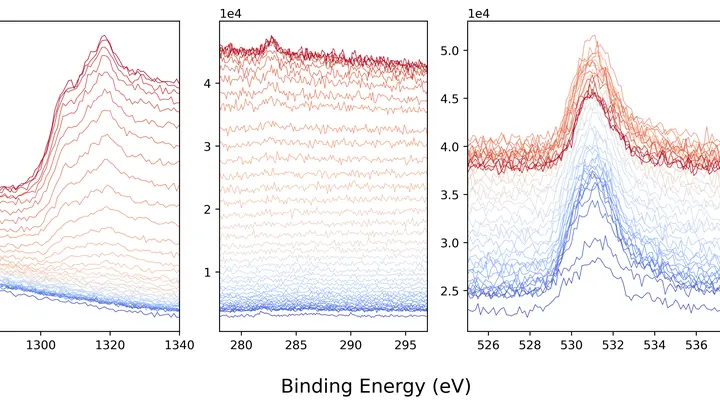
Two-dimensional bismuth on a silicon substrate is a promising material for future electronics. Its edges conduct current without loss, like a highway with no traffic lights. But bismuth itself is delicate: air and moisture quickly degrade its properties.
Light passing through a thin crystal can change color and the direction of its oscillations. In a molybdenum disulfide flake just hundreds of atoms thick, an infrared beam turns green, and its polarization, the way the light wave oscillates, obeys the crystal's geometry.
Silicon is like a universal building block: it goes into the chips in your phone, solar panels, and lasers. But if you squeeze it with immense force, the atoms rearrange into new patterns: these forms are called allotropes. One of them, Si-XIII, was first spotted more than twenty years ago, but its exact pattern remained a mystery.
Quantum technologies often use light, but not just as a light bulb — rather as a carrier of information. One approach is to encode data in frequency: each 'color' of a photon can be a separate memory cell. The problem is that working with such color states requires a whole lab: a photon source, filters, modulators, detectors.
Light passing through a lens bends slightly. For an optical computer, this is like a warped mirror for an artist: the image is there, but the details blur. An Ising machine using light beams tackles problems like packing luggage or planning a courier's route.
An ordinary solar cell does one thing: when the sun shines, current flows. Here, when the sun shines, the current flows differently depending on which side you bring the magnet.
In a silicon carbide crystal, which looks like a transparent stone, there are hidden defects — places where atoms are out of line. One such defect acts as a quantum node: an electron inside it spins and processes information, while the nucleus of a neighboring atom quietly stores it.
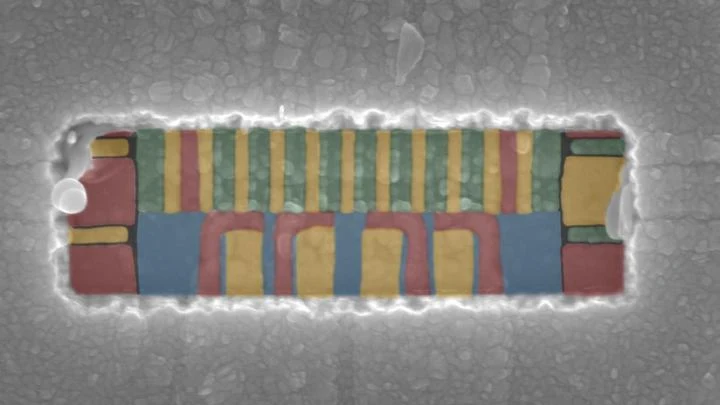
On a silicon chip that resembles a neighborhood, qubits, electrons with spin, live in separate 'houses.' Previously, neighbors could only chat over the fence, but now a road has been laid between them: along it, a qubit can ride to any of the four stops. The road is a bus that carries the electron without losing its quantum state.
A quantum computer is like an orchestra where electrons and nuclei play different instruments. Usually, the conductor needs two batons: microwaves for electrons and radio waves for nuclei.
A quantum computer is like an orchestra that has to tune its instruments before every piece. Tuning takes time and requires quiet — in our case, deep cold. For silicon chips with boron atoms, this tuning is usually done with microwaves, slowly and only at temperatures below 2 kelvin (minus 271 degrees Celsius).
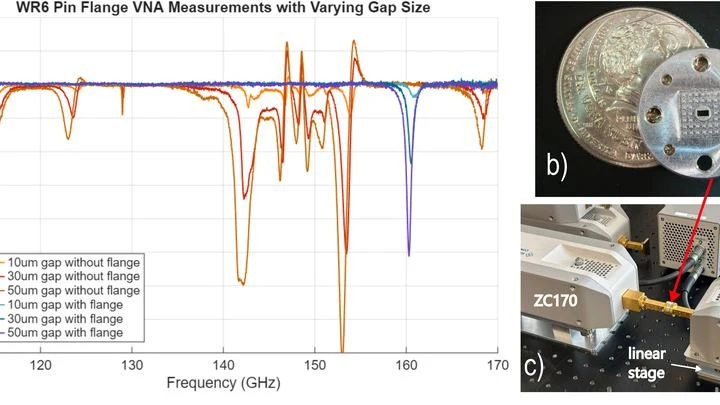
In Chile's Atacama Desert, at an altitude of nearly five kilometers, stands a radio telescope that catches millimeter waves from the depths of space. These waves carry the heat of distant galaxies, but first they must pass through a window — a thin plate of silicon that separates the cold receiver from the warm outside world.
A silicon wafer is like cookie dough. Heat it in an oven, and tiny raisins appear inside — defects in the crystal lattice that can emit single photons. These "raisins" are called color centers, and they are needed for quantum computers and secure communication.
A light pulse in an optical fiber is like a starter's pistol shot: short, sharp, and unmistakable against the silence. It is exactly such pulses that the new artificial neuron, built on a silicon chip, produces.
Accurate measurements of gravity are needed by geologists and navigators alike. But conventional gravimeters are bulky instruments that take a long time to 'settle' after each measurement. What if you need to track rapid changes in gravity — say, while moving underground or in flight? That calls for a device that is small and responsive.
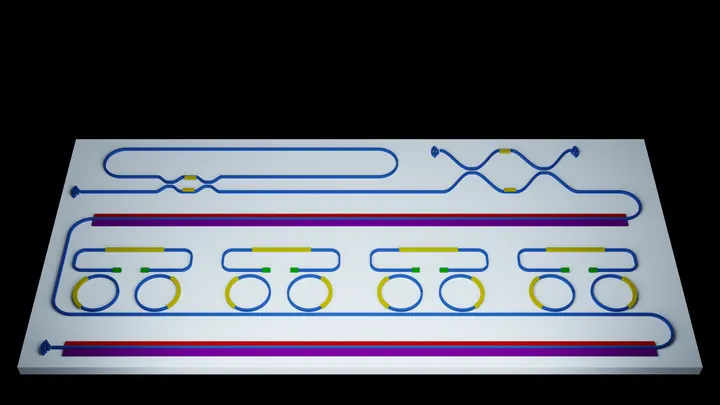
In the world of microchips, where streams of photons, quanta of light, carry information, a fundamental problem arises: light passing through matter inevitably heats it. This heating spawns thermal fluctuations — chaotic, unpredictable jostling of atoms that disrupts precise device operation.
A tiny diamond with defects, nitrogen atoms that replaced carbon, hides an unusual feature. Around each defect, an extra electron spins like a top that can be tilted by radio pulses. On its own, this top is too quiet to reach a superconducting qubit — an artificial atom operating at temperatures colder than outer space.