The Machine That Doesn't Get in Its Own Way express
An orchestra where each musician plays their own part but hears only the neighbor. One wrong note, and a wave of errors rolls through the hall. That's how Ising machines work — special devices for solving problems where you need to find the best option among many. Their elements, or "spins," are connected, and if you update them all at once, they start interfering with each other like musicians coming in at the wrong time.
Usually, spins are updated one by one, but that's slow. The authors came up with adding a bit of inertia to each spin, like a flywheel that prevents sudden jerks. With inertia, spins stop reacting to every rustle from their neighbors and can all update at once without ruining the overall result. They tested it on material cutting problems (Max-Cut), a spin glass model (Sherrington-Kirkpatrick), and signal detection in wireless communications.
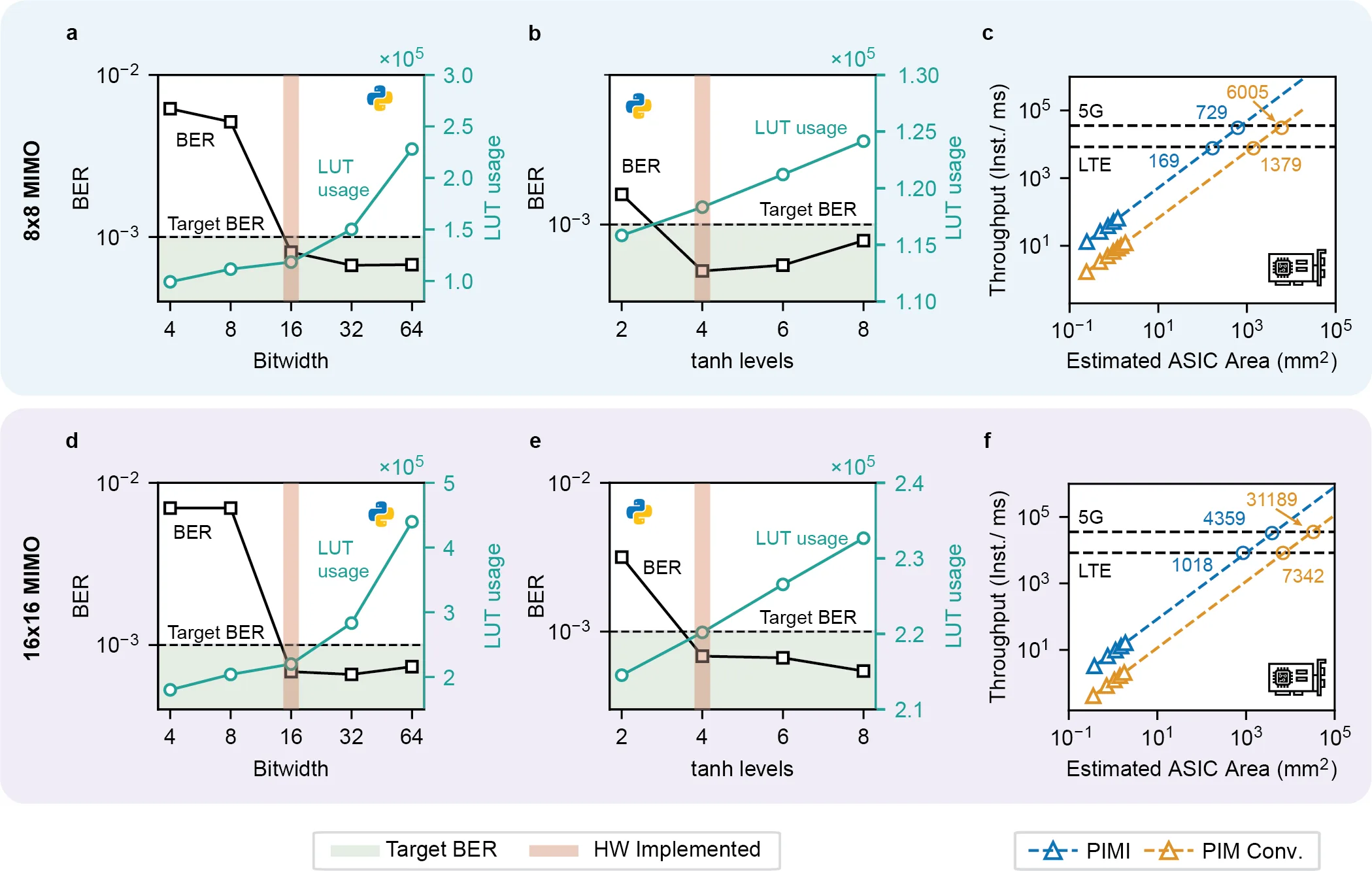
The practical payoff shows in 5G: real-time signal detection demands fast decisions. The Ising machine with inertia met strict quality and speed requirements while taking up a reasonable area on the chip. An orchestra where everyone plays together in harmony: that's what they achieved.
Original abstract
as written by the authors arXiv:2604.17109
Ising machines -- special-purpose hardware for heuristically solving Ising optimization problems -- based on probabilistic bits (p-bits) have been established as a promising alternative to heuristic optimization algorithms run on conventional computers. However, it has -- until now -- been thought that Ising spins that are connected in probabilistic Ising machines cannot be updated in parallel without ruining the machine's solving ability. This has been a major challenge for using probabilistic Ising machines as fast solvers for densely connected problems. Here, we circumvent this by introducing a modified Ising spin dynamics with an added inertia term, and verify in algorithm simulations, FPGA hardware emulation, and FPGA experiments that it enables fully parallel, synchronous updates while improving rather than degrading success probability. We evaluated on various types of abstract (Max-Cut and Sherrington-Kirkpatrick-model) and application-derived (MIMO, wireless detection) dense Ising benchmark instances. Performing fully parallel updates results in a speed advantage that grows faster than linearly with the number of spins, giving rise to large time-to-solution increases for practical problem sizes. For both Max-Cut and the SK-1 model at a problem size of 200, our approach achieved an average speedup of $$\approx 35\times$$, with the best single-instance speedup reaching $$150\times$$. As an example of the practical utility of our approach in an application where speed is critical, we further show by co-designing the algorithm dynamics with the hardware implementation -- co-optimizing for solver ability and silicon resource usage -- that probabilistic Ising machines based on our approach satisfy the stringent solution quality and latency/throughput requirements for real-time MIMO detection in modern 5G cellular wireless networks while using a practically reasonable silicon area.
The Sherrington-Kirkpatrick model, on which the machine was tested, describes a spin glass — a material where magnetic moments are frozen in random directions, like people stuck in a crowd, pushing each other in different directions.