cs.ET cs.ET

14 articles

articles

An Orchestra of Every Note: How Classical Machines Play Quantum Music
In 2023, a group of researchers at Oak Ridge National Laboratory ran a simulation of a 61-qubit quantum circuit on the Theta supercomputer. Storing its state vector would have required 32 exabytes of memory, more than the total capacity of all hard drives on the planet. But thanks to data compression, they fit it into 768 terabytes.
Quantum Conductor: Entangled Photons Take the Concert Stage
In September 2024, the concert hall in Linz had more than just an orchestra on stage. Next to the musicians, a setup was generating pairs of entangled photons: a laser with a wavelength of 405 nm passed through a nonlinear crystal and split into two photons at 810 nm, which flew off to two measurement stations, Alice and Bob.
A Quantum Orchestra Where Noise Accompanies the Melody
An orchestra tunes up before a concert. Each musician locks into the common rhythm, and order emerges in the hall. A quantum reservoir computer works in a similar way: qubits, like musicians, interact with each other, turning a chaotic signal into a predictable melody. Reservoir computing has been around for a while.
Quantum Physics2026-01-131 minarXiv:2601.08213express
How a Computer Reads Qubits in an Instant
A quantum bit, or qubit, is like a coin spinning on a table, able to be both heads and tails at once. For the computer to know what came up, you have to stop the coin and look. Previously, this stopping was done with a delay: data was read out, taken to a regular computer for processing, and only then was the result known.
Mesoscale2026-01-192 minarXiv:2601.13229express
Magnetic Disks Instead of Microchips
On a table lies a handful of round magnets. As long as no one touches them, they lie in disarray. But send a short current pulse through them, and each disk flips: the north pole swaps with the south. Neighboring disks push each other with their fields, like people in a crowded queue, and the whole handful arranges into a pattern that depends on which way the magnetic wind blew and how warm it is around.
cs.ET2026-01-262 minarXiv:2601.18435express
How a Single Atom Decides Whether You See or Not
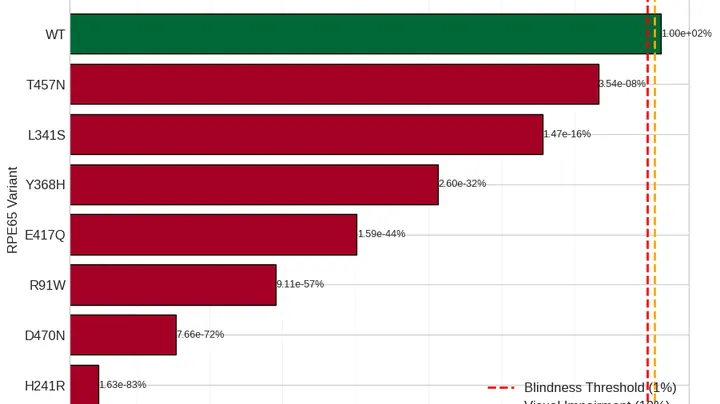
Deep in the eye, in a thin layer of cells, a tiny molecular machine works. It captures light and turns it into a signal that the brain interprets as an image. But sometimes a typo occurs in the blueprints of this machine — a single letter of the genetic code changes, and a person is born blind.
Dreams as the Brain's Nightly Cleanup
At night, the brain doesn't switch off. Instead, it sorts through the day's events like a librarian arranging books on shelves. But where do those strange, sometimes nonsensical dream images come from? Many have assumed they're just random noise with no meaning. A new computer model shows that randomness doesn't hinder: it helps.
cs.ET2026-02-072 minarXiv:2602.15048express
A Lattice That Senses Cracks Before They Appear
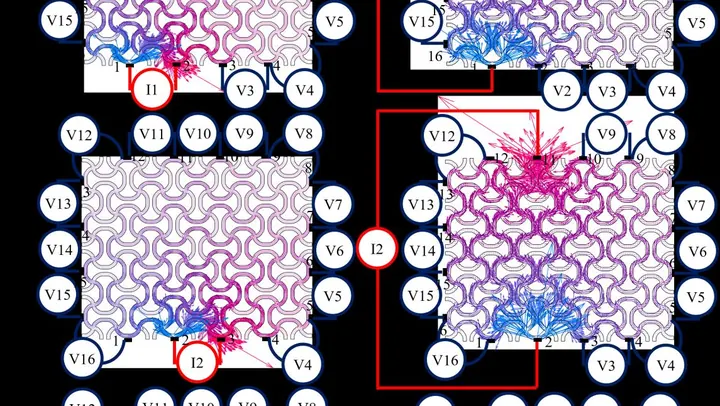
Ordinary materials break in silence. First, invisible struts inside them snap, and only then does a crack appear that you can see with your eyes. Engineers at Carnegie Mellon University have taught a material to 'talk' about such hidden damage. They 3D-printed a lattice resembling honeycomb but with a more intricate pattern.
q-bio.MN2026-04-051 minarXiv:2604.04285express
Amplify Without Spending a Drop of Fuel
A molecular amplifier is like a door latch: a weak signal opens the way for a strong one. In living cells, such amplifiers work constantly, but they almost always burn fuel. Can you amplify a signal without expending energy?
cs.ET2026-04-181 minarXiv:2604.17109express
The Machine That Doesn't Get in Its Own Way
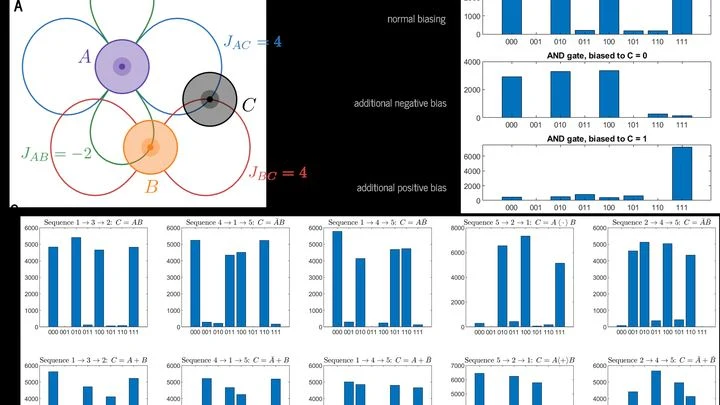
An orchestra where each musician plays their own part but hears only the neighbor. One wrong note, and a wave of errors rolls through the hall. That's how Ising machines work — special devices for solving problems where you need to find the best option among many.
cs.ET2026-04-272 minarXiv:2604.24561express
Tuning a Neural Network by Radio
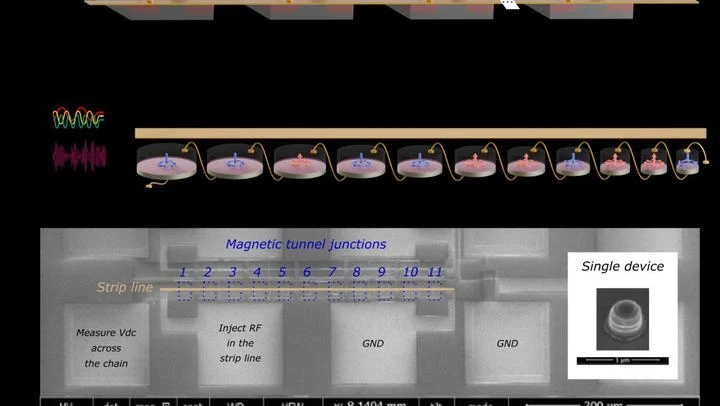
A radio receiver picks up only one station because its resonant circuit is tuned to that station's frequency. Magnetic vortices in a new type of computing element work in much the same way.
cs.ET2026-07-141 minarXiv:2607.12862express
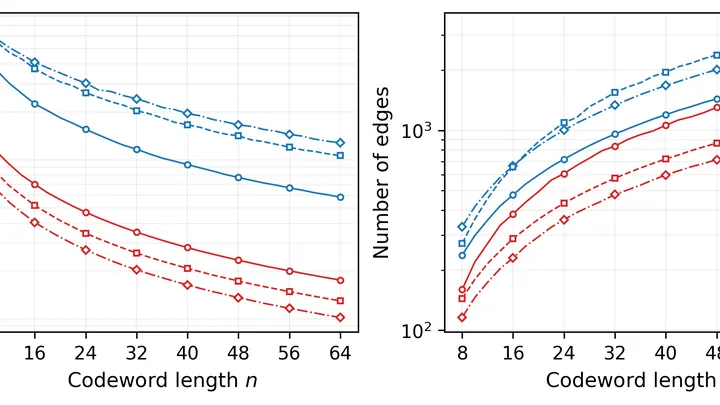
Choosing a Recipe for a Neurochip: How to Best Fix Interference
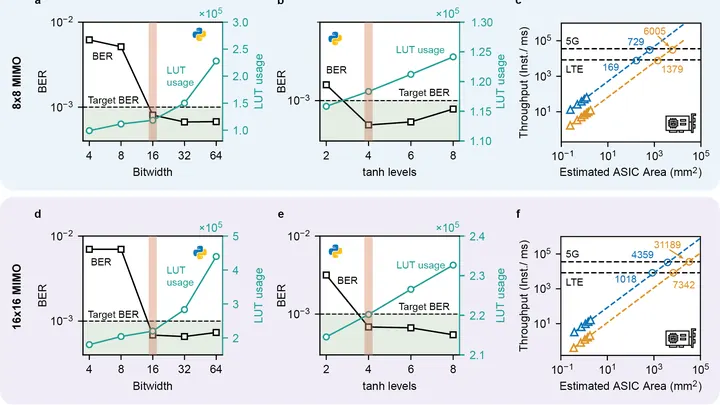
Neurochips work differently from conventional computers, which are built according to the blueprints of von Neumann with separate memory and processor. At the core of these chips is a network of simple cells, similar to neurons, and, like water that evenly fills containers of any shape, they easily find a solution without unnecessary steps.
cs.LO2026-07-151 minarXiv:2607.13531express
Chemical Soup Computes Numbers: How Reactions Became a Computer
In boiling soup, molecules collide chaotically and react. But if you measure how their concentrations change, patterns emerge. This is how carbon chemical networks work — mixtures of molecules that spontaneously 'cook' information, turning each reaction into an elementary computation. Previously they were used only for modeling nature.
cs.ET2026-07-151 minarXiv:2607.13644express