Quantum computing resource optimization is the field of making quantum algorithms and hardware more efficient, reducing the number of qubits, gates, or physical resources needed to solve a problem. Quantum computers are extremely scarce resources: current devices have only a few hundred noisy qubits, and every additional qubit or operation increases the chance of errors. Optimization techniques aim to squeeze the most computational power out of limited hardware, whether by designing more compact algorithms, reducing the depth of quantum circuits, or finding ways to simulate large systems with fewer qubits. This is crucial for achieving practical quantum advantage in chemistry, materials science, and optimization problems.
History
The field grew alongside the development of quantum algorithms in the 1990s, but resource optimization became a distinct discipline in the 2010s as hardware matured and researchers realized that near-term devices could not run full-scale algorithms without significant optimization. The concept of 'quantum advantage' with limited resources was popularized by the Google quantum supremacy experiment in 2019, which highlighted the importance of efficient resource use.
How it works
One approach is algorithm-level optimization: rewriting quantum circuits to use fewer gates or qubits, for example by exploiting symmetries in the problem or using variational methods that adaptively reduce circuit depth. Another is hardware-level optimization: improving qubit connectivity, error rates, or readout speeds to reduce the overhead of error correction. Hybrid classical-quantum algorithms, such as the variational quantum eigensolver, offload part of the computation to classical computers, minimizing the quantum resources required. Recent work also focuses on energy efficiency, since quantum computers consume significant power for cooling and control electronics.
In practice
Resource optimization is used in quantum chemistry simulations, where it enables the study of molecules that would otherwise require thousands of qubits, and in the design of quantum error correction codes that minimize the physical qubit overhead. It also guides the development of quantum hardware roadmaps, helping companies decide which qubit technologies to pursue.
Fun fact
A single quantum chemistry simulation that would take a classical supercomputer ten years can be compressed into a day on a quantum computer, but only if the algorithm is optimized to fit within the limited coherence time of the qubits.
A washing machine sometimes tears clothes. To get a whole shirt, you wash several and then piece one together from the survivors. A quantum computer treats 'magic states'—special ingredients without which complex computations are impossible — in much the same way.
These states are extremely fragile. The slightest noise, and the magic evaporates.
A conventional computer computes by shuttling electric charges along wires. But can you compute with heat? A network of pipes carrying hot and cold water can perform simple logic operations if the pipes are connected in the right order.
A quantum annealer is like a smart oven: it searches for the lowest point in an energy landscape to find the answer. But many constrained problems, like "pick exactly three items"—can't be loaded directly into such an oven. They have to be translated into unconstrained quadratic formulas, usually by adding penalties.
In a three-dimensional scene, each point is like a candy whose color changes depending on the viewing angle. To describe this play of shades, dozens of numbers are stored for each point — a special mathematical function invented by Joseph Fourier. Memory fills up instantly.
Wireless communication for robots is like a conversation in a noisy workshop, where every word can get lost in the din or arrive too late. In this mess, entropy of the channel, robots fail to yield in time, and coordination breaks down.
Neurochips work differently from conventional computers, which are built according to the blueprints of von Neumann with separate memory and processor. At the core of these chips is a network of simple cells, similar to neurons, and, like water that evenly fills containers of any shape, they easily find a solution without unnecessary steps.
Searching for the global minimum in the Sherrington–Kirkpatrick spin glass model resembles climbing a glacier, where every crevasse is a treacherous local optimum, and the true bottom lies buried beneath a chaos of ice blocks. A classical climber, trudging along the gradient, would almost certainly freeze in the nearest crevice.
Recommendation systems that decide which post you’ll see next run on deep neural networks made up of thousands of operations — intricate computation Graphs (blueprints of operations on data). These systems are living, ever-evolving Dynamical Systems: the slightest architecture change cascades through the entire graph.
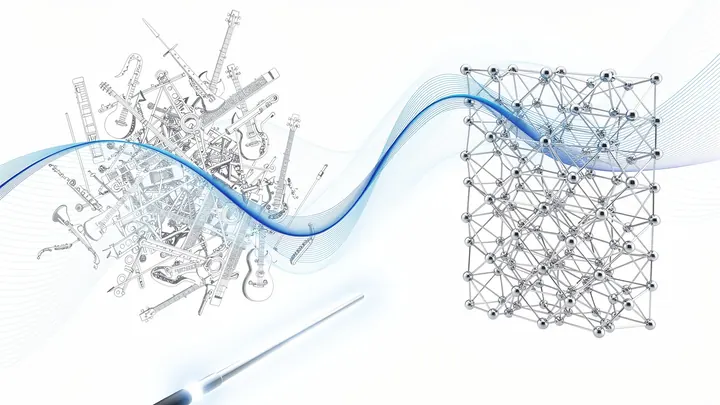
A metallurgical workshop piled high with aluminum scrap looks like an orchestra out of tune before a concert: each instrument is off-key in its own way. Offcuts of airplane wings, crushed cans, shavings from milling machines: each 'instrument' has its own metallicity, nonlinearly influencing the final 'melody' of strength and thermal conductivity.
Gold doesn't lie on the surface: it's hidden in tons of barren rock. To extract a gram of precious metal, prospectors sift through cubic meters of dirt.
Picking out a single faulty microchip from a million, without any clue what the fault looks like, is a classic needle-in-a-haystack problem. A classical computer would test each chip one by one.
Neutrinos are nearly elusive particles that permeate everything around us. In a dense cloud, such as during a star explosion, they begin to collectively change their type, or 'flavor.' This process is like a crowd of people synchronously changing the color of their clothes, but not all at once — rather in waves.
An X-ray tomograph is like a carpenter who examines a log from all sides to see where the void is inside. It takes dozens of flat shadow images, rotating the source and detector around the object. Then a 'reconstruction' program glues these shadows into a 3D model. The quickest reconstructor is the FBP algorithm (filtered back projection).
The orchestra is playing, but the musicians can't hear each other: each follows their own tempo, while the conductor tries to weave the disparate sounds into a single melody.
Before assembling a huge puzzle, you need to stamp out the pieces — otherwise the picture won't come together. In fusion-based quantum computers, the role of such pieces is played by tiny clumps of light — photonic resource states. They are collided and measured to gradually grow the computational fabric.
Inside every cell, life is bustling: tiny protein machines tirelessly haul cargo, read genes, and fix errors. But their work is far from perfect: they often 'spin their wheels,' take backward steps, or get stuck in futile cycles. It's like a city traffic jam where cars dart around aimlessly, burning fuel.
An orchestra where each musician plays their own part but hears only the neighbor. One wrong note, and a wave of errors rolls through the hall. That's how Ising machines work — special devices for solving problems where you need to find the best option among many.
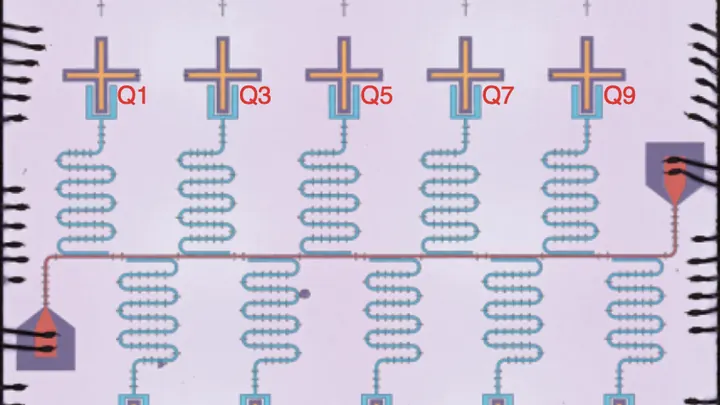
Qubits in a superconducting quantum computer are like tightly stretched strings. When a particle from space or from a radioactive decay flies by, it strikes these strings and they start to vibrate. This vibration disrupts the fragile quantum states, and computations go awry.
An ordinary camera captures light reflected from objects and builds a picture from it. But if the object is hidden behind an obstacle or does not reflect light, radio waves come to the rescue: they pass through walls and fog, and a computer reconstructs the image from scattered signals.
A spoon drops into a cup of hot coffee, and ripples spread across the surface. They show how quickly the disturbance moves away from the point of impact. In the quantum world, physicists look for similar 'ripples on water'—how information spreads along a chain of atoms.
Bitcoin mining is like a lottery: miners sift through billions of numbers to find one lucky winner. A regular computer does this blindly, burning electricity. A quantum computer could sort through possibilities faster, like finding a needle in a haystack by shaking the whole stack at once.
The authors of a new study calculated what such a quantum "shaker" would actually cost.
Physical systems can compute. If you build a landscape of hills and valleys so that the lowest point corresponds to the answer, the system will roll there by itself, like a ball. The problem is that the bottom is often flat, and the ball crawls around for a long time before settling.
The authors propose nudging the ball to the right place before it even starts.
In quantum batteries, charging can be accelerated by shuffling the steps in time, like a deck of cards. Instead of a smooth energy climb, you get abrupt efficiency explosions, like microscopic supernovae inside atoms.
A standard MRI machine is a huge magnet that you can't move, plus a powerful computer that turns signals from the body into a picture. In recent years, portable scanners with weaker fields have appeared: they are light, cheap, and can work in a field hospital or an ambulance.
A water molecule resembles a tiny dumbbell: two hydrogen atoms attach to an oxygen atom at an angle. This dumbbell doesn't stay still: it stretches, compresses, and rotates. Each such motion has its own energy, like steps on a ladder.
A tiny particle floats in a laser beam like a speck of dust in a flashlight's glow. Water molecules constantly jostle it — randomly, from all sides. Usually these bumps are a nuisance: the particle twitches, and precise measurements turn into a lottery. But physicists have figured out how to turn the interference into an advantage.
A quantum processor is like an orchestra where each musician (qubit) must play their part precisely in time. But in reality, the instruments go out of tune: qubits lose energy, and their interactions get distorted. To tune this orchestra, you first need to record how it sounds right now: that is, measure the noise parameters and couplings.
Quantum computers promise to describe molecules with perfect accuracy, but their main nemesis is noise. Every extra qubit and every extra operation add errors. Chemists and physicists have now devised a way to compute molecules with half the qubits: the HSQD method.
A chemist searching for a new drug is like a cook without a recipe: they have a list of desired properties but millions of possible ingredients. Each trial is costly and time-consuming, so you need to experiment wisely.
The new program SEISMO acts like a chef who tastes the dish after every step and immediately decides what to add next.
Quantum communication via satellite is like a roll call between two distant lighthouses: the beam must hit the detector exactly, or the message can't be read. But in space, everything shakes — sunlight heats the hull, thrusters cause vibrations, and delicate optics drift off-axis.
Inside a tokamak, a giant magnetic donut, plasma is heated to hundreds of millions of degrees. It doesn't touch the walls; it floats in a vacuum, held by invisible magnetic fields. But plasma is finicky: a slight change in current or pressure and its shape starts to wobble like jelly on a plate.
When making popcorn, a microwave uses electricity only to heat the kernels. A gas stove heats the entire burner and the air around it. The same difference applies between a photonic quantum chip and a classical supercomputer when solving a problem devised by Scott Aaronson.
An ordinary neural network for quantum chemistry is like a student who learns from mistakes but keeps tripping over the same spot. It crawls toward the right answer, is sensitive to settings, and often loses stability. For the fluorine molecule, the new method sped up calculations by 17,900 times compared to the popular Adam method.
A quantum system, like a person in a noisy room, gradually loses the thread of conversation: its state dissipates into the surroundings. But sometimes, as if suddenly recalling an important thought, it can recover part of the lost information. Physicists call this phenomenon non-Markovian dynamics: the environment's memory of the system's past allows information to flow back.
An electrocardiogram is like a musical score, where each note is a heartbeat. A doctor hears the melody and spots the off-notes — arrhythmia. But listening to the score for hours is tiring, so a smart monitor is placed by the patient's bedside.
Electrons — tiny particles in molecules — constantly maneuver, avoiding collisions like passengers during rush hour. To calculate their behavior, scientists set a personal distance rule: a mathematical function that indicates how close one electron can get to its neighbor.
Drug design is like picking a lock: the drug molecule must fit precisely into the target protein. But the lock is submerged in water, and the fluid’s friction alters the fit. Classical calculations account for this by modeling the key dissolving into the solvent for hours per attempt.
When a computer can't handle multiplying two giant tables of numbers, they're sliced into tiny pieces and sent out to dozens of helper servers. For secret data, mathematical tricks are used so the helpers never see the original numbers. Usually, the higher the secrecy, the more servers you need.
The authors proposed using a special quantum property — entanglement between the servers.
Turning CO₂ into fuel is like finding the one perfect way to pack billions of items into a suitcase. A classical computer tries options one after another, taking decades, while a quantum computer sees all combinations at once.
An orchestra tunes up before a concert. Each musician locks into the common rhythm, and order emerges in the hall. A quantum reservoir computer works in a similar way: qubits, like musicians, interact with each other, turning a chaotic signal into a predictable melody.
Reservoir computing has been around for a while.