Neural Computing cs.NE

10 articles

Neural networks, connectionism, genetic algorithms, artificial life, adaptive behavior.

articles

The World as a Graph: Neural Network Learns to Predict El Niño
The ocean resembles a giant web, where each thread connects distant points of water. When one spot warms, winds and currents change thousands of kilometers away. The neural network in this study wove such a web for the first time on its own to predict El Niño.
Why Neurons Can't Be Friends with Everyone
A neuron in the brain is like a person handing out business cards at a crowded conference. At first, making acquaintances is easy, but as the address book fills up, each new contact requires more effort: there's little room left. The authors based their model on this 'crowding' rule: the more incoming connections a neuron already has, the harder it is to form another one.
q-bio.PE2026-04-121 minarXiv:2604.10571express
Evolution by the Same Rules
Engineers improving neural networks act like breeders: they try a variant, check the result, and keep the best. They collected 935 such trials from 161 papers and measured how often a code tweak turns out beneficial, harmful, or neutral. The picture is familiar to any biologist: 68% of changes degrade performance, 19% do nothing, and only 13% yield a gain.
cs.ET2026-04-181 minarXiv:2604.17109express
The Machine That Doesn't Get in Its Own Way
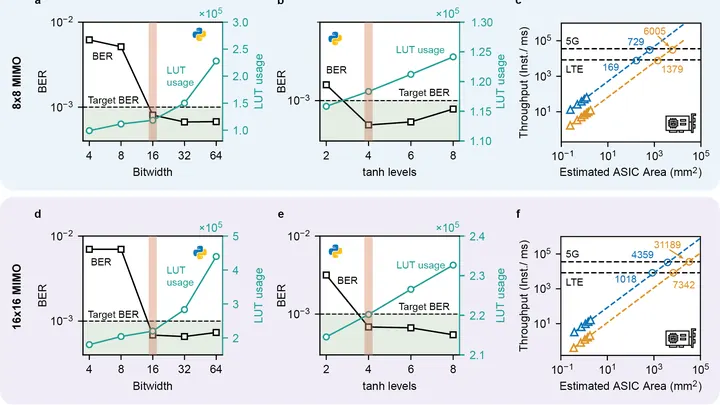
An orchestra where each musician plays their own part but hears only the neighbor. One wrong note, and a wave of errors rolls through the hall. That's how Ising machines work — special devices for solving problems where you need to find the best option among many.
Neurons as Conductors: Why the Brain Can't Learn Without Them
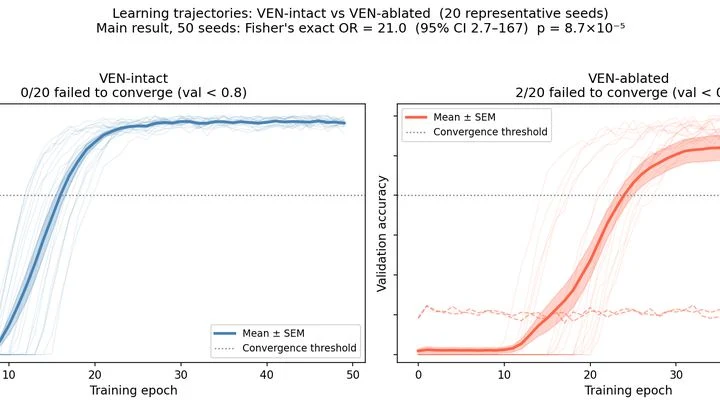
An orchestra at its first rehearsal without a conductor. Violins come in at the wrong time, brass is late, and instead of a symphony, you get cacophony. That's roughly how a computer model of the brain behaves when you remove special cells — von Economo neurons.
Cartographers of Evolution: How Algorithms Learn to Explore, Not Just Optimize
A robot in a maze walks into a dead end. A minute later, it’s the first to find the exit. This illogical maneuver is exploration, not a mistake. Like a cartographer circling a mountain to see its slopes. Evolutionary algorithms in silico have long mimicked selection and mutation to search for the best solutions.
cs.ET2026-07-151 minarXiv:2607.13644express
Division That Doesn't Fragment Memory
Holding in mind the exact position of a pen as it's slowly moved is a routine task for the brain. For artificial neural networks, it's nearly impossible. Standard recurrent networks like GRU and LSTM tend to break continuous motion into rigid steps: the pen doesn't glide smoothly but jumps from point to point.
Atomic Physics2026-08-181 minarXiv:2608.17807express
Memory from a Cesium Vapor
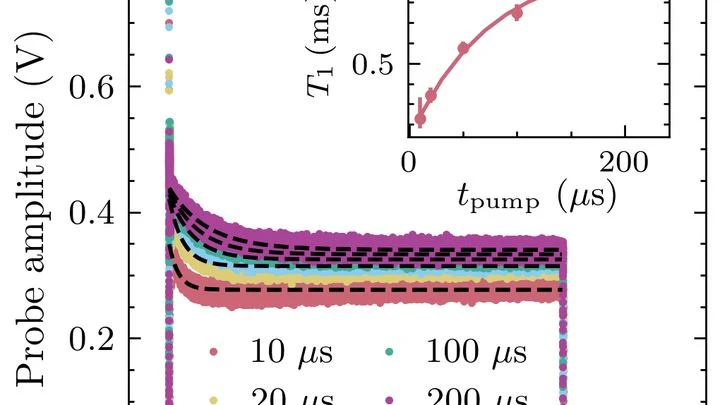
A beam of light enters a glass cell filled with cesium vapor and changes the internal state of the atoms: this is how information is recorded. A moment later, another beam reads it out by how the atoms absorb light. It's not a hard drive, but rather a notebook that turns its own pages. Eight such "pages" are created by an acousto-optic deflector — a device that bends light with sound.
Neural Computing2026-08-191 minarXiv:2608.18569express
Brain vs. the Mirror Maze
Getting lost in a hall of mirrors is easy: every wall reflects another, and you feel like you've been here before. The brain gets similarly confused when surrounded by many similar places. Neurons responsible for the spatial map can fire the same signal for two different corners of a room. This is called spatial ambiguity.