Real-time processing refers to computing systems that deliver output within a strict time constraint—typically milliseconds or less—so that the result is available immediately for decision-making or control. In physics and engineering, real-time systems are essential for feedback loops, live data analysis, and interactive simulations. The defining feature is not speed per se but determinism: the system must guarantee a response within a deadline, regardless of load.
History
Real-time computing emerged in the 1960s with military and aerospace applications, such as missile guidance and Apollo navigation. The term became formalized in computer science literature in the 1970s, with foundational work by Liu and Layland on scheduling algorithms.
How it works
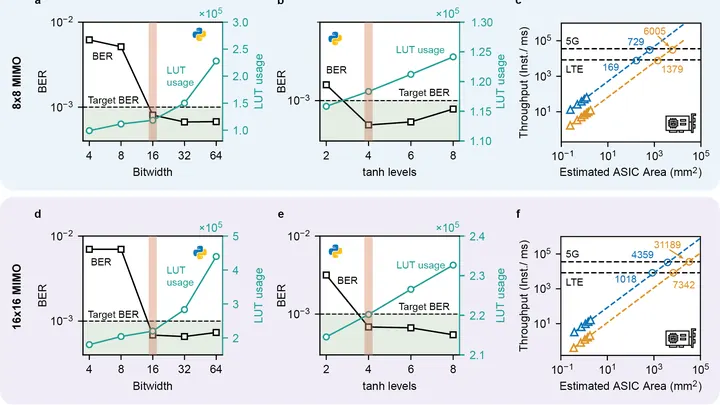
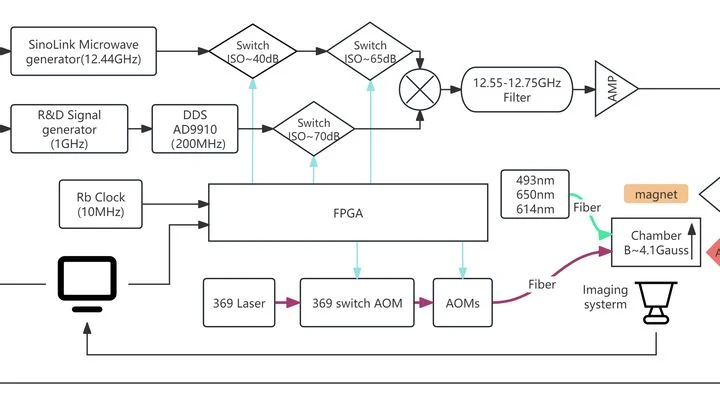
Real-time systems prioritize tasks by their deadlines, often using preemptive scheduling and dedicated hardware to minimize latency. In data acquisition, sensors stream measurements to a processor that applies algorithms on the fly, discarding or compressing data as needed. For control applications, the output directly adjusts actuators—like steering a telescope or stabilizing a laser—within microseconds. The challenge is balancing throughput with latency, and modern systems often use field-programmable gate arrays (FPGAs) or specialized processors to meet hard deadlines.
In practice
Real-time processing is used in particle physics experiments (trigger systems that select rare events), gravitational-wave detectors (filtering noise in real time), and medical imaging (ultrasound and MRI reconstruction).
Fun fact
The Large Hadron Collider's real-time trigger system reduces 40 million collision events per second to about 1,000 that are stored, all within microseconds, using custom electronics.
A quantum computer is like an orchestra where each instrument is a qubit and the conductor is the control processor. The conductor must not only set the tempo but also change the score on the fly if a soloist plays something unexpected.
One hundred milliseconds. In that time, after a lightning strike or a short circuit, the power system either returns to normal operation or loses stability. A new-generation Neural Network Oscillations learns to sense this moment, like an experienced tightrope walker anticipating a gust of wind.
Imagine an experienced chef during rush hour: suddenly a stove fails or a key ingredient runs out. Instead of panicking, he instantly reworks the recipes — speeding up some dishes, slowing down others, reallocating resources on the fly. This principle of dynamic adaptation underpins a new generation of ultra-reliable networks.
In the 1990s, philosopher John Searle devised a thought experiment: a person sits in a room and, without knowing Chinese, follows instructions to produce correct answers in Chinese. From the outside, it seems they understand the language, but inside, it's just mechanical rule-following.
A busy intersection without traffic lights. Cars drive, brake, and change lanes, and from the outside, it looks like complete chaos. But if you watch for a while, you can notice a rhythm: the flow thickens and thins. In physics, this rhythm of disorder is called entropy: it shows how far a system is from calm equilibrium, like water in a boiling kettle.
In the kitchen, the sequence of actions is strictly dictated by the recipe: first chop, then fry, and nothing else. In quantum physics, the role of the recipe is played by causality — one event causes another, and they cannot be swapped. But in recent years, theorists have devised clever scenarios where the order of events seems to 'hang' in uncertainty.
An orchestra where each musician plays their own part but hears only the neighbor. One wrong note, and a wave of errors rolls through the hall. That's how Ising machines work — special devices for solving problems where you need to find the best option among many.
A laser that usually produces a steady beam starts to tremble near its threshold, like a string about to sound. This trembling is not a defect but quantum noise: atoms inside the laser emit light randomly, without any external cause.
In a lab, you measure a very weak signal — say, a tiny change in a magnetic field. The instrument trembles from passing cars, from the experimenter's breathing, from wires heating up. This technical noise can't be fully eliminated, and it sets a limit on precision. An ordinary sensor works like a scale that sways with any draft.
A typical quantum bit is destroyed by the slightest disturbance — heat, magnetic fields. Physicists made a pair of atoms work together so that disorder wouldn't erase the record. Information was encoded not in each atom individually, but in the difference of their states — like the tension of a rope between two buoys.
A tiny particle floats in a laser beam like a speck of dust in a flashlight's glow. Water molecules constantly jostle it — randomly, from all sides. Usually these bumps are a nuisance: the particle twitches, and precise measurements turn into a lottery. But physicists have figured out how to turn the interference into an advantage.
To understand a mechanism, you have to poke it. A child taking apart an alarm clock doesn't just stare at the gears: they turn the wheel and listen to how the ticking changes. Scientists do the same: instead of passive observation, they feed specially chosen signals into the system and watch the response.
A solar panel on a roof produces little current in the morning, a lot at noon, and stays silent at night. Wind doesn't blow randomly either: it's often stronger in the morning and evening than during the day. Energy providers need to know in advance how much energy will be available in an hour or three, so they can switch on backup plants or store electricity in batteries in time.
Every few years, the warm current off the coast of Peru shifts, and fishermen come home empty-handed. This is El Niño, the breath of the tropical Pacific, which affects weather from Indonesia to California. Predicting its arrival is as hard as predicting where a stone thrown into a raging river will roll.
Optical fiber transmits light, but along the way it jitters and dims. To ensure that two parties at opposite ends of the line get the same set of random numbers for encryption, the receiver uses a digital corrector, like noise-canceling headphones that subtract the street hum but sometimes also eat the quiet notes of the music.
A group of people searches for a lost item in a large park. Some get tired and leave, others join along the way. The number of searchers is constantly changing. How does this affect the search time? Until now, science had no clear answer.
In a new study, a general model of such a process has been built. In it, independent participants randomly enter and leave the search.
The task resembles a giant maze with a single exit among billions of dead ends. A conventional computer checks each corridor step by step — taking centuries. A quantum processor launches a wave that seeps through all paths at once. The correct route echoes back, amplifying, and the answer is found in hours. That’s exactly how the “peak” circuits worked in the new experiment.
Fog thickens over the line "def max(a: Int, b: Int): Int". What does it do? It returns the larger of two numbers, but how can you verify that? You could write a dozen tests with specific pairs: max(2,3)=3, max(5,5)=5, max(-1,0)=0. Still, a nagging doubt remains: what if it breaks for, say, a million and minus a million?