Parallel processing is a method of computation where multiple operations are executed simultaneously, rather than one after another. In classical computing, this means splitting a large problem into smaller independent parts that can be solved at the same time by multiple processors or cores. The goal is to reduce total computation time and handle problems too large for a single processor. In the context of modern physics and technology, parallel processing also extends to novel computing paradigms, such as quantum computing and optical computing, where the inherent parallelism of physical phenomena is exploited to perform many calculations at once.
History
The concept of parallel processing dates back to the 1960s with early supercomputers like the CDC 6600, but it became mainstream with the advent of multi-core processors in the early 2000s. The theoretical foundations were laid by researchers like Gene Amdahl, who formulated Amdahl's law in 1967, describing the limits of speedup from parallelism.
How it works
In a conventional multi-core processor, a task is divided into subtasks, each assigned to a different core. These cores work concurrently, sharing data through a memory hierarchy and synchronizing when needed. In quantum computing, parallelism arises from superposition: a quantum bit (qubit) can represent both 0 and 1 simultaneously, and a set of qubits can process many states at once. Similarly, optical chips use light waves that propagate in parallel, allowing multiple signals to be processed simultaneously without interference. The key challenge is managing communication and avoiding bottlenecks, as described in the article 'Как заставить суперкомпьютер работать без заторов' (How to make a supercomputer work without congestion).
In practice
Parallel processing is used in supercomputers for climate modeling, molecular dynamics, and artificial intelligencetraining. It is also central to modern graphics processing units (GPUs) and quantum computing research, as highlighted in articles about quantum algorithms and optical chips.
Fun fact
The world's fastest supercomputers today use millions of cores, but even with perfect parallel processing, the speedup is limited by the sequential portion of the task, as described by Amdahl's law.
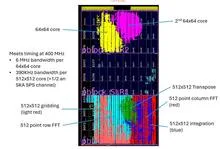
A radio telescope with thousands of antennas is like a giant ear that hears the whole sky at once. But an ear cannot draw a picture: signals from every pair of antennas must be multiplied, and in an array of ten thousand elements there are already fifty million pairs. A classical correlator does exactly that, and its complexity grows as the square of the number of antennas.
The brain doesn't just react to the world: it's constantly guessing what will happen next. This principle is called predictive coding: neurons compare expectations with reality and update their internal picture when an error occurs. But how such a complex system could be wired into the living tissue of the cortex remained unclear.
The robot juggler catches and throws balls in precise rhythm with a human, like two пульсара sending pulses in unison. Juggling three balls is a classic cascade, governed by a steady beat, like the uniform rotation of a cosmic lighthouse. Break the rhythm and the pattern crumbles.
In boiling soup, molecules collide chaotically and react. But if you measure how their concentrations change, patterns emerge. This is how carbon chemical networks work — mixtures of molecules that spontaneously 'cook' information, turning each reaction into an elementary computation. Previously they were used only for modeling nature.
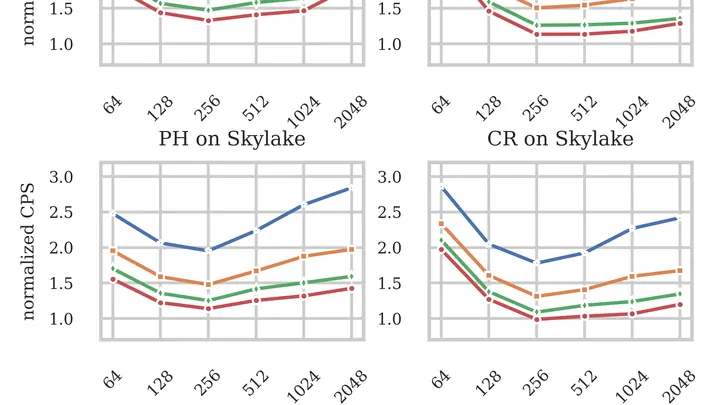
A traditional filter works like a long chain of people passing a message around: each waits for the previous one to finish. That's slow. Engineers applied a clever method — cyclic reduction. They rearrange data so that dependencies between samples become not long chains but small groups.
Power systems with solar panels and wind turbines are like a chess game: cloud cover and load changes are the opponent's moves, impossible to foresee. To maintain balance, operators used to run through dozens of scenarios (uncertainty) — that took too much time and computing power.
Quantum tunneling — the ability of particles to pass through barriers forbidden by classical physics — powers stars with thermonuclear fusion, ignites primordial nucleosynthesis, and gives us flash memory.
Gold doesn't lie on the surface: it's hidden in tons of barren rock. To extract a gram of precious metal, prospectors sift through cubic meters of dirt.
Once Richard Feynman saw in quantum systems a challenge for classical computers. Now we face the inverse problem: understanding what exactly the quantum processor has simulated. Among the states it births are veritable 'black boxes'—topological phases of matter.
Imagine an interpreter sitting in a meeting room, translating every word. But then they notice their translation could improve if they learned from their mistakes. They start noting which phrases caused confusion and adjust them. Within an hour, their translation is more accurate and the meeting runs smoother.
In a grand courtroom, a meeting is in session. Hundreds of translator-neurons simultaneously hear fragments of phrases, and must piece them into a single coherent picture. This is exactly how large brain networks turn scattered signals from the eyes into a unified object image.
Quantum computers in the cloud are like a post office: you send a letter, and someone else reads the address and the contents. In ordinary computing, the server sees your data and algorithm. Blind quantum computing is an unopenable envelope: the server does the work but doesn't know what it's doing.
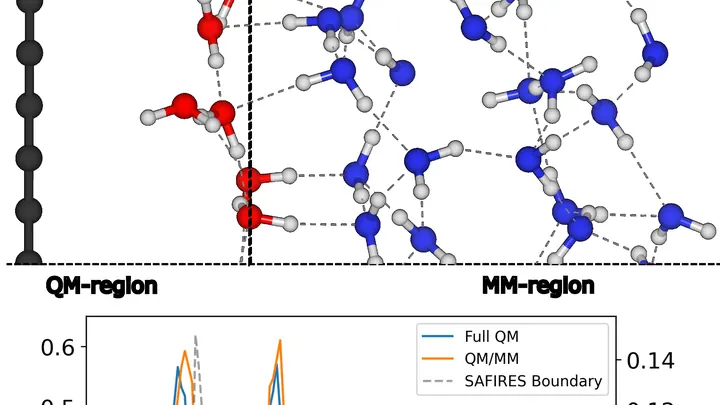
Imagine a huge swimming pool. In one corner, a chemical reaction is underway that needs to be calculated with jeweler-like precision. But the surrounding water is not just decoration: its molecules jostle, attract, and influence the reaction. How do you account for this endless dance of particles without drowning in calculations?
In the kitchen, the sequence of actions is strictly dictated by the recipe: first chop, then fry, and nothing else. In quantum physics, the role of the recipe is played by causality — one event causes another, and they cannot be swapped. But in recent years, theorists have devised clever scenarios where the order of events seems to 'hang' in uncertainty.
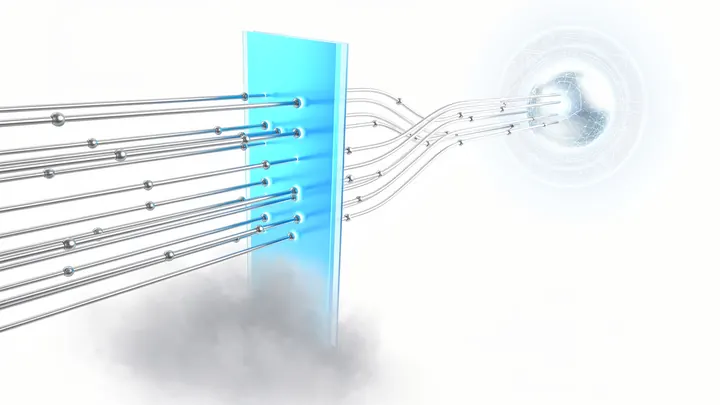
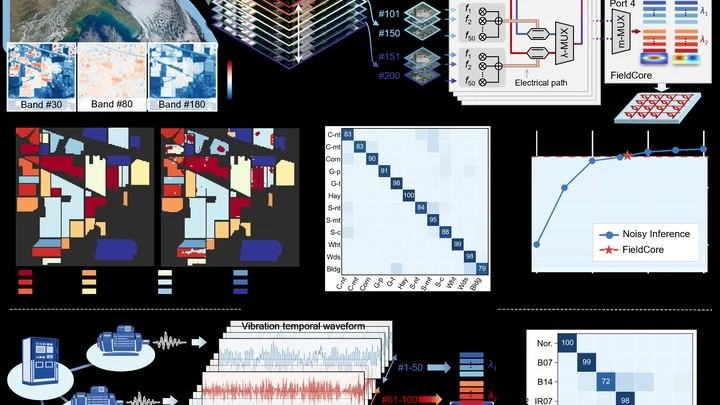
A typical computer shuttles electricity along copper traces, and every operation is a queue: first one thing, then another. Light works differently. In a single beam, you can mix dozens of signals without them interfering, like different voices in a choir, singing at once but each heard distinctly.
The new FieldCore chip uses five such "voices" at once.
An orchestra where each musician plays their own part but hears only the neighbor. One wrong note, and a wave of errors rolls through the hall. That's how Ising machines work — special devices for solving problems where you need to find the best option among many.
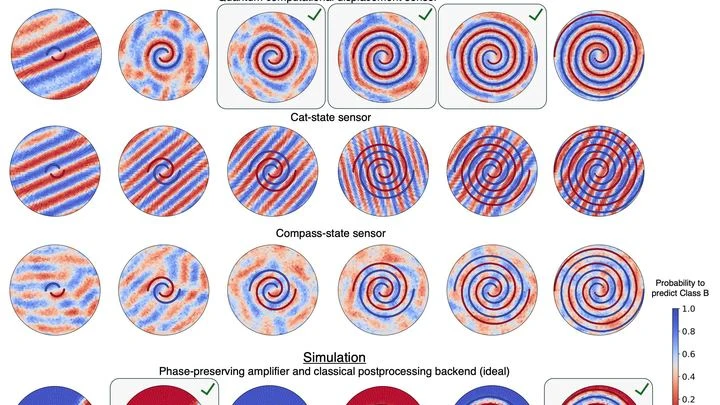
A judge walks into the courtroom but doesn't look at the evidence: he immediately delivers the verdict. That's how the new quantum sensor works: it doesn't measure the signal but directly decides which class it belongs to.
In conventional quantum sensing, it's all like a detective story: first you gather clues (measure the signal), then you analyze them.
A classical computer sorts data like a person meticulously sifting through grains of sand of different colors. A quantum processor takes its cue from nature: just as a droplet of water splits sunlight into a rainbow, revealing all hues at once, this new algorithm instantly grasps the essence of vast information arrays.
A quantum computer holds atoms in light traps, like marbles in dimples. To read out the answer, you need to photograph each atom and determine whether it's glowing or not. Previously, analyzing such an image took so long that the computer sat idle. Now, engineers have created a specialized board that looks at the photo and instantly finds all the atoms.
Physical systems can compute. If you build a landscape of hills and valleys so that the lowest point corresponds to the answer, the system will roll there by itself, like a ball. The problem is that the bottom is often flat, and the ball crawls around for a long time before settling.
The authors propose nudging the ball to the right place before it even starts.
A tiny particle floats in a laser beam like a speck of dust in a flashlight's glow. Water molecules constantly jostle it — randomly, from all sides. Usually these bumps are a nuisance: the particle twitches, and precise measurements turn into a lottery. But physicists have figured out how to turn the interference into an advantage.
Water in a narrow gap crawls on its own: that's the capillary effect that pulls sap up a stem. But if it hits a step, the liquid can freeze, like a traveler before a high threshold. Scientists built tiny glass channels and watched when a drop steps over the ledge and when it gets stuck.
Light passing through ripples on a water surface paints dancing patterns on the bottom of a pool. Engineers have used a similar idea to make light compute. They fabricated a tiny plate with a wavy relief: each ridge and groove deflects rays in its own way. When an image falls on such a surface, the light transmitted through it converges at different points behind it.
A quantum processor is like an orchestra where each musician (qubit) must play their part precisely in time. But in reality, the instruments go out of tune: qubits lose energy, and their interactions get distorted. To tune this orchestra, you first need to record how it sounds right now: that is, measure the noise parameters and couplings.
In the superconducting circuits that make up quantum computers, extra particles, quasiparticles, are born from time to time. They are like random passersby who barge into the processor's work and spoil the calculations.
Graphs are considered identical if their 'terrain' matches. Imagine two maps with mountains and valleys: even if drawn differently, the heights and steepness of slopes can be the same.
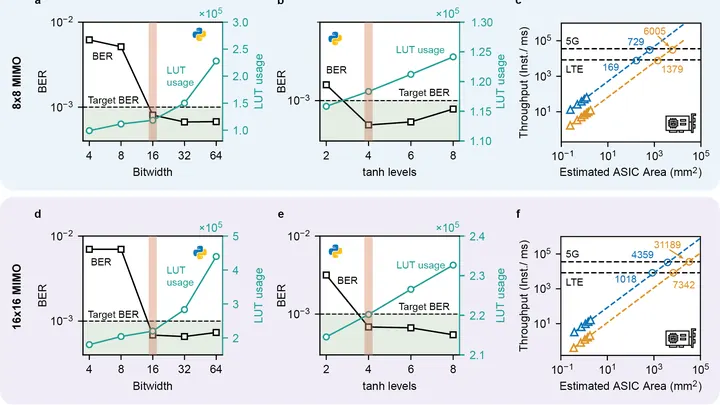
A conventional computer sees the world flat: numbers are just points on a line. But a color image or a 3D scene demands more — four numbers that describe both position and rotation. Such quadruples are called quaternions, and until now electronics handled them clumsily, breaking them apart and reassembling them.
The new chip changes the approach.
Computer models that predict material properties at the atomic level usually require long, manual tuning. To work accurately, the model needs to see many examples — how atoms are arranged and how they interact. Scientists spend weeks hand-picking these examples. The new program AutoPot does it all by itself.
Two seemingly incompatible mathematical languages describe a single quantum reality. The first is the language of quantum walks: here, a particle (such as an electron or even a quasiparticle in a condensed medium) takes a stroll on a graph, simultaneously exploring all possible paths — much like a pedestrian in an unfamiliar city instantly finding…
Light passing through a birefringent crystal changes its polarization depending on wavelength. This profile is like a mosaic assembled from rare flashes, where each shard hints at the shape of its neighbors.
Two pendulums on the same wall, swinging out of step, will be in sync within an hour. Christiaan Huygens noticed this synchronization back in 1665, watching the clocks in his workshop. Today, researchers repeat his observation in the lab, but with a twist: the pendulums are not wooden but quantum.
Three thousand meters above sea level, a sheer cliff face. A classical climber picks a single route and crawls up step by step, often getting stuck in a local minimum: a small niche with no upward path. A quantum climber acts differently: it can leap across a canyon and land in a neighboring energy basin where the route is better.
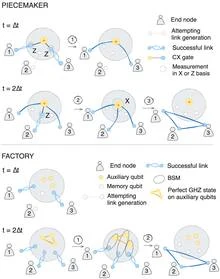
Assembling a puzzle as pieces arrive, rather than waiting for the complete set, is the philosophy behind a new protocol for distributing quantum entanglement. In quantum networks, where nodes exchange Bell pairs, the traditional approach resembles a patient assembler who waits until all pieces are on the table before starting.
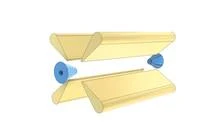
Six barium ions lined up in a flat hexagon inside a Paul trap, a device that holds charged particles with oscillating electric fields. But a slight change in the shape of the trapping potential made the crystal rearrange: one ion moved to the center, and the other five formed a ring around it.
Every day, the power grid faces a puzzle: which power plants should be switched on to reliably meet demand without breaking the bank? For 15 generators and 24 hours, the number of possible schedules exceeds 2.3×$$10^{108}$$, more than the number of atoms in the visible universe. No classical supercomputer can sift through all of them, so dispatchers settle for a compromise.
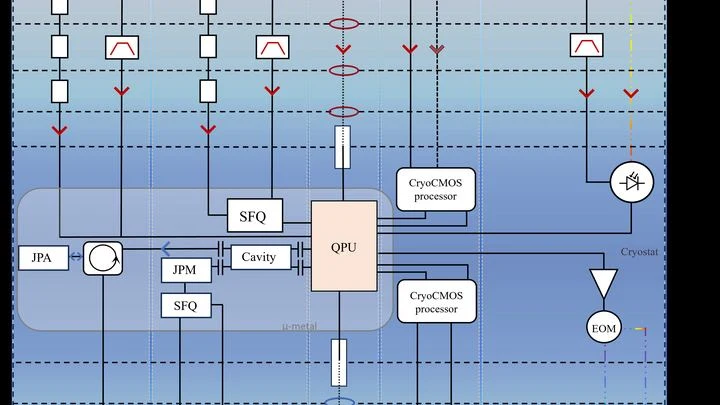
Imagine an orchestra where every musician plays an instrument that breaks at the slightest warmth. The conductor is the quantum processor, and the musicians are the qubits — fragile carriers of quantum information. To keep them in harmony, you need a whole team of tuners sitting in the next room, sending commands through a soundproof wall.
A single quantum processor is like a solo musician. It can play a simple tune, but a symphony requires an orchestra. To solve problems that demand enormous computational power, processors must be networked.
A supercomputer simulating laser plasma is like a kitchen where hundreds of chefs are preparing a single dish. If ten people crowd around one stove while another stands empty, the work grinds to a halt. The same happens in simulations: plasma particles bunch up in certain regions of space, leaving others nearly empty.