The Pulse of a Solar Flare: How Magnetic Knots Snap and Reconnect express
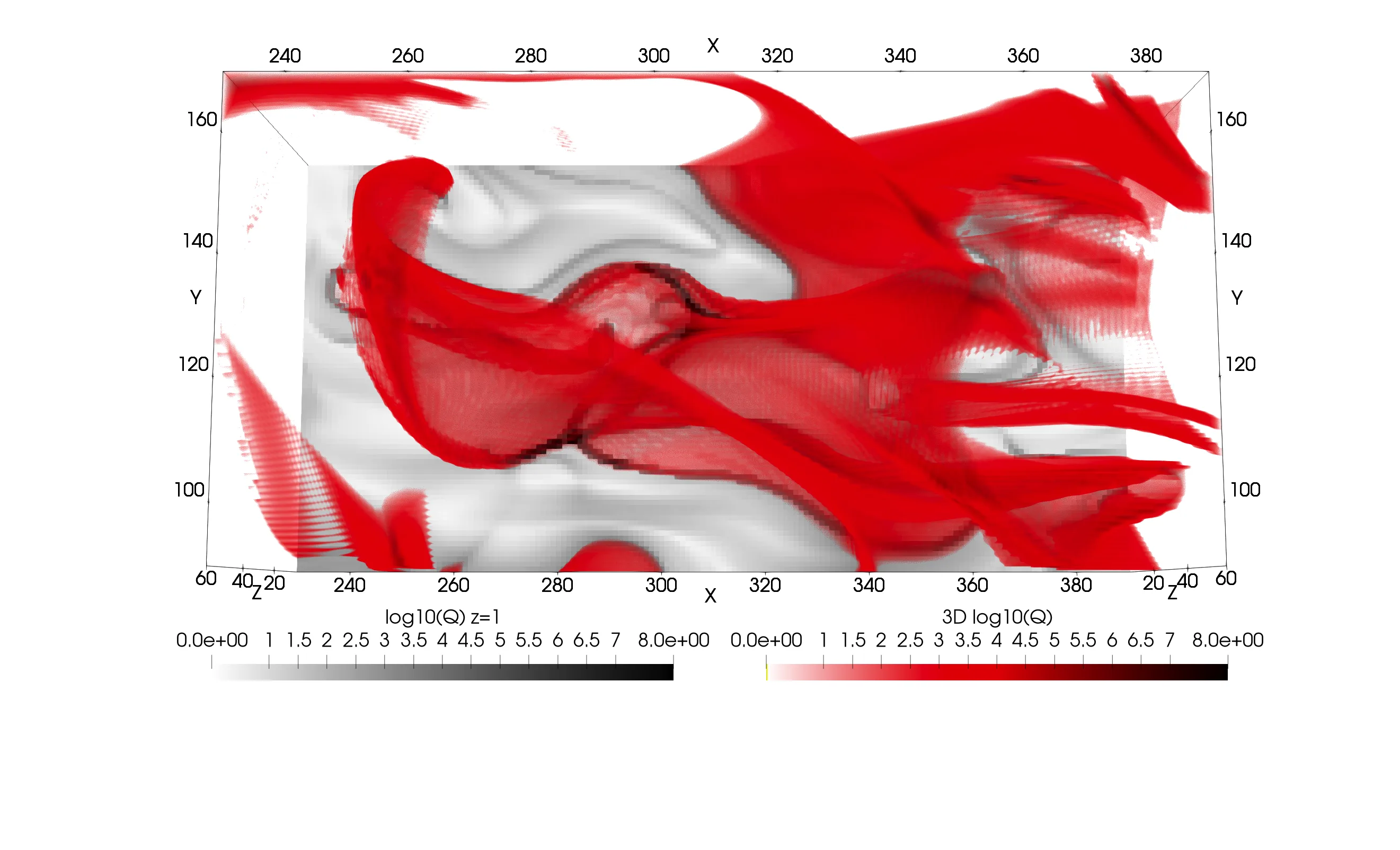
A solar flare is like a giant rubber band that's been twisted and let go. Magnetic field lines on the Sun tangle, snap, and reconnect — a process called magnetic reconnection. At the break point, energy bursts out: particles accelerate, plasma heats up, and we see bright ribbons on the surface.
In March 2022, a moderate flare erupted on the Sun. Two spacecraft watched it simultaneously: one detected X-rays (hard radiation produced when fast particles slam into stuff), the other recorded ultraviolet glow. It turned out both signals pulsed in the same rhythm — roughly every 35 seconds, brightness rose and fell.
The scientists also noticed something else: bright ultraviolet spots slid across the surface like sparks from a campfire. But their motion didn't match the X-ray pulsations. That means the flare's main energy was released not where the spots moved, but in specific loops that stayed put.
This scenario helps explain how the Sun actually unleashes its stored magnetic energy. Flares aren't a single explosion but a series of rapid magnetic 'snaps,' and now we see which parts of that machine are the loudest.
Original abstract
as written by the authors arXiv:2604.17330
Apparent slipping motions of flare ribbon kernels and the formation of hard X-ray (HXR) footpoints are important signatures of magnetic reconnection in solar flares. Ultraviolet (UV) and HXR ribbon emission can show quasi-periodic pulsations (QPPs), but the link between HXR QPP sources and slipping reconnection remains poorly understood. In this work, we analyze high-cadence IRIS and STIX observations of the 2022 March 31 M9.6 flare. STIX detected non-thermal QPPs with periods of $$\approx$$35 s from two relatively stationary footpoints. The majority of the HXR QPPs were correlated with UV pulsations observed by the IRIS Slit Jaw Imager in ribbon regions encompassing these footpoints. In one such region observed under the IRIS slit, the Si IV 1402.77{\AA} line exhibited pulsations in intensity, Doppler shift, and width, some of which were coincident with HXR QPPs. Apparent slipping motions of the UV kernels were also observed, but their locations, timing, and UV intensity variability showed lower correlation with the HXR QPPs. The ribbons along which the slipping kernels were found correspond well to footprints of quasi-separatrix layers (QSLs), regions of high magnetic connectivity gradients, identified using a NLFFF extrapolation. Our multi-instrument analysis suggests that strong deposition of energy by non-thermal electrons was concentrated in a specific loop system within a large-scale 3D reconnection structure. Slipping kernels were subjected to weaker, if any, energization by non-thermal electrons, offering new constraints on 3D reconnection and flare energy release.
The pulsation period, about 35 seconds, is comparable to the time it takes a person to take 10–12 breaths. The solar flare 'breathed' at the pace of calm breathing.
In Stanislaw Lem's novel 'Solaris,' the planet's ocean pulses with mysterious rhythms — similarly, a solar flare turns out to be not chaos but an ordered pulse of magnetic fields.