Magnetic loops are arch-like structures of magnetic field lines that emerge from the Sun's surface and extend into the corona, the Sun's outer atmosphere. They are the building blocks of active regions, which are areas of intense magnetic activity often associated with sunspots, solar flares, and coronal mass ejections. These loops are filled with hot plasma, which is trapped and guided by the magnetic field, making them visible in X-ray and ultraviolet images of the Sun. They range in size from small, short-lived loops to giant structures spanning hundreds of thousands of kilometers.
History
The existence of magnetic loops was inferred from early observations of the solar corona during eclipses, but their true nature was revealed in the mid-20th century with the advent of X-ray telescopes, which showed the loops as bright structures. The Skylab mission in the 1970s provided the first detailed images of these loops, and subsequent missions like SOHO and SDO have mapped their evolution in unprecedented detail.
How it works
Magnetic loops are formed by the Sun's internal dynamo, which generates magnetic fields through the motion of conductive plasma. When these fields emerge through the photosphere, they form pairs of opposite polarity footpoints on the surface. The magnetic field lines connect these footpoints, arching through the corona. The plasma inside the loop is heated to millions of degrees, much hotter than the surrounding corona, and is confined by the magnetic pressure. The loops can become unstable, leading to magnetic reconnection—a process where field lines break and reconnect, releasing enormous amounts of energy as flares and heating the corona.
In practice
Understanding magnetic loops is crucial for space weather prediction, as their instability leads to solar flares and coronal mass ejections that can disrupt satellites, power grids, and communication systems on Earth. They are also studied as natural laboratories for plasma physics, particularly for understanding magnetic reconnection.
Fun fact
The plasma inside a magnetic loop can be heated to over 10 million degrees Celsius, yet the loop itself is often cooler than the surrounding corona, a paradox that remains one of the biggest unsolved problems in solar physics.
On the surface of the Moon and asteroids, you can find pits smaller than a pinhead but with shiny, melted rims. Such marks are left by tiny meteorites, but the exact impact speed at which melting occurs remained unclear.
A sunspot, a dark island on the fiery surface, lives its own turbulent life. Beneath it, in invisible depths, giant magnetic loops drift like twisted cables. When such a loop emerges, it can discharge as a flare, and hurl clouds of charged particles into space.
Scientists have long tried to understand what determines the strength and suddenness of these events.
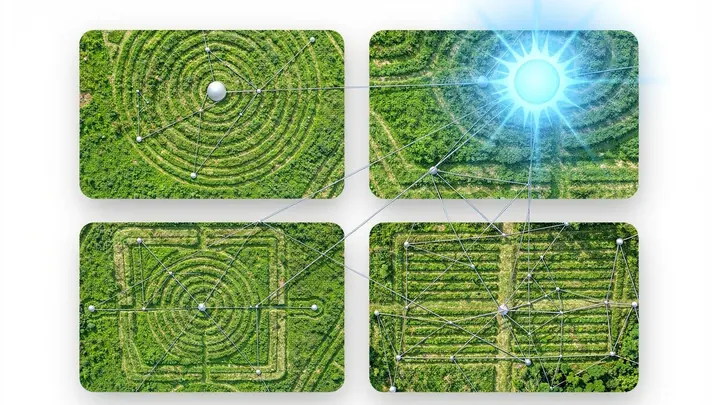
Deep in the Amazon rainforest, beneath a multi-layered canopy of leaves, lie vast earthen figures — squares, rectangles, the occasional rhombus. For decades they teased archaeologists with their silent geometry, until a researcher armed with orbital optics saw them as an astronomical instrument.
Active galactic nuclei (AGN) are the universe’s powerhouses: their X-ray coronae blaze millions of times hotter than stellar atmospheres. But what strikes the spark? A ten-day X-ray campaign by the XRISM and XMM-Newton satellites, aimed at NGC 3783, provided the answer: it’s actual thunderstorms.
A tightly twisted phone cord snaps and scatters sparks. Magnetic fields on the Sun behave the same way: they twist, break, and reconnect, powering flares. For the first time, astronomers have witnessed this process directly. One loop was twisted by 540 degrees — one full turn and then half again. That’s three times more than previously thought possible.
A powerful vacuum cleaner sucks in not only dust but also its own collection bag. That's roughly how a black hole behaves at the center of a 'red dot'—a distant galaxy where the glow comes not from the hole itself but from its dense gas shroud. This shroud is so thick it resembles a puffed-up cool star. And, like many stars, it has a magnetic field.
A planet's magnetic field is like an invisible shield: it catches charged particles from the solar wind and stretches out behind the planet into a long tail, like a fluttering scarf.
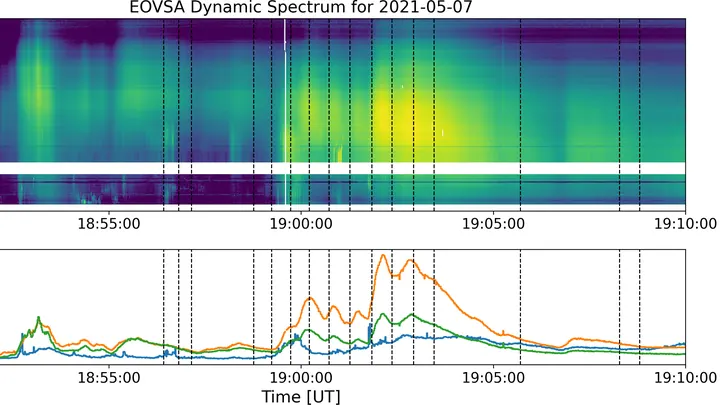
A sunspot, a dark island on the scorching surface, breathes. Every three minutes, a wave spreads from it, runs along an invisible magnetic arch, and makes the plasma above a neighboring spot flare with a radio signal. Radio telescopes caught seven such flares in a row on February 14, 2024.
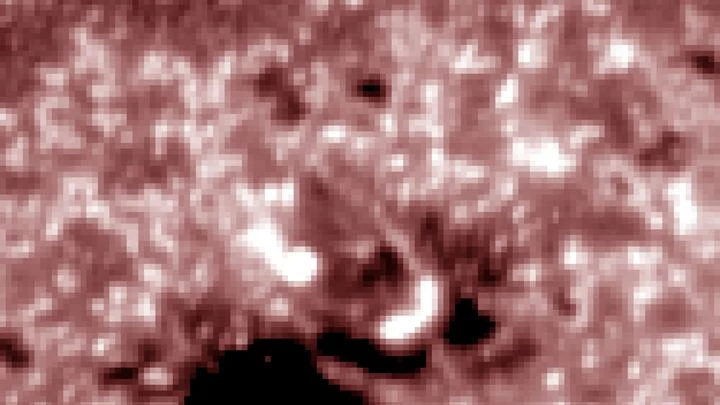
The Sun sometimes produces flares — bright explosions that hurl streams of charged particles into space. On April 22, 2021, one such flare occurred in an active region where a dark sunspot was crossed by a bright "bridge" of hotter gas.
The Sun sometimes produces giant clouds of plasma that try to escape into space. But often they fail: an invisible magnetic cage keeps them near the surface. Such failed eruptions are called "trapped."
Scientists built a computer model to understand exactly how this cage works.
A solar flare is like a short circuit in a giant neon sign. Inside the Sun, magnetic fields twist into loops, like rubber bands, and when they reconnect, energy bursts into space. Part of it goes into hard X-rays, produced by particles accelerated to nearly the speed of light.
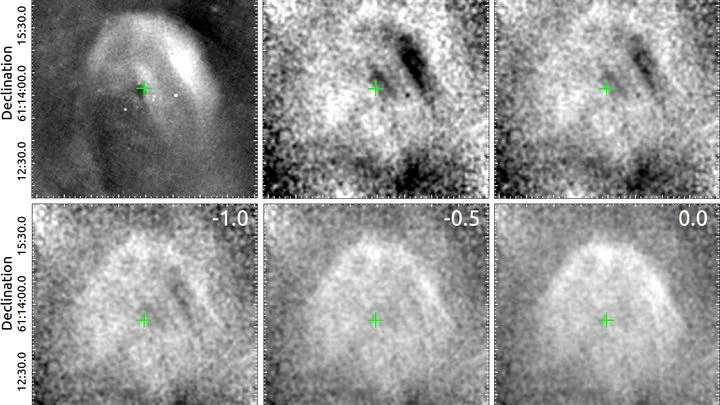
The VLA radio telescope peered into the Boomerang Nebula — a cloud inflated by the wind from a rapidly spinning neutron star. The new images reveal details as small as a lunar disk on the sky: an elongated core around the pulsar and a long arc curving around it from the north.
A solar flare is like a giant spring that gets twisted and twisted, and then suddenly snaps. The energy stored in the magnetic field is unleashed into space within minutes, heating plasma to millions of degrees.
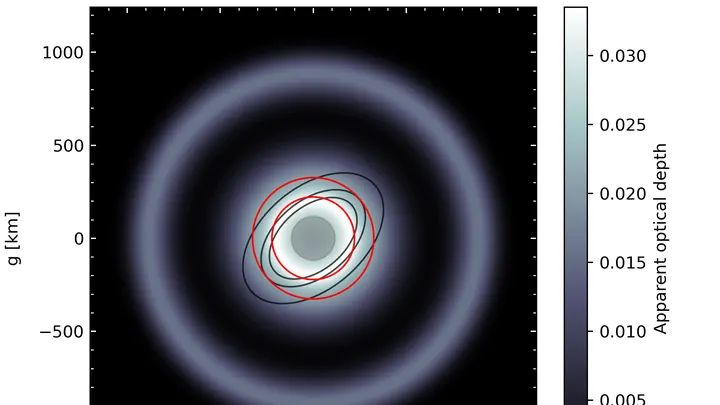
Only by passing in front of a star did Chiron reveal its secret. Three icy hoops encircle the 200-kilometer body — a hybrid of comet and asteroid. Previously, they were only hinted at by spectra of reflected light and brightness fluctuations.