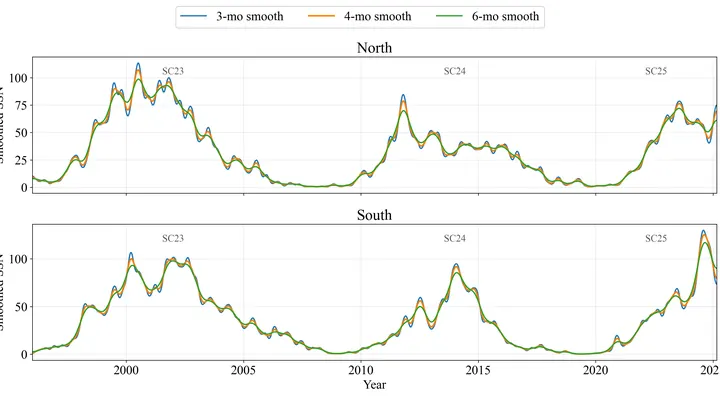
The quasi-biennial oscillation (QBO) is a periodic variation in the behavior of the Sun, with a cycle lasting roughly 1.7 years. It is distinct from the well-known 11-year sunspot cycle, operating on a shorter timescale. The QBO is observed in solar activity indicators such as the frequency of strong flares, which rise and fall in a pattern that repeats about every two years.
How it works
The Sun's magnetic field undergoes complex changes, and the QBO is thought to arise from interactions between different layers of the solar interior and its magnetic dynamo. These interactions modulate the emergence of magnetic flux on the surface, which in turn affects flare production. The oscillation is quasi-biennial because the period is not perfectly regular, varying slightly from cycle to cycle.
In practice
Understanding the QBO helps improve space weatherforecasting, as flare activity influences satellite operations and communications on Earth.
Fun fact
The QBO in the Sun is similar in timescale to a well-known oscillation in Earth's stratosphere, though the two are unrelated.
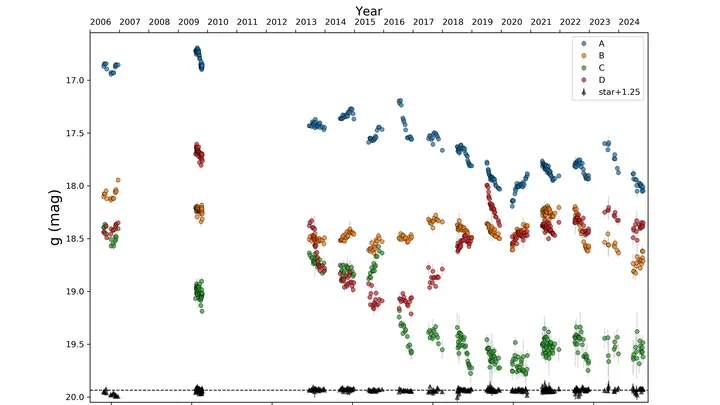
Try to pick out the rhythm of a distant drum through the noise of a construction site. Standard methods look for a steady "tick-tock-tick," but if the drummer plays erratically, with sharp hits and pauses, they might miss it entirely. That's roughly how astronomers searched for periodic signals in the emission of blazars — active nuclei of distant galaxies that shoot powerful jets of particles toward us.
The Sun is constantly struck by blows — magnetic reconnection in the plasma releases energy, making the corona flare up. After each such blow, magnetohydrodynamic waves linger in the plasma loops, like the fading ring of a bell.
At the heart of massive galaxies, monstrous gravitational 'cocoons' brew — black holes with billions of solar masses, shrouded in a dense veil of gas and dust. But any metamorphosis requires breaking the shell.
A planet glides across a star's disk, and for a moment becomes a flashlight. It blocks a tiny patch of surface, revealing details that otherwise escape our view. That's exactly how astronomers peered into the dark spots on V1298 Tauri, a young twin of our Sun. They were aided by the James Webb Space Telescope JWST and three giant planets in orbit.
The Sun doesn't burn steadily: it erupts in series. Like a campfire that dies down and then suddenly throws out showers of sparks, these "fiery seasons" last from six months to a year and a half, and during them the star shows an unusually high number of sunspots.
Two ultra-thin sheets, each just one atom thick, are placed on top of each other and slightly rotated. Like two sheets of colored tracing paper: while they lie flat, the picture is one thing, but give them a twist and a moiré pattern appears. Here, though, the pattern isn't visible to the eye, but it completely changes how the material handles light.
A giant cauldron that barely smolders most of the time, but occasionally spits out showers of sparks. That is roughly how the supermassive black hole at the center of our galaxy — Sagittarius A*—behaves. It weighs four million times as much as the Sun and lies 26,000 light-years away.
Gravitational wave detectors work like sensitive microphones, picking up the trembling of space from distant cosmic catastrophes. When two black holes merge into one, the newborn object rings like a bell, and that ringing is a unique 'voice' of gravity.
A sunspot, a dark island on the scorching surface, breathes. Every three minutes, a wave spreads from it, runs along an invisible magnetic arch, and makes the plasma above a neighboring spot flare with a radio signal. Radio telescopes caught seven such flares in a row on February 14, 2024.
A solar flare is like a giant rubber band that's been twisted and let go. Magnetic field lines on the Sun tangle, snap, and reconnect — a process called magnetic reconnection. At the break point, energy bursts out: particles accelerate, plasma heats up, and we see bright ribbons on the surface.
At the heart of galaxy 1ES 1927+654, a black hole behaves like a lighthouse with a faulty mechanism. Every six and a half minutes, it releases a burst of X-ray light, a rhythm astronomers have been tracking since 2022. At first, the beacon's tempo wandered — speeding up and slowing down, with intervals ranging from one beat every eighteen minutes to one every seven.
A radio signal travels from Mars to Earth, but on the way it has to push through the invisible "wind" of charged particles blowing from the Sun. This wind, like ripples on water, slightly distorts radio waves.
A distant quasar appears as four points of light arranged in a cross. This is how the gravity of a galaxy lying along our line of sight distorts the view: it acts like imperfect glass, multiplying the image. Each point is the same object, but its light travels different paths.
Every 1151 years, seven planets of the Solar System, from Mercury to Neptune, find themselves at almost the same points in their orbits. Their positions scatter by less than a degree, as if the celestial mechanism is wound to the same tune. This rhythm was discovered by comparing planetary positions over 2600 years using precise tables of celestial motion.
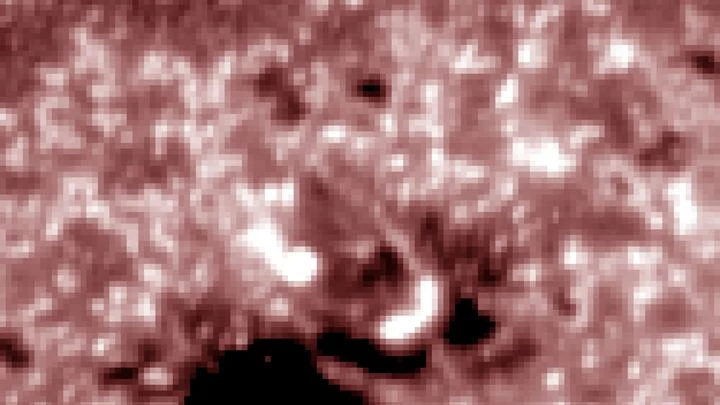
The Sun sometimes produces flares — bright explosions that hurl streams of charged particles into space. On April 22, 2021, one such flare occurred in an active region where a dark sunspot was crossed by a bright "bridge" of hotter gas.
A solar flare is like a short circuit in a giant neon sign. Inside the Sun, magnetic fields twist into loops, like rubber bands, and when they reconnect, energy bursts into space. Part of it goes into hard X-rays, produced by particles accelerated to nearly the speed of light.
A quantum computer is like an orchestra where each musician, a qubit, must play its note without missing a beat. But every now and then, a passerby, a particle of radiation from space, bursts into the hall and throws the musicians off rhythm. Such glitches are called error bursts, and they disrupt computations.
Cosmic rays are charged particles that reach us from distant stellar explosions. But before hitting a detector, they must pass through the bubble of the solar wind. The Sun breathes: it inflates this bubble, then contracts it.
For three years straight, every night, telescopes have stared at one point in the sky. There lies the galaxy Mrk 421, whose core shoots a jet of particles aimed almost exactly at Earth. Such objects are called blazars. A black hole at the galaxy's center spins matter into a disk, and some of it is ejected outward in two narrow beams.
The Sun is not a calm sphere but a boiling cauldron that follows its own rhythms. Roughly every 11 years, its activity peaks: more dark spots appear on its surface, and streams of charged particles fly into space. But hidden within this grand cycle is a shorter one — about 1.7 years.
The James Webb Space Telescope looks back in time and sees the universe when it was less than a billion years old. In this young universe, galaxies already shine, and at their centers sit supermassive black holes — the ones that will later grow into giants. How did they manage to gain mass so quickly?
In the center of galaxy J2344 five years ago, a black hole tore apart a star, and now scorching gas bubbles there — a cosmic “stew pot”. Every 12 hours, giant X-ray bubbles rise in it, and on their ascent, super-hot splashes lasting 5–30 minutes appear.
Short gamma-ray bursts — instantaneous, but most powerful explosions — are born from the mergers of neutron stars (the superdense remnants of dead stars).
Short, powerful bursts of radio static from deep space have long puzzled scientists. Their source is believed to be the ultra-dense cores of dead stars, where magnetic fields are unimaginably strong.
The Penrose tiling, assembled from two types of tiles, covers a plane without a repeating pattern — a mathematical marvel discovered by Roger Penrose that has found physical embodiment in the quantum world. Researchers modeled a chain of particles interacting according to a rule reminiscent of Fibonacci numbers and the golden ratio.
A quantum system, once born, does not forget it. Even after dozens of lifetimes, a trace of the initial state remains in its decay: a slowly decreasing power-law tail. For two fluorescent dyes, erythrosine B and eosin Y, this tail has been observed for the first time in two spectral channels simultaneously.
At the core of the distant galaxy SDSS J1335+0728, 2.5 billion light-years from Earth, a supermassive black hole beats out a rhythm. Every few days it flares in X-rays like a cosmic metronome, but in 2025 that metronome suddenly shifted from allegro to andante.
Place two pendulums side by side and give one a gentle push; the other will soon pick up the rhythm. This behavior isn't limited to clocks on a shared shelf; it also applies to the plasma inside the Sun. In the star's convection zone, two huge ring-shaped flows circulate: one closer to the surface, the other deeper. Each oscillates with its own period—12.05 and 9.52 years.