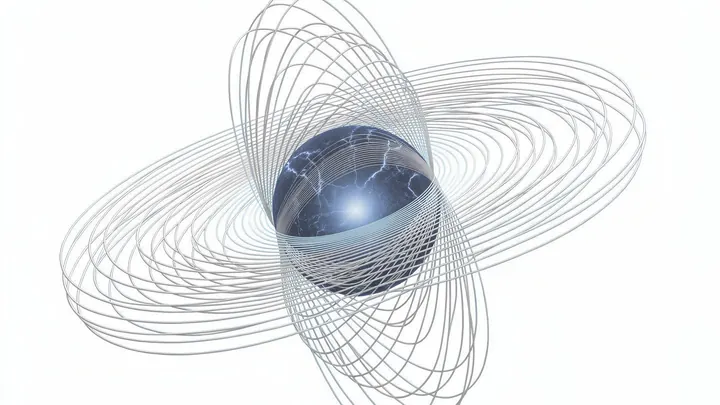
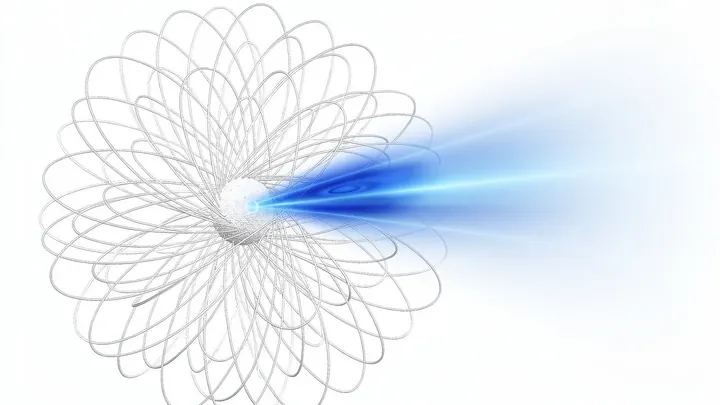
An X-ray pulse is a periodic burst of X-ray radiation emitted by a pulsar — a rapidly rotating, highly magnetized neutron star. As the star spins, beams of radiation from its magnetic poles sweep across space like a lighthouse; when a beam points toward Earth, we detect a pulse. These pulses are extremely regular, with periods ranging from milliseconds to seconds, and they serve as natural cosmic clocks.
History
The first pulsar was discovered in 1967 by Jocelyn Bell Burnell and Antony Hewish, who detected radio pulses. X-ray pulsars were identified later, following the launch of X-ray astronomy satellites in the 1970s.
How it works
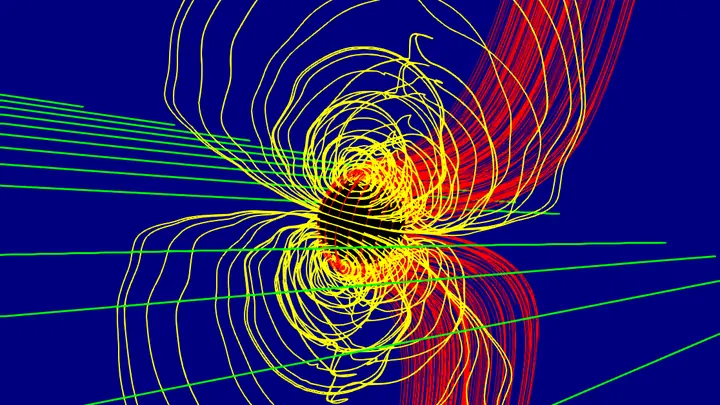
Pulsars emit X-rays when charged particles are accelerated in their intense magnetic fields, often drawing energy from the star's rotation. The emission is beamed along the magnetic axis, which is tilted relative to the rotation axis. As the star rotates, the beam sweeps past our line of sight once per rotation, producing a pulse. The timing of these pulses is so stable that it rivals atomic clocks, though glitches and timing noise can occur.
In practice
X-ray pulses are used for spacecraft navigation: by measuring the arrival times of pulses from multiple pulsars, a spacecraft can determine its position in deep space, as demonstrated by the NICER experiment on the International Space Station.
Fun fact
The period of the Crab pulsar's X-ray pulses is about 33 milliseconds, and it is slowing down by roughly 38 nanoseconds per day as it loses rotational energy.
Pulsar PSR J0614-3329 spins 318 times per second. A point on its equator moves at about 10% of the speed of light. From a distance, the star looks like a lighthouse spinning so fast that its beam blurs into a continuous ring.
Radio waves from a distant pulsar travel through the interstellar medium, encountering invisible magnetic structures the size of the distance from the Sun to Earth. One such structure is a current sheet, where the magnetic field abruptly changes direction, like a compass needle flipping from north to south.
It's like a sprint record: to break it, you need a perfect run-up. But for sub-millisecond pulsars, the run-up is too short. The fastest known pulsar, PSR J1748-2446ad, spins 716 times per second — faster than a kitchen blender. If it were the size of Earth, a point on its equator would move at about 0.24 times the speed of light. But why doesn't any pulsar spin even faster?
Picture a lighthouse on the shore at night. Its lamp is off almost all the time, but once every few days, for a split second, it blazes so brightly that the light is visible beyond the horizon.
When a laser beam hits a gas, it tears electrons from atoms and accelerates them to nearly the speed of light. As these electrons fly through the plasma, they emit X-rays, like a glowing trail from a fast particle. In the new work, physicists made a single laser pulse create not one but two such trails in succession.
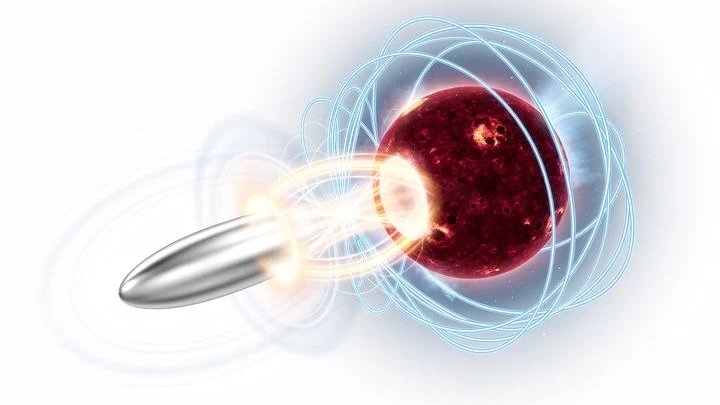
A shooter aims at a target, pulls the trigger, and hears two shots: one loud, one quiet. That's how the new setup works, except instead of bullets, there's an electron bunch, and instead of shots, there are two flashes of light. One flash is X-ray, the other is terahertz. They fly to the same point with perfect timing.
A lighthouse doesn't flash steadily but in short, bright pulses. The neutron star in the system 4U 1323-62 is such a lighthouse in the X-ray range. It pulls gas from a companion star, and when enough material accumulates on its surface, a thermonuclear explosion occurs — an X-ray burst.
A lighthouse flashes for a fraction of a second and goes dark again. The MeerKAT telescope in South Africa catches such flashes in the radio band. During its observations, it picked up 27 new sources that no one had seen before. Neutron stars are the remnants of exploded stars, compressed to the size of a city.
The light of a distant lighthouse does not go out all at once: first it flares brightly, then slowly fades into darkness. That is how the X-ray pulsar 4U 0115+63 behaves — a neutron star that periodically brightens when gas from a companion ordinary star falls onto it.
Pulsars are rapidly spinning neutron stars that emit radio pulses like a lighthouse. But some of them stay silent almost all the time, occasionally emitting a single pulse. Such objects are called rotating radio transients (RRATs). They were discovered nearly twenty years ago, but they remain a mystery.
Pulsar PSR J1740+1000 is a city-sized star spinning faster than a kitchen blender. After a supernova explosion, it left behind a dense core that accelerates particles to near-light speeds. These particles fly into space, and previously it was thought they scatter in all directions, like splashes from a stone thrown into water.
89 milliseconds. That's how long a vortex avalanche lasts that abruptly speeds up the rotation of the Vela pulsar — one of the most famous 'glitching' pulsars. Pulsars are rapidly spinning neutron stars born in the collapse of supernovae.
The Sun is constantly struck by blows — magnetic reconnection in the plasma releases energy, making the corona flare up. After each such blow, magnetohydrodynamic waves linger in the plasma loops, like the fading ring of a bell.
For over a century, astronomers puzzled over the capricious behavior of RR Lyrae stars: their brightness periodically waxed and waned with unpredictable amplitude, like a lighthouse with a faulty mechanism. The Blazhko effect, discovered in 1907, taunted scientists for decades.
A waterfall that doesn't heat up from the fall but freezes — that's roughly how gas behaves as it flows onto a neutron star in an X-ray pulsar when the star shines dimly. Usually, infalling matter is heated to a white-hot glow, but new work shows the opposite.
The flash lasts a thousandth of a second, but in that instant it releases as much energy as the Sun emits in a day. Such signals, fast radio bursts, have been caught by telescopes since 2007, and their source remains a mystery. A new study offers an elegant answer: it's all about a cosmic amplifier.
In 1967, astronomers caught the first radio signal from a distant cosmic lighthouse — a pulsar. Since then, thousands of these stellar remnants have been discovered, slicing through space with beams like a revolver's burst.
Think of a merry-go-round: it's easier to spin a light one, harder to spin a heavy one. Neutron stars, the ultra-dense remnants of exploded stars, behave in a similar way. Astronomers looked at fifty binary systems where one neutron star orbits another and noticed: the heavier the star, the longer its spin period. The link isn't strict, but it's statistically noticeable.
A massive star doesn’t simply fade away — it blows up as a supernova, leaving behind an expanding remnant and a wildly spinning neutron star — a pulsar. In this cosmic storm, astonishing patterns emerge, and the 'Nimbus'–'Thunder' system is a dazzling illustration.
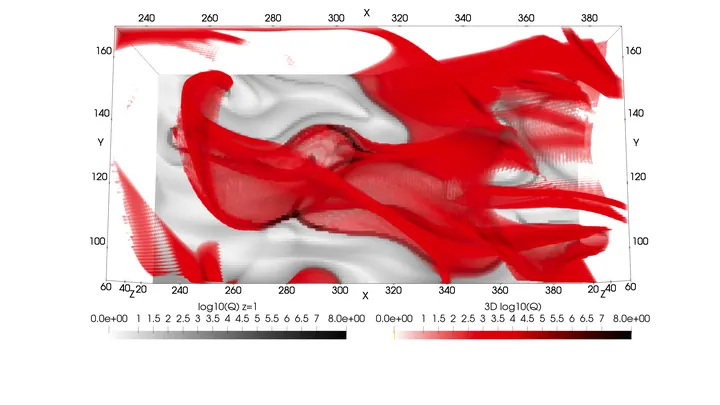
A tightly twisted phone cord snaps and scatters sparks. Magnetic fields on the Sun behave the same way: they twist, break, and reconnect, powering flares. For the first time, astronomers have witnessed this process directly. One loop was twisted by 540 degrees — one full turn and then half again. That’s three times more than previously thought possible.
A radio telescope is not just an antenna, but a computing machine that builds an image from millions of equations. This mathematical prism is as fragile as glass: one wrong digit in the calibration, and the real sky splits, spawning phantom sources.
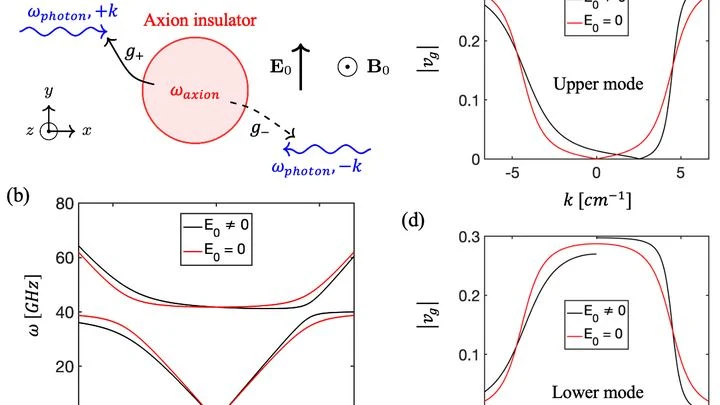
A regular flashlight shines equally forward and backward. But in magnetic crystals, a axion appears — a ghostly excitation, like a wave going around a stadium: atoms pass a magnetic impulse to each other. When light meets an axion, a hybrid forms, whose fate depends on electric and magnetic fields.
Even Jocelyn Bell Burnell, who first detected the strict periodicity of radio signals, noticed that some pulses would suddenly vanish. Today we know: variability is not a whim, but the voice of intricate electrodynamics.
In 2022, astronomers began discovering strange cosmic beacons — long-period radio transients. Unlike fast pulsars, discovered by Jocelyn Bell Burnell in 1967, these objects flared with periods of tens of minutes and hours.
Since their discovery in 2007, fast radio bursts (FRBs) have teased astrophysicists with their elusive nature. These millisecond signals arrive from distant galaxies and carry colossal energy: for an instant, they radiate as much as the Sun does in a month.
A streetlamp flickers as someone walks past. That's roughly how our nearest star, Proxima Centauri, behaves: it flares in response to the motion of its planets.
Astronomers observed the star with a highly sensitive instrument, the ESPRESSO spectrograph. It captures light and splits it into colors, much like a prism.
A spinning top whirls at great speed and, instead of a steady hum, emits a quiet buzz — because it is slightly dented. Neutron stars work much the same way: city-sized spheres compressed to such density that a teaspoon of their material weighs as much as a mountain.
The first exoplanet was discovered around an unusual cosmic lighthouse — a neutron star known as a pulsar. These ultra-dense remnants of dead stars spin at tremendous speeds and emit precise radio pulses.
A lighthouse blinks steadily once per second. If it moves in a circle, its flashes arrive sometimes a bit early, sometimes a bit late, and they give away an invisible companion. That's exactly how astronomers exposed the hidden partner of the star IY Lyrae.
IY Lyrae is a pulsating variable star in the thick disk of the Galaxy.
A lighthouse that changes the color of each flash in time with its rotation: that's one way to describe what astronomers saw when they pointed the latest X-ray telescope, XRISM, at the pulsar Hercules X-1. This object is a neutron star pulling matter from a companion ordinary star.
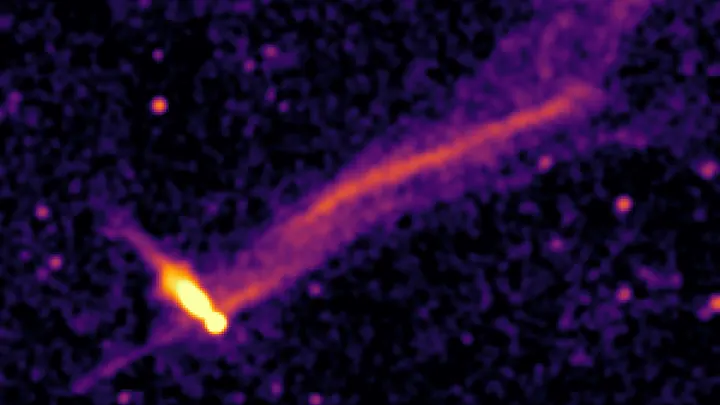
Deep in space, a rapidly spinning neutron star, a pulsar nicknamed the Lighthouse, speeds through tenuous gas. Like a motorboat cutting through water, it leaves a glowing trail of charged particles behind. In X-rays, this trail appears as a bright tail and a thin filament stretching over many light-years.
Two neutron stars — these are ultra-dense remnants of dead stars, each the size of a city but heavier than the Sun. Their existence was predicted back in 1934 by Fritz Zwicky. A teaspoon of this matter weighs billions of tons. When two such objects draw close before merging, their magnetic fields twist and snap like taut strings.
When two supermassive black holes circle each other before merging, they shake spacetime itself, like a speedboat racing across a lake leaves waves in its wake. These waves are called gravitational waves. They travel through the Universe and pass through everything, even the Earth.
A sunspot, a dark island on the scorching surface, breathes. Every three minutes, a wave spreads from it, runs along an invisible magnetic arch, and makes the plasma above a neighboring spot flare with a radio signal. Radio telescopes caught seven such flares in a row on February 14, 2024.
A solar flare is like a giant rubber band that's been twisted and let go. Magnetic field lines on the Sun tangle, snap, and reconnect — a process called magnetic reconnection. At the break point, energy bursts out: particles accelerate, plasma heats up, and we see bright ribbons on the surface.
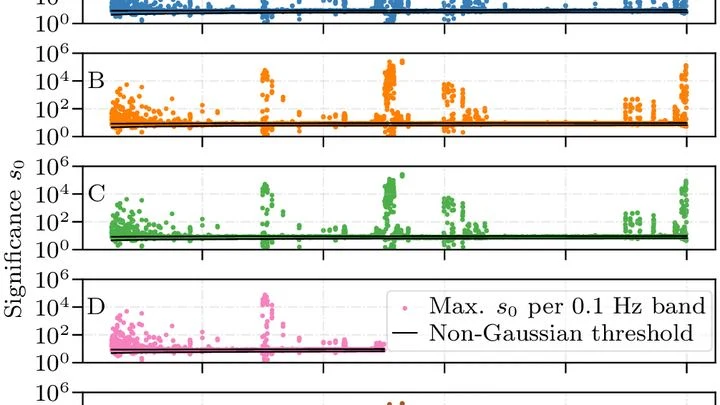
The night sky looks calm, but if you listen in on the radio band, it's full of short clicks and rustles. Astronomers are combing the sky for solitary radio pulses — bursts lasting milliseconds that come from various corners of the Galaxy and beyond.
One such search is underway at the 100-meter radio telescope in Effelsberg, Germany.
The lighthouse in the Crab Nebula blinks thirty times per second. It's a pulsar — a dead star that, as it spins, shoots out narrow beams of light, and Earth sweeps through them like a ship crossing a lighthouse beam. This lighthouse has two beams: the main pulse and the interpulse.
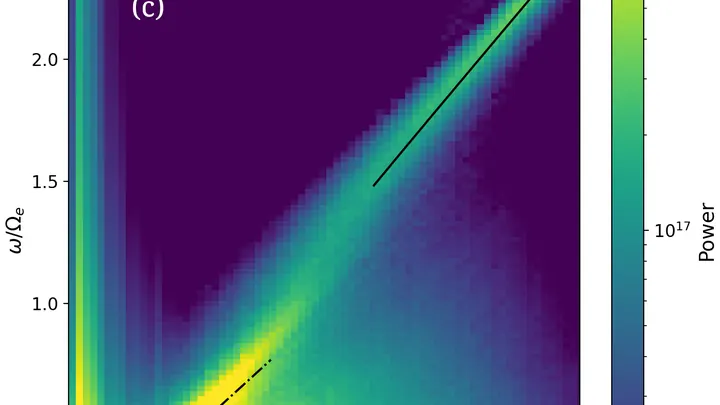
When water boils in a kettle, waves of steam ripple through the kitchen. A similar process happens in space, in plasma — gas so hot that electrons are stripped from atoms. Around black holes and neutron stars, this plasma isn't just hot: its particles zip around at nearly the speed of light.