Noise That Doesn't Kill but Disguises express
The quantum world is like an orchestra where each musician, a particle, plays their part, and together they create a harmonious symphony. But as soon as noise, random clicks and interference, enters the hall, the melody starts to drift. For a long time, it was believed that such noise (physicists call it decoherence) simply destroys any fragile quantum state, turning it into ordinary classical mush. New work shows that this is not always the case.
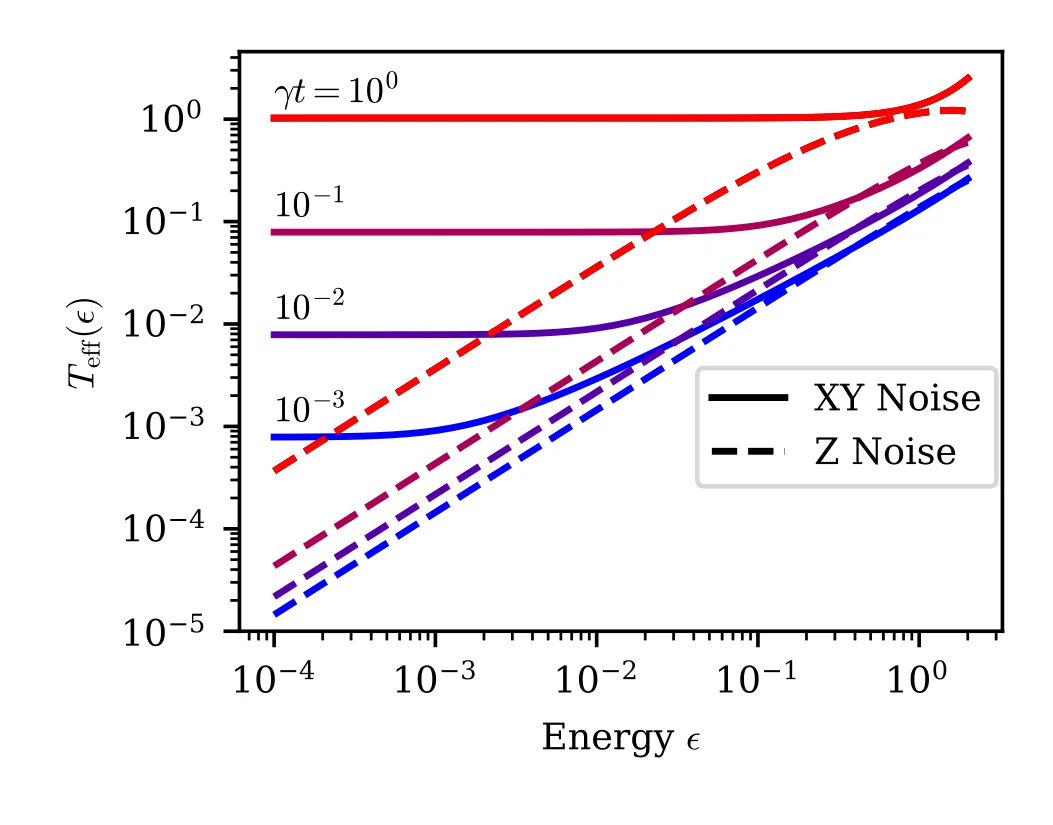
The authors took a simple model — a chain of particles that can point 'up' or 'down,' like tiny magnetic arrows. In its ground state, this chain sits on the edge between order and chaos: this is called a critical state, akin to water at the freezing point: not yet ice, but no longer liquid. Then they 'switched on' noise acting on each particle independently. This noise is of a special kind, so-called Pauli noise, named after Wolfgang Pauli; it resembles random jolts that flip or slightly jostle the magnetic arrows. The expectation was that the critical state would fall apart, but instead something strange emerged.
This is like an orchestra that, despite the crackling in the hall, keeps playing, but now its music sounds like a recording on an old vinyl record: the same melody, but with a characteristic hiss. The most surprising part is that this hiss is not just interference but a new form of order. The noise didn't kill the critical behavior; it shifted it into a different state that can be detected with a simple probe — a single additional qubit attached to the chain. No complex procedures, such as repeating the experiment many times or post-selecting successful outcomes, are required.
Practically, this means that quantum effects can be far more resilient than we thought. Even in a noisy, hot environment, they don't vanish without a trace; they hide in correlations that are accessible to measurements. This is a step toward understanding how the quantum world transitions to the classical, and how we can observe this process in detail.
In this work, noise is not just a nuisance but a tool that creates a new length scale, as if random jolts built an invisible lattice. This length manifests in the behavior of fermionic correlators — mathematical objects that describe how particles 'sense' each other at a distance.
In Greg Egan's novel 'The City of Permutations,' noise and decoherence act as fundamental limiters for quantum computing — here, however, noise unexpectedly becomes a creator of new order.