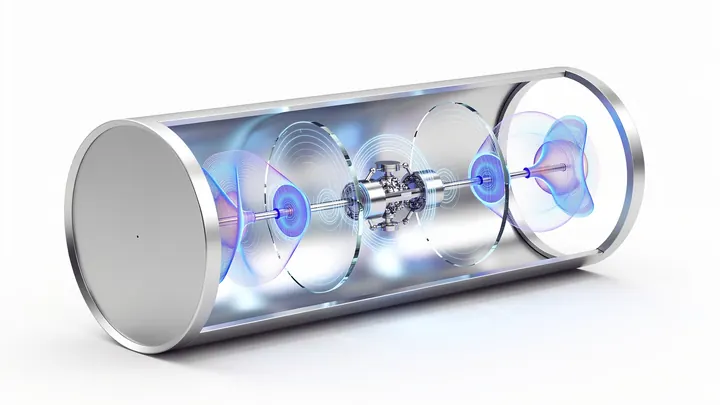
A dark state is a quantum state of a system that does not interact with light — it neither absorbs nor emits photons. In molecular systems, this means the state is effectively 'invisible' to optical excitation, yet it can still participate in energy transfer processes. Because it is decoupled from the radiation field, it is also largely immune to the thermal noise that would otherwise disrupt the coherence of the system, making it a robust carrier of energy or information.
History
The concept of dark states emerged from quantum optics in the 1970s, particularly in the context of coherent population trapping and electromagnetically induced transparency, with key contributions by Arimondo and others.
How it works
In a system of coupled quantum emitters (like molecules or spins), certain linear combinations of excited states can have a total transition dipole moment of zero. This destructive interference means the state has no coupling to the electromagnetic field, so it cannot decay by emitting a photon. The system can be driven into such a state via coherent control, and once there, it remains protected from radiative losses and many types of environmental decoherence.
In practice
Dark states are used in quantum memory and quantum repeaters, where they allow storage of quantum information without decay, and in energy transfer studies in photosynthesis, where they may enhance efficiency.
Fun fact
Dark states are the principle behind 'coherent population trapping', where atoms can be trapped in a non-emitting state even while continuously illuminated by resonant light.
The quantum world is full of surprises. In a Kerr parametric oscillator, a device where light is trapped in a ring and driven by an external field, researchers recently noticed something strange: pairs of energy levels merge in an embrace. Physicists have dubbed this a "spectral kiss" spectroscopy.
In an orchestra, one musician plays so quietly that their sound is almost inaudible in the overall chorus. In the quantum world, such 'quiet' states are called dark: their energy barely escapes, like light in a darkened room. But if there are many musicians, their mutual influence can unexpectedly awaken even the most silent one.
A ball on a slope with two pits usually rolls into the nearest one and comes to rest. But if the slope is slightly deformed and 'remembers' recent nudges, the ball can hang around halfway for a long time — in a narrow spot it doesn't want to leave. That's exactly the trick physicists played with light.
Every isolated quantum system inevitably moves toward thermal equilibrium — a state where all details of the past are erased. It’s like an orchestra: instead of a symphony, it starts playing white noise — random but statistically predictable notes.
The quantum world is like an orchestra where each musician, a particle, plays their part, and together they create a harmonious symphony. But as soon as noise, random clicks and interference, enters the hall, the melody starts to drift.
A drummer stays silent, but from the pauses you can tell where he didn’t hit. Similarly, physicists built an image by catching not light, but moments of absolute darkness. The picture emerged from silence.
In the experiment, they shone light from an ordinary lamp onto the object.
Lasers usually heat things up. But in some crystals, light can carry heat away, like a teapot cooling under a bright lamp. In diamond, this job falls to defects: spots where a nitrogen atom replaces carbon, with a vacancy nearby.
Sunlight is a turbulent stream carrying inseparable pairs of droplets. That’s what quantum entanglement looks like: two particles are so connected that a fluctuation in one instantly resonates in the other. In the past, creating such pairs required a 'calm pool' — a perfectly tuned laser beam.
A quantum dot the size of a few thousand atoms blinks like a faulty light bulb. It flashes brightly, then almost goes dark. Previously, it was thought that in dark moments it emits not only single photons but also extra pairs — a defect for quantum communication.
Two beams of light, red and blue, enter a tiny ring made of silicon nitride. The ring is smaller than the thickness of a human hair. At the input, both beams are equally bright. But inside the ring, one of them suddenly starts to outshine the other, like two equally matched people in a debate where one unexpectedly gains the upper hand.
Dark matter makes up 85% of the matter in the Universe, yet remains invisible. It only reveals itself through gravity. We can catch it by its cosmic 'hum' — a faint vibration that permeates space. A single detector is powerless here: the signal is too quiet.
Physicists turn many sensors into a quantum ensemble.
Emptiness isn't always empty: it can hide energy, like supercooled water hides ice. Physicists call this false vacuum — a state that only needs a nudge to cascade into the true one.
A turnstile lets you through only forward, and not a step back. Physicists have implemented a similar principle on a tiny semiconductor chip for single photons — particles of light.
In the world of microchips, where streams of photons, quanta of light, carry information, a fundamental problem arises: light passing through matter inevitably heats it. This heating spawns thermal fluctuations — chaotic, unpredictable jostling of atoms that disrupts precise device operation.
Two travelers head for the same destination. One starts closer but takes a winding country road. The other starts farther away but immediately hits the highway. The second arrives first. In quantum physics, this paradox is known as the quantum Mpemba effect: a state initially farther from equilibrium reaches it faster than one that starts closer.
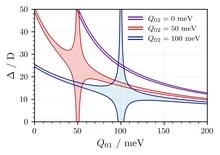
Two voices in a molecular duet can sound in unison or cancel each other into silence. In physics, such silence is called a dark state: a quantum excitation that does not interact with light and therefore lives unusually long.
Spontaneous emission, the very process that lights up lamps and stars, has long been considered a pesky noise in quantum physics. This cacophony of random photons ruthlessly destroys fragile quantum entanglement, like radio static drowning out a distant melody.