A squeezed state is a quantum state with reduced noise in one variable at the expense of another, used in enhanced measurement and entanglement generation.
51 related articles · 3 formulas · 1 who worked here
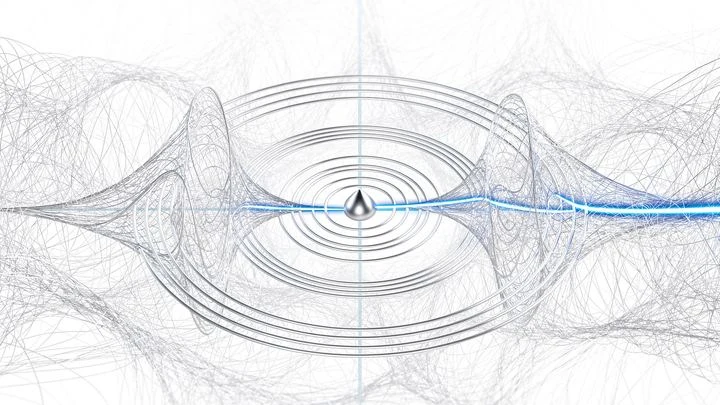
A squeezed state is a nonclassical state of the electromagnetic field in which the variance (spread) of one quadrature variable (e.g., phase) becomes smaller than the vacuum level, while that of the conjugate becomes larger. Mathematically, it is obtained by applying the squeezing operator S(ζ) = exp[½(ζ* a² − ζ a†²)] to the vacuum or a coherent state. The parameter ζ = r e^{iθ} specifies the squeezing degree r and the direction in phase space. Such states are generated in nonlinear crystals via parametric down-conversion or four-wave mixing and are widely used to enhance the precision of interferometric measurements.
History
The first theoretical works belong to Yamamoto and Haus (1970s). In 1981, Carlton Caves showed the quantum-mechanical limits of interferometric measurements and proposed using squeezed light to overcome them. The experimental generation of squeezed states was first achieved by Slusher's group in 1985. In the 2000s, Rainer Weiss and colleagues developed a technique for injecting squeezed vacuum into gravitational detectors, which became one of the key achievements recognized by the 2017 Nobel Prize.
How it works
Squeezing is generated in a nonlinear crystal with χ⁽²⁾ susceptibility. In the parametric amplification regime, a pump photon with frequency ω_p decays into two entangled photons with frequencies ω_s and ω_i. If one of the beams is detected, conditional squeezing is realized in the other. In LIGO, squeezing of the vacuum state is used: squeezed vacuum is directed into the dark port of the Michelson interferometer, which reduces photocurrent fluctuations without introducing additional classical noise. The evolution equation in the Heisenberg picture for the quadratures is described by a linear squeezing transformation, preserving the commutation relations.
In practice
Allows gravitational-wave observatories to catch the shudder of space from black hole collisions, improving sensitivity by orders of magnitude.
Fun fact
In the LIGO detector, squeezed light reduces quantum noise so much that a length change of a four-kilometer arm by one-thousandth of a proton diameter can be noticed.
A ship in a bottle is assembled from the inside, not the outside: masts and sails are pulled through the narrow neck, and once inside the glass they settle into the right pose on their own. Chemists have done something similar with a single cobaltocene molecule, which they pulled into the gap between layers of a two-dimensional crystal.
Three voices merging into a single chord. In the physics of quantum materials, this image takes on a literal meaning: three layers of graphene, separated by thin spacers, force electrons and holes from different layers to move as a single fluid.
A laser hits an atom, and tears out an electron. The brighter the light, the stronger the kick, and the faster the electron flies away. That's how the familiar picture works, where light is a smooth wave. But what if the light isn't smooth but 'squeezed,' with quantum fluctuations, like the trembling of a string?
A short flash of light is like a musical phrase: you can distinguish individual notes if you listen very carefully. But in the quantum world, these 'notes'—temporal modes — are squeezed down to picoseconds, and ordinary optics can barely tell them apart.
A handful of pebbles drops into a pond: each one sends out ripples. If the pebbles are different, the ripples will be different too: some sharp, some smooth. But when you look at the water from a distance and see only a small part of the ripples, all those differences blur together.
Two tiny diamonds float in a vacuum, separated by a distance that light cannot cross during the experiment. Inside each, like a frozen spark, resides an entangled spin — a quantum state linking them into a single whole. Now the diamonds begin to move, but not just any motion: each one seems to split, existing in two places at once.
A handful of pebbles drops into a pond: each one sends out ripples. If the pebbles are different, the ripples will be different too: some sharp, some smooth. But when you look at the water from a distance and see only a small part of the ripples, all those differences blur together.
Imagine a huge puzzle where each piece is a quantum particle. To complete the picture, you don't just fit the pieces together: you need to entangle them in a special way. Usually, this is done by carefully applying operations one after another, like assembling the puzzle strictly by the instructions, row by row.
In a pot of water carefully heated above its boiling point, the liquid remains calm. But the slightest disturbance, and it violently turns to steam. Physicists call this a metastable state: it seems stable, but in reality it's ready to break apart at the slightest nudge.
Hot water sometimes freezes faster than warm water: this odd fact is known as the Mpemba effect. Now something similar has been found in the quantum world: a state with weak entanglement (a special quantum connection between particles) can beat a more entangled one to the finish line.
A stone drops into a pond, and ripples spread across the water. In the same way, massive bodies generate gravitational waves, except it's space itself that ripples. So far, these waves have been caught by giant detectors that barely flinch as a wave passes through. But what happens on the microscopic scale, inside a tiny piece of matter?
The quantum world never stands still. Even in the most perfect resonator, a trap for particles of light, energy gradually leaks away, and information is erased. Physicists call this process decay, and it has its own rhythm: some 'notes' fade quickly, while others linger.
The quantum world is like a kitchen where particles suddenly appear out of "nothing." But you need a chef — a classical field acting as an external source. Glauber's theorem, long known in optics, has now been generalized: it shows exactly how the field "cooks up" particles, be they photons or gravitons.
Take two thin sheets of a semiconductor. One is saturated with free electrons, like a packed café where every table is taken. The other, by contrast, is full of empty spots—'holes' eager to be filled. When these sheets are brought close together, a spark of attraction jumps between them: electrons and holes begin to feel each other across the thin gap.
In a tight row of atoms, spaced closer than the wavelength of light, a remarkable state hides. The excitation is distributed among all particles so that their radiation cancels itself out. This quantum 'silence' is an ideal vault for a photon: it can be stored there hundreds of times longer than usual.
Two charged spheres collided and flew apart in different directions. You'd think it was all over — but the light from their farewell still wanders through space. In the ordinary world, this is a well-known effect: an accelerated charge always radiates.
A pendulum weighing a few grains of sand swings on a hair-thin glass fiber. Its motions are so faint that the thermal jostling of air molecules seems like a hurricane. Yet such a pendulum is the key to witnessing quantum wonders in the world of large objects.
A tiny defect in a diamond crystal is like a sensitive microphone picking up the faintest magnetic fields. That's how sensors based on nitrogen-vacancy centers work (where a nitrogen atom and a neighboring vacancy form a quantum system). To hear the whispers of individual molecules, the sensor is placed right at the surface.
A pale green crystal was placed in a magnetic field and cooled below one kelvin — almost to absolute zero. Inside it hide chains of copper atoms that behave like tiny magnetic needles. Usually their orientation is chaotic, but the strong field and cold make the needles align in a unified impulse, like soldiers on a parade ground.
After a hit, a black hole rings like a bell. But instead of sound, it emits gravitational waves whose frequency rapidly decays: these are called quasinormal modes. From such a 'ring,' you can infer the hole's mass, spin, and other properties.
Hot tea cools down, and ice cream melts — heat always flows from warm to cold, and this law seemed unbreakable. But in the quantum world, even familiar rules can be rewritten. Physicists placed a tiny mechanical resonator (a vibrating bridge the size of a microbe) in an optical cavity between two mirrors.
An optical trap holds an atom almost motionless, like a ball on a soft spring. But as soon as acceleration appears, say gravity, the equilibrium shifts. The atom moves within the standing light wave, and this changes the rate at which it exchanges energy with the field. The frequency of this exchange becomes a direct indicator of acceleration.
A massive aluminum cylinder weighing a ton hangs in a vacuum. A gravitational wave, a ripple in spacetime, passes through it, and the bar begins to tremble almost imperceptibly. That trembling can be heard as sound: gravitational waves turn into a phonon — a quantum of sound vibrations.
Three laser beams intertwine into a triangle. Each is linked to the other two: this is the structure of the new scheme that physicists call "fully connected three-mode squeezed vacuum." This is not just three independent light sources: inside a special crystal, triples of entangled photons are born, and the connection between them resembles a complete graph of…
A delicate watermark on wet paper, and a fogged-up glass before your eyes. That's roughly what reading quantum states of light looks like: fragile photon patterns get distorted by losses, and detectors catch only a small fraction of the signal.
Inflate a balloon, and the dots on its surface move apart from each other. Our universe expands in much the same way. The mathematical model of this process is called de Sitter space — where scientists study how the tiniest 'building blocks' of matter, elementary particles, behave.
But in a curved, constantly expanding space, the usual description of particles breaks down.
Water from a faucet boils quickly, but in the last moment before the boiling point, everything seems to freeze — bubbles hesitate, the temperature stalls. So it is in quantum systems: when a material approaches a critical point, its internal clock stretches to infinity.
A raw digital photo resembles a mosaic: each pixel holds only one base color — red, green, or blue. To compress such a file, it's split into brightness (a detailed black-and-white image) and color components.
The quantum world is often compared to a musical instrument. Each system, whether an atom or a chain of particles, sounds at its own frequencies, which physicists call energy levels. In chaotic systems, like an orchestra without a conductor, these frequencies usually fill the entire available range without gaps.
Quantum vacuum is not absolute emptiness. It is more like a taut membrane that constantly ripples from invisible particles popping in and out of existence. Even in total darkness, this membrane trembles. Physicists decided to see how it behaves around a thin spherical shell, inside which is ordinary flat space, like in our room.
Light waves are never perfectly smooth — they are constantly jittered by quantum ripples. These almost invisible nudges were studied by Nobel laureate Roy Glauber, who laid the foundations of quantum optics. Now physicists have learned to freeze these ripples.
A black hole is where the usual rules break down. At its center, according to classical physics, lurks a singularity: a point of infinite density where everything that falls in gets crushed. Quantum theory was supposed to soften this picture.
A living cell constantly emits faint magnetic signals, as if whispering. Scientists eavesdrop on this whisper with two microscopic 'microphones'—magnetic field sensors.
An ordinary network of four optical waveguides is like an intersection without traffic lights: the signal wanders in all directions and mixes. But if you look only at some of the outputs, the picture changes. An illusion arises that the system has losses — though in reality energy doesn't disappear; it just goes into unobserved ports.
A runner on the middle of a track suddenly switches to a walk — not speeding up or slowing down, but maintaining a constant pace. Something similar may have happened to the universe itself shortly after the Big Bang.
A magnetic field holds a tiny particle in mid-air, like an invisible dance partner. A special tuning of the field creates a trap with two "positions." In the ordinary world, a dancer occupies only one, but in the quantum world — both at once. Physicists have learned to achieve this for dust grains weighing trillionths of a gram.
The quantum vacuum is not a dead void but a boiling cauldron of probabilities. In some theories, our Universe is frozen in a metastable state: like superheated water, it's ready to explode into steam at the slightest nudge.
Quantum entanglement often behaves like a synchronized dance visible from only one angle. Change the way you observe it, and the particles appear disconnected. This limits secure communications. Now physicists have created a pair of photons whose 'dance' is flawless from all perspectives.
At temperatures billionths of a degree above absolute zero, a Bose–Einstein condensate emerges — a state where thousands of atoms march in a single quantum key.
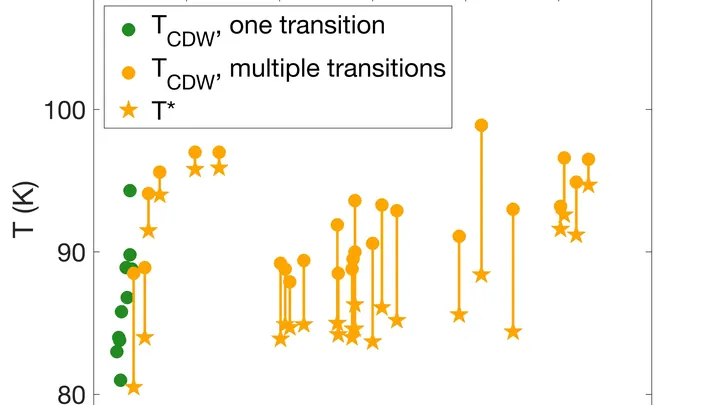
Sometimes a crystal behaves like an interpreter who gets distracted by every rustle in the room, and a one-hour meeting stretches into two. In the metal ScV₆Sn₆, atoms are arranged in a kagome pattern (a weave of hexagons and triangles), and upon cooling, a charge density wave emerges — a periodic deformation of the electron cloud.