Imagine a kettle with boiling water. Normally, when water turns into steam, you can see bubbles and bubbling. But if you heat water under high pressure, you can reach a state where water and steam become completely indistinguishable — this is the critical point. At this point, liquid and gas merge into a single state, like a thick fog, but without a surface boundary. It's similar to how, in the morning, the air is so saturated with moisture that dew droplets and air merge into one whole.
History
The critical point was discovered by Charles Cagniard de la Tour in 1822, but systematically studied by Thomas Andrews in 1869. Andrews showed that for each gas there is a temperature above which it cannot be liquefied. In 1873, Johannes van der Waals proposed an equation of state for real gas that for the first time explained the existence of a critical point based on molecular forces. In the 20th century, Landau developed the theory of second-order phase transitions, and Wilson applied renormalization group to describe universal critical phenomena.
How it works
From a microscopic perspective, the critical point is the result of a balance between intermolecular attraction, which tends to condense the substance, and thermal motion, which tends to expand it. At the critical temperature, the attraction energy equals the thermal energy, and the phase boundary disappears. This is described by the van der Waals equation, which includes parameters a and b. At the critical point, compressibility tends to infinity, and the correlation length of fluctuations becomes macroscopic, leading to critical opalescence. In modern understanding, critical phenomena are universal and do not depend on system details, but are determined only by the dimensionality of space and the symmetry of the order parameter, as described by renormalization group theory.
Fun fact
Did you know that at the critical point, water can simultaneously wet and not wet the walls of the container? The difference between liquid and steam disappears, and surface tension vanishes, so the liquid stops forming droplets.
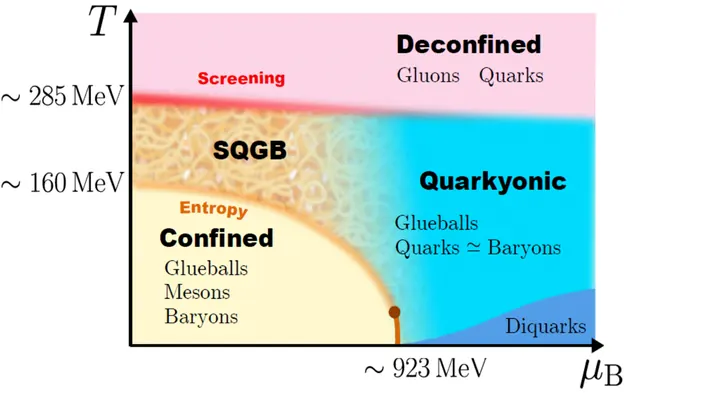
The map of dense nuclear matter resembles a road map: lines of phase transitions cross at critical points, like highways at intersections. Until now, only two intersections were known on such a map: the nuclear liquid-gas and deconfinement, where hadrons dissolve into quarks.
One universal interpreter for all dialects of sodium. Liquid sodium in a reactor behaves differently: near the pipe wall it is dense and fast, near the boiling surface it is rarefied and slow. Previously, each state required its own set of calculations, as if hiring a new translator for every phrase.
In a nine-story building with a thousand rooms on each floor, some people whisper and others shout. Neighbors pass the message along, but if everyone speaks too softly, the message fades by the third floor. If too loudly, by the top floor it becomes an unintelligible roar. Between these extremes, there is a regime where a whisper makes it all the way through without distortion.
In the depths of sub-Neptunes, the most common type of planet in the Galaxy, though not one you could stand on, silicate magma and hydrogen mix into a single supercritical cocktail. Previously, it was thought that beneath the dense hydrogen atmosphere lay a sharp boundary with molten silicate, like oil on water.
Ordinary ice turns into water at zero degrees. And matter at nuclear density, quark-gluon plasma, undergoes something similar at about 155 MeV (roughly two trillion degrees).
Many materials behave like finicky ice: at one pressure they melt, at another they turn harder. Superconductors in the cuprate family are no exception. Their ability to carry current without loss depends on how tightly the crystal lattice is squeezed. In a new study, physicists traced this dependence for the compound Bi-2223.
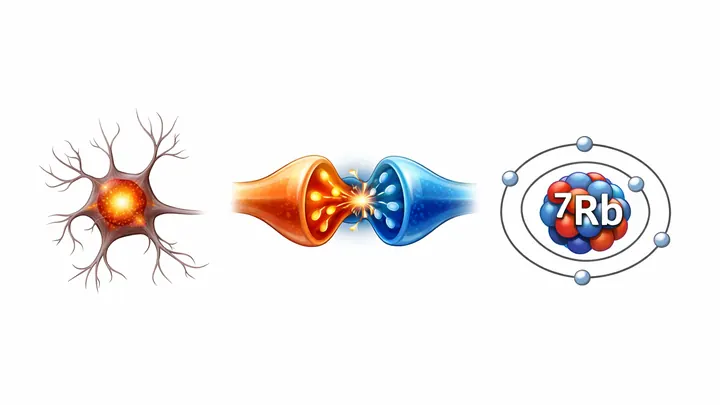
A cloud of atoms cooled to near absolute zero suddenly starts behaving like a brain. One excited atom triggers a chain reaction — neighbors light up in turn, and an avalanche of activity sweeps through the gas. Physicists call this Rydberg facilitation: atoms are easier to excite when an excited one is nearby.
If you squeeze water between two glass plates so that only two layers of molecules fit, it becomes something between a liquid and ice. At room temperature, molecules in such a trap still move but arrange themselves into a semblance of a crystal lattice.
Atomic nuclei are rarely perfect spheres. More often, they resemble a slightly squashed ball — the electric charge inside is unevenly distributed, and protons may shift a bit, creating a tiny 'pear-shaped' bulge.
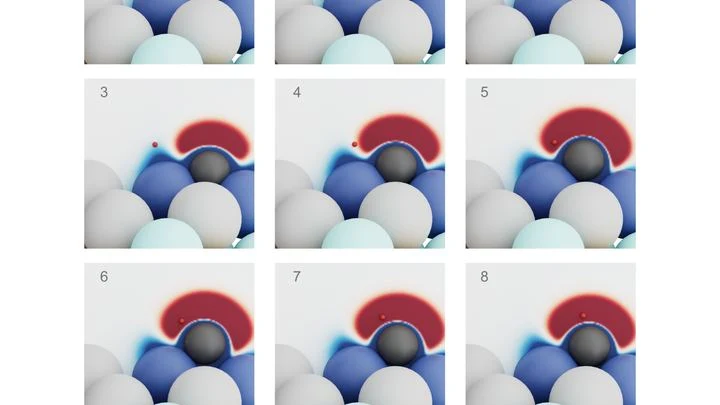
A kitchen sponge soaked in syrup: in some spots there's more syrup, and your finger sticks right away; in others, it barely touches. That's roughly how a catalyst surface works. Molecules don't react everywhere but at especially sticky points — active sites.
Tiny magnets on a lattice, the classic Ising model, are usually described by how neighbors influence each other. But what happens when the system is closely watched? Each measurement of a coupling energy is like a gaze that forces the magnets to 'decide' their state.
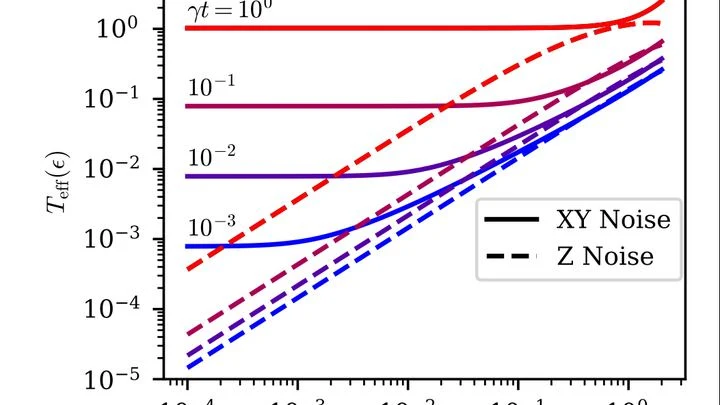
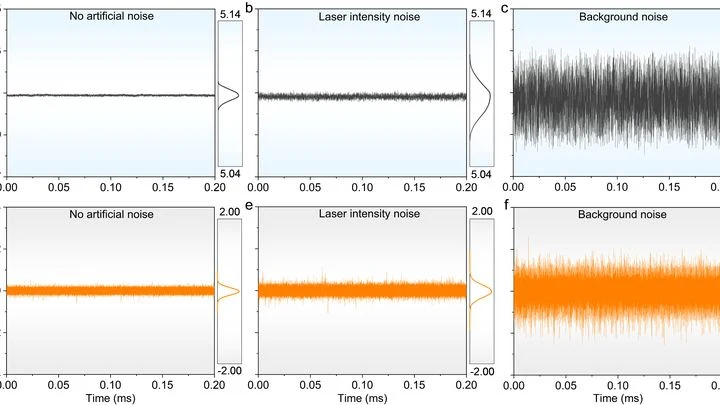
The quantum world is like an orchestra where each musician, a particle, plays their part, and together they create a harmonious symphony. But as soon as noise, random clicks and interference, enters the hall, the melody starts to drift.
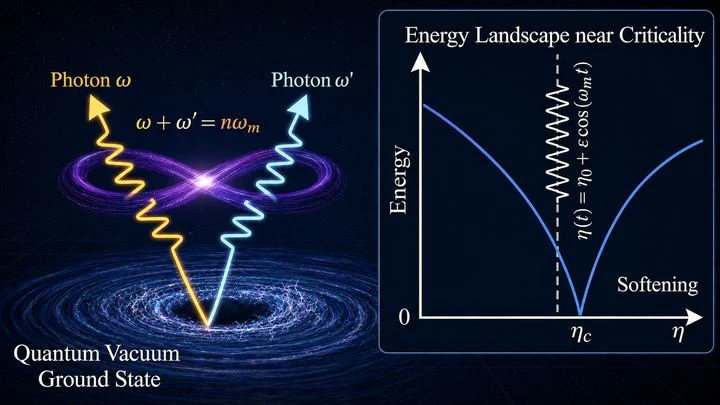
The quantum vacuum is not emptiness, but a tautly stretched string, where particles constantly appear and vanish. Abruptly changing conditions, like shifting the mirrors of a microcavity, causes the 'string' to emit real photons.
An aluminum pot on the stove melts at 660 degrees Celsius — everyone knows that. But what happens if you heat aluminum a hundred times hotter? The liquid starts to boil, and here's the puzzle: at what exact temperature does that happen?
A superconductor is a material through which current flows without loss, like water through a perfectly smooth pipe. But to make the pipe perfect, you have to cool it to very low temperatures. Physicists have long been looking for ways to make such a pipe at warmer temperatures, and one clue is the quantum critical point.
A copper crystal is squeezed in diamond anvil cells. As pressure mounts, a battle unfolds inside the material between two states: one prepares electrons for superconductivity, the other hinders their pairing. Scientists tracked this struggle using ultrashort laser pulses.
Superconductivity is when electric current flows without losses, like water through a perfectly smooth pipe. It usually occurs at very low temperatures, but there are materials where it appears at higher ones.
Water in a kettle, as it boils, clearly separates into liquid and steam. But under enormous pressure, the boundary vanishes: the substance enters a supercritical state — neither one nor the other, but something in between.
Black holes can do this too.
Any cook knows: whether dough sticks to a pan depends on what happens at the interface between two media. For molten metals, that interface long remained invisible — temperatures above 200 °C made it impossible to resolve individual atoms.
Water is the only common liquid that doesn't immediately contract when cooled. Ice melts, and water becomes denser, but only up to 4 degrees Celsius. Beyond that, with further cooling, it expands again. This quirk explains why fish survive in freezing ponds: the densest water sinks to the bottom, while a lighter cold layer stays on top and turns into ice.
A superconductor is a material that, when cooled sufficiently, conducts electricity without losses, like water flowing through a perfectly smooth pipe. But if you hit it with a brief flash of light, it quickly loses this property.
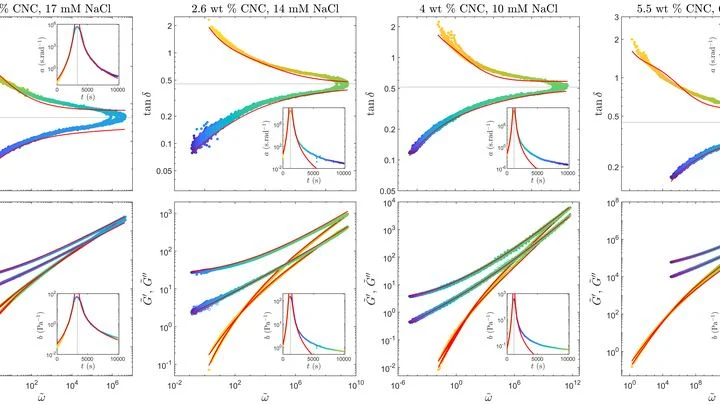
In a glass of water with charged cellulose rods (the kind you get from wood), a curious transformation takes place. As long as the rods repel each other, the mixture flows like a liquid. But add a pinch of salt, and the repulsion weakens, the rods start to stick together and form a three-dimensional network: the liquid sets into a gel.
A crystal made of strontium, iodine, oxygen, and hydrogen looks like an ordinary white powder. But when you squeeze it with a force of hundreds of thousands of atmospheres, a rearrangement begins inside. Iodine atoms, which usually keep their distance, suddenly move closer and form new bonds.
Weighing a piece of ice in a glass of water can tell you how much water has already frozen. If the scale is off by a factor of three, the ice will appear much larger than it really is. A similar story happened with calculations of the superconducting phase in a crystal of nickel, lanthanum, and samarium under high pressure.
Two twins look identical, but one is left-handed and the other right-handed. In the world of elementary particles, there are similar pairs: Ξ- and its antiparticle Ξ+. They are born together in the decay of the J/ψ particle and, like entangled twins, maintain a connection even at a distance.
A superfluid flows without friction, like water in a perfectly smooth pipe, but the moment it hits an obstacle, the picture changes. In a new study, researchers looked at how a superfluid stream flows around rectangular walls and pits with sharp corners.
Inside some materials, electric current flows with zero resistance. These are superconductors, and they only work when it's very cold. Copper oxides are special: they stay superconducting at somewhat higher temperatures, but why has been a puzzle for forty years.
To tell one protein from another, you need to describe its shape and composition. There are dozens of such descriptions: molecular length, charge, solubility. But not all are equally useful. A method called Differentiable Information Imbalance (DII) can pick out the most informative features while discarding the rest.
In a superconductor, electric current flows without loss, like water through a perfectly smooth pipe. But if you place such a material in a magnetic field, vortices appear inside — tiny whirlpools where superconductivity is destroyed. As long as these whirlpools stay put, current flows freely.
Light is trapped in a tiny cavity and circles around like a ball in a groove. If you slightly change the material inside, the light notices immediately, and gives a signal. Usually, such sensors work like spring scales: the harder you press, the more noticeable the shift. But there's another, trickier approach: make even a weak perturbation produce a disproportionately large response.
Salt in a glass of water is a crowd of charged particles. When there's plenty of water, each particle floats on its own, wrapped in a thick fur coat of water molecules. But as you keep adding salt, the water runs out for everyone, and the particles start seeking each other out. First, they stick together in pairs, then in larger clumps.
A drop of a thick cornstarch-water mixture falls onto a table. Normally, such a mixture solidifies instantly upon a sharp impact: you can even run across a pool filled with it. But in this experiment, things went differently. The high-speed camera captured that in the first instant after contact, the drop spreads out like an ordinary liquid.
Water freezes at zero and boils at one hundred degrees. Matter made of quarks and gluons also has boundaries between states, but instead of a thermometer, the temperature here is measured in millions of electron-volts.
Water in a kettle heats to 100 degrees, and stops being water, turning into steam. Something similar happens to atomic nuclei when they are smashed together at enormous speeds in the Large Hadron Collider.
Scientists applied an unusual mathematical approach in the equations of искривления пространства-времени and obtained a new type of charged чёрных дыр. Their behavior turned out to be surprisingly familiar: this is how вода in a pot behaves when it starts to boil.
In a chain of cold spins stretched along a single line, order and disorder can intertwine into a pattern that defies the usual rules. Two states of matter, two kinds of "order," are separated by a crossroads where the roads do not converge but diverge.