The ground state is the lowest possible energy level of a quantum system — an atom, a molecule, a nucleus, or a collection of particles. It is the state in which the system rests when no external energy is supplied, and it serves as the reference point for all excitations. In quantum mechanics, the ground state is not a state of zero motion: even at absolute zero temperature, particles retain a minimum 'zero-point' energy due to the uncertainty principle. This means the ground state is a dynamic equilibrium, not a static stillness.
History
The concept emerged from Niels Bohr's 1913 model of the atom, which introduced discrete energy levels, and was formalized in the 1920s with the development of quantum mechanics by Schrödinger, Heisenberg, and others.
How it works
In a quantum system, energy levels are discrete. The ground state is the lowest of these levels, and any transition to a higher level requires absorbing a photon or other energy quantum. When a system in an excited state relaxes, it returns to the ground state, often emitting light or heat. The properties of the ground state — its energy, symmetry, and wavefunction — determine many observable behaviors, such as chemical bonding, magnetism, and superconductivity.
In practice
Ground states are central to quantum computing, where qubits are initialized in their ground state before operations, and to laser technology, where population inversion requires emptying the ground state to achieve stimulated emission.
Fun fact
The ground state of a hydrogen atom has a nonzero kinetic energy of about 13.6 electronvolts — the same energy required to ionize the atom — even at absolute zero.
Electrons in a solid usually either run freely (metal) or are locked in place (insulator). But sometimes strong mutual repulsion locks them into a halfway state: charges stand still, while spins, tiny magnetic arrows, continue to live their own life. This is called a Mott insulator.
Soil is not a solid sponge but a labyrinth of pores of various sizes. After rain, water does not fill them all at once: first the narrowest ones, then the wider ones. Physicists built a theory of this process based on a simple image — a set of communicating vessels.
Boson stars are gravitational atoms. Only instead of electric charge, gravity itself serves as the nucleus, holding a cloud of scalar field in quantized clumps.
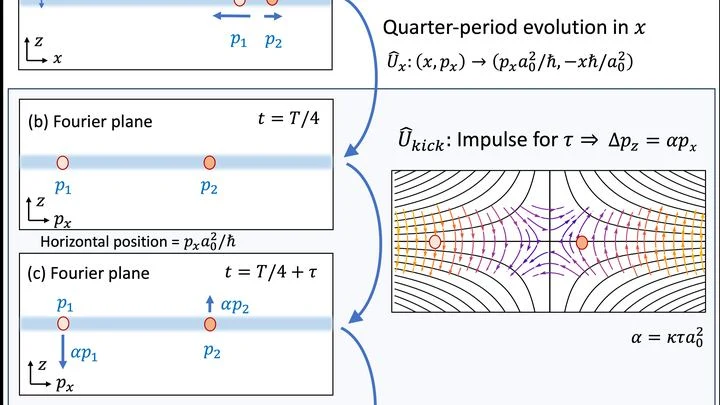
Gravitational-wave observatories are like a keen ear listening for distant rumbles of cosmic catastrophes. To catch the faint whisper of merging black holes, detectors of gravitational waves use specially prepared light — known as squeezed vacuum.
Our universe isn't just expanding: it's doing so faster and faster. It's like raisin bread dough in the oven: the raisins move apart, and the farther they've already separated, the faster they continue to recede. The strange force pushing the cosmos apart is called dark energy. Most scientists think it's constant, like a permanent spring built into the very fabric of space.
A soap bubble hangs in the air, and its shape already contains everything needed to calculate the internal tension. A similar principle worked in a new study on quantum gravity. Physicists took a closed surface, an analog of such a bubble, and specified a few numbers on it: for example, the electric field strength and the curvature.
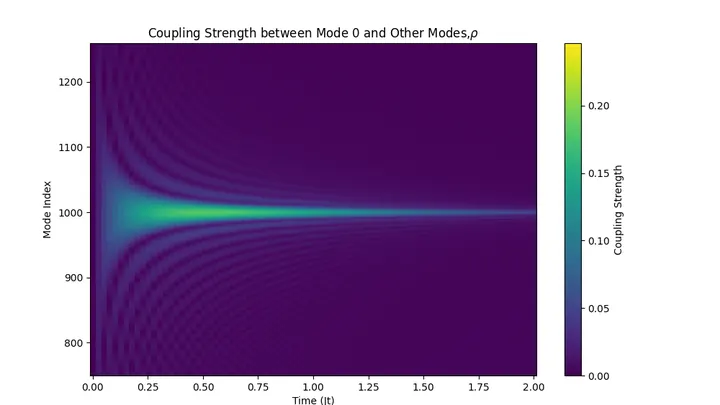
In an orchestra, one musician plays so quietly that their sound is almost inaudible in the overall chorus. In the quantum world, such 'quiet' states are called dark: their energy barely escapes, like light in a darkened room. But if there are many musicians, their mutual influence can unexpectedly awaken even the most silent one.
A pot of soup forgotten on the stove cools to room temperature. It seems everything has come to rest. But if you look inside with a quantum magnifying glass, you'll find that water molecules haven't frozen: they continue their dance. It's just that now the dance is steady, not turbulent like when boiling.
Throw a stone into a pond, and ripples spread across the water. Throw two stones nearby, and the ripples intersect, creating a pattern of reinforced and canceled waves. That's interference.
Two thin sheets with honeycomb patterns were stacked and slightly rotated, creating a new pattern — a moiré, like the shimmer of silk. The electrons in the experiment behaved similarly: they arranged themselves into two layers, with one layer rotated exactly 30 degrees relative to the other.
A quantum battery is not a box of chemicals but a chain of tiny magnets (spins) capable of storing energy. Its main trick: charge many particles at once, using their quantum entanglement. But there's a catch — not all entanglement works.
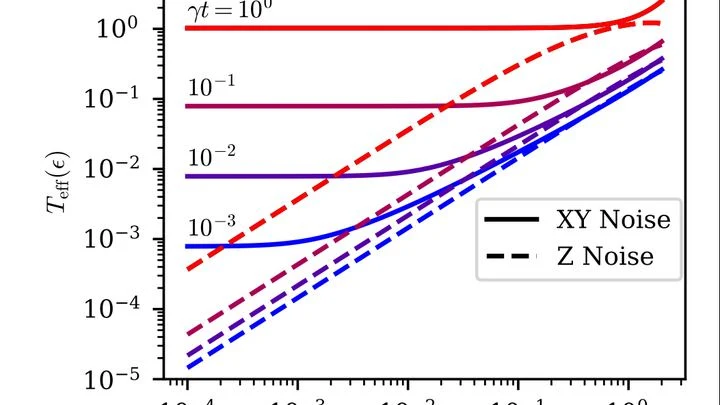
The quantum world is like an orchestra where each musician, a particle, plays their part, and together they create a harmonious symphony. But as soon as noise, random clicks and interference, enters the hall, the melody starts to drift.
A fisherman casts a net into a quiet backwater. The longer the rope, the weaker he feels the faintest nibble — the wave fades along the way. But what if the signal didn't die out but grew stronger? That's roughly the trick described by the authors of a study on an ensemble of particles placed in a field with a special 'stepped' force gradient.
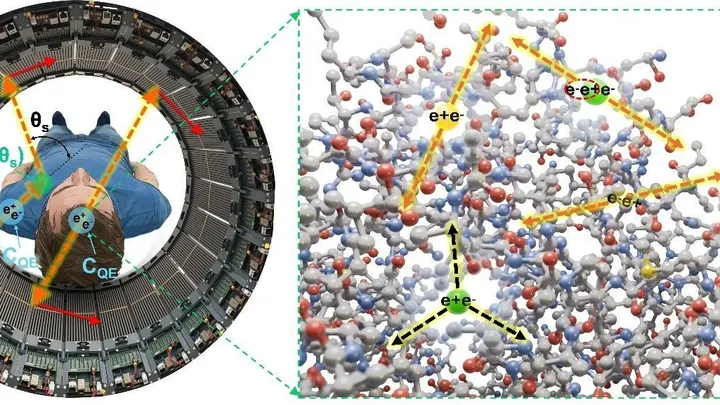
Two photons fly out from a single point in a patient's chest. They are twins: alter one, and you instantly know about the other. This connection is called quantum entanglement. In a PET scan, these pairs are born inside the body when an injected radioactive substance meets electrons in the tissues.
The degree of entanglement is not constant.
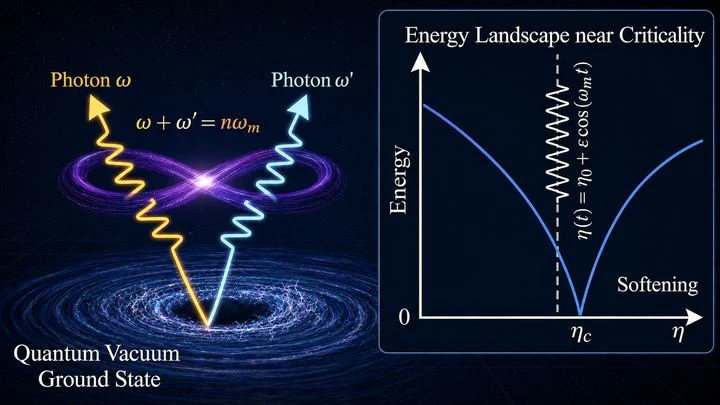
The quantum vacuum is not emptiness, but a tautly stretched string, where particles constantly appear and vanish. Abruptly changing conditions, like shifting the mirrors of a microcavity, causes the 'string' to emit real photons.
Two tiny dust grains hover at the crossing of laser beams. Each is held by its own 'tweezer'—a focused beam that keeps the particle from falling. Inside a mirrored cavity, light bounces between the walls, and its oscillations are coupled to the trembling of the grains.
A quantum system can possess a property called magic. It's not about tricks: it's a measure of how hard it is to reproduce its behavior on a classical computer. Ordinary states, known as stabilizer states, are easy for a computer to handle. But states with magic leave it stumped.
In the basement of a laboratory in Jyväskylä, a trap holds a single atom aloft, like a magician balancing a ball on a fingertip. The tin-113 atom is unstable: sooner or later it captures one of its own electrons and becomes indium-113, emitting an elusive particle — the neutrino. How much energy is released in the process was previously known only approximately.
Fireflies flash in a dark forest: you see each flash, but not the flight. A quantum gas microscope can show individual cold atoms, like those fireflies. But until now, it couldn't tell you how fast they're moving.
Now scientists have found a way to fix that.
Two quantum dots are like two tiny pockets in a piece of silicon where an electron can sit, like a ball in a cup. When the pockets are far apart, each electron lives on its own, and its energy resembles the levels of a solitary atom.
In the quantum world, the path to calm sometimes resembles a paradoxical race: starting further from the finish, the system reaches equilibrium faster. This effect, a quantum analog of the Mpemba phenomenon, is due to the rapid growth of entropy — a measure of disorder.
According to ordinary mechanics, an electron in an atom should spiral into the nucleus and crash into it, like a surfer losing speed and falling off the board. But atoms live for billions of years. Because space isn’t empty. Even in absolute vacuum, an invisible electromagnetic sea ripples — the zero-point field. Its waves continuously nudge the electron.
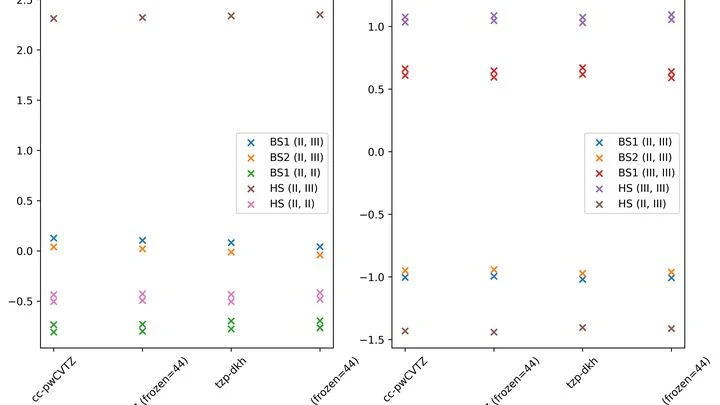
A quantum dot is a box so small that an electron inside cannot have just any energy, but only strictly defined values, like the steps of a staircase. Each step can accommodate several electrons, but exactly how many is the question. If a step is double, two electrons can stand on it; if single, only one.
A quantum computer is like a pot of boiling water: particles are jostling around chaotically, and you need to calm them down to get a useful answer. In a new study, physicists have devised a way to cool a chain of 19 quantum spins (tiny magnets) right on a real device.
In every handful of fertile soil, there are bacteria that do something no factory can: they take nitrogen straight from the air and turn it into fertilizer. The secret lies in the enzyme nitrogenase, and its working core, a cluster of iron and molybdenum atoms, looks like a tiny factory floor.
Chemists have long tried to understand how this factory works from the inside.
An ultracold atomic cloud, resembling fog, hints that gravity might not work as Newton said. On the outskirts of galaxies stars move faster than expected, and MOND theory tweaks the law of gravitation over large distances, removing the need for dark matter.
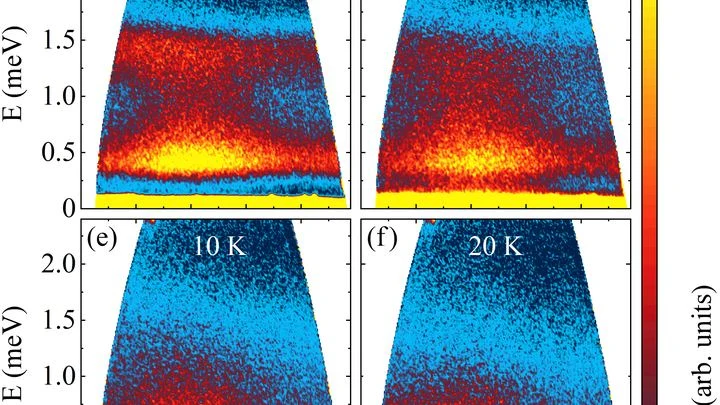
The tiny magnetic arrows inside a crystal of terbium-iridium oxide behave strangely: instead of lying along their preferred axis, they stand across it. This state fully forms when cooled to 1.5 Kelvin — colder than outer space.
Researchers probed the crystal with neutrons and observed how these flipped arrows oscillate and exchange energy.
Hot water sometimes freezes faster than cold — this is the Mpemba effect. In the quantum world, it’s even more astonishing: a system bubbling with disorder (with high entropy) can settle incredibly faster than one that is almost calm.
The solution lies in islands of silence within any system — regions untouched by the destructive noise of the environment.
Emptiness isn't always empty: it can hide energy, like supercooled water hides ice. Physicists call this false vacuum — a state that only needs a nudge to cascade into the true one.
Cooled nearly to absolute zero with liquid helium, the semiconductor disk reached such a low level of entropy that its thermal trembling became less than one phonon — a quantum of sound.
Everything tends toward equilibrium: tea cools, a pendulum swings to rest. The measure of this movement is entropy — growing disorder. But sometimes hot water freezes before warm. The Mpemba effect isn't just a curiosity: it shows up in the quantum world too. Scientists have devised a way to control this paradox.
Intelligent action begins with a plan. Just as an architect needs blueprints to evaluate options, any agent with will needs to repeatedly copy data about reality.
An orchestra without a conductor, where each musician hears only the hall's echo, can create a powerful melody. That's how a quantum battery works: many particles, immersed in a warm environment, don't dissipate heat but exchange it synchronously. Instead of chaos, an orderly charge emerges.
Two travelers head for the same destination. One starts closer but takes a winding country road. The other starts farther away but immediately hits the highway. The second arrives first. In quantum physics, this paradox is known as the quantum Mpemba effect: a state initially farther from equilibrium reaches it faster than one that starts closer.
The hall is silent, but the conductor has already raised the baton. The orchestra is quiet, yet the score is changing. So it is in an optical resonator: there is no light, but the quantum vacuum—that emptiness filled with short-lived field fluctuations—is already conducting the…
Imagine a soloist trying to blend their voice with a choir. If the choir sings in unison, the soloist's voice stands out for a long time; but if the choir scatters across a wide range — from deep basses to ringing sopranos — the soloist dissolves almost instantly. In quantum physics, the role of such a choir is played by a thermal bath — a massive environment.
Quantum entanglement long remained a curiosity — 'spooky action at a distance,' as Erwin Schrödinger put it, which shatters our conventional picture of the world. But in 2008, physicists realized: entanglement can be used not only to transfer bits, but also to teleport energy.