Quantum entanglement manifestations refer to the observable phenomena that arise when two or more particles are correlated in such a way that the state of one cannot be described independently of the others, even when separated by large distances. These manifestations include violations of Bell inequalities, quantum teleportation, and the emergence of collective coherence in many-body systems. Entanglement is not just a philosophical curiosity; it is the resource that powers quantum computing, quantum cryptography, and quantum sensing.
History
The concept was introduced by Erwin Schrödinger in 1935, following the famous Einstein-Podolsky-Rosen paper. John Bell's inequalities in 1964 provided a testable distinction between quantum mechanics and local hidden-variable theories, and Alain Aspect's experiments in 1982 confirmed quantum predictions.
How it works
When particles interact, their quantum states can become entangled, meaning the combined wavefunction cannot be factored into individual particle states. Measuring one particle instantly determines the state of its entangled partner, regardless of distance—a phenomenon Einstein called 'spooky action at a distance.' This non-locality is not a violation of relativity because no information is transmitted faster than light; the correlations are established at the moment of measurement, but the outcomes are random. In many-body systems, entanglement can give rise to emergent phenomena like quantum phase transitions and topological order.
In practice
Entanglement is used in quantum key distribution for secure communication, in quantum teleportation for transferring quantum states, and in quantum metrology for ultra-precise measurements. It is also the basis for quantum error correction in quantum computers.
Fun fact
Entanglement can be 'monogamous': if particle A is maximally entangled with particle B, it cannot be entangled at all with particle C, a property that is crucial for the security of quantum cryptography.
Three voices merging into a single chord. In the physics of quantum materials, this image takes on a literal meaning: three layers of graphene, separated by thin spacers, force electrons and holes from different layers to move as a single fluid.
Two observers, Alice and Bob, sit at opposite ends of the same lab. Between them is a source that fires off two pulses in turn. Each pulse gives birth to a wave packet flying toward its own detector. So far, this looks like an ordinary experiment with quantum particles.
Imagine an orchestra where every musician plays their own part without listening to the others. Suddenly, without any visible command, neighboring musicians begin to sync perfectly, yet there is still no overall melody.
If you accelerate one of four entangled particles to enormous speed, their quantum entanglement doesn't just melt away: it first weakens, then strengthens again. Physicists discovered this unexpected twist while studying the behavior of a special state called the Dicke state in a world governed by the laws of relativity.
An infinite chain of atoms spaced at equal intervals. Shift the entire chain by one step, and the picture doesn't change. That's translational symmetry: the world looks the same wherever you look. You'd think such a simple rule would give rise to simple states, like a crystal lattice assembled from identical building blocks.
But the authors counted those blocks anew.
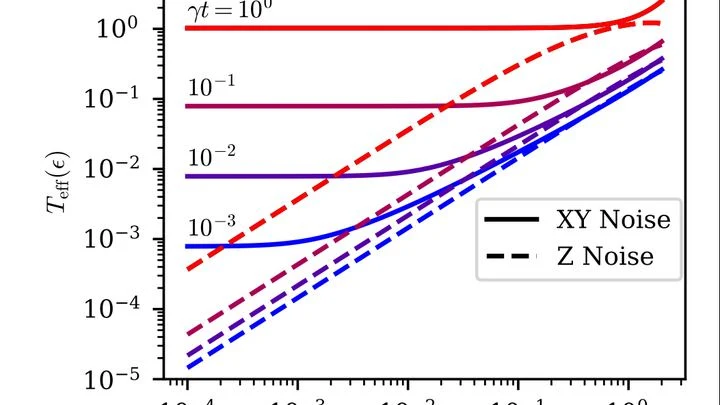
The quantum world is like an orchestra where each musician, a particle, plays their part, and together they create a harmonious symphony. But as soon as noise, random clicks and interference, enters the hall, the melody starts to drift.
Entangled photons are like two couriers marching in lockstep: their quantum states, particularly polarization, are synchronized so that measuring one instantly determines the state of the other, even at a distance. In a material, this synchronization gets disrupted.
A quantum dot the size of a virus, squeezed between mirrors, gives birth to two photons in a short flash of light. These photons fly out as a pair, and their polarizations, the directions of wave oscillation, are linked such that knowing one instantly tells you the other.
In the quantum world, a collision between particles doesn't destroy their individuality but ties them into an inseparable knot: internal states and motions become intertwined like threads in an intricate tapestry.
A chain of twenty-four atoms, arranged with optical precision, begins its evolution from a state resembling a chessboard: every other atom is excited, and neighboring excitations are forbidden. After a few microseconds, the global picture becomes so entangled that the original pattern is no longer discernible.
In September 2024, the concert hall in Linz had more than just an orchestra on stage. Next to the musicians, a setup was generating pairs of entangled photons: a laser with a wavelength of 405 nm passed through a nonlinear crystal and split into two photons at 810 nm, which flew off to two measurement stations, Alice and Bob.
A thermometer dipped into a sample usually tells you only the temperature. But if the temperature oscillates slightly and the sample responds with a delay, that response hides more: the imaginary part of the heat capacity, which turns out to be able to hear the quantum echo of time.
Two particles begin their dance in complete independence. Neither knows of the other's existence. But under the invisible music of deformed spacetime, their motions gradually synchronize: entanglement is born in the system—that very quantum connection Einstein called 'spooky action at a distance.'
In the ordinary world, energies add up simply: take the energy of…