Light enters strictly from above express
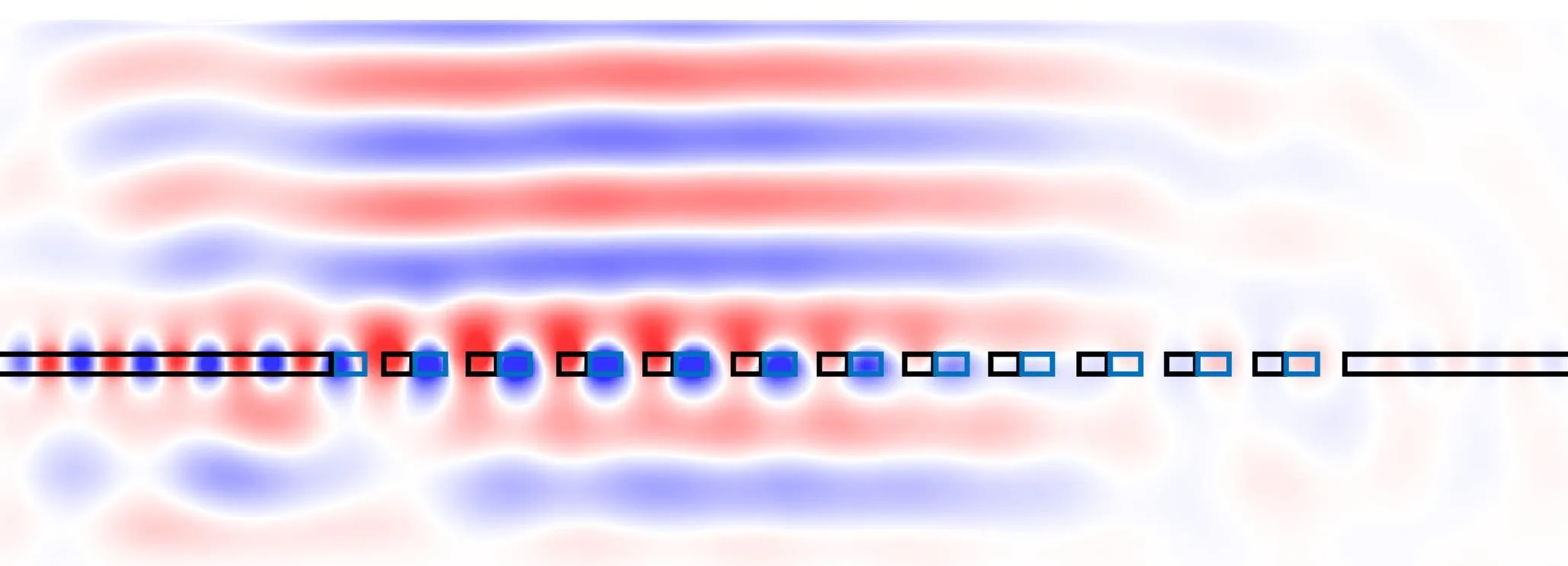
A laser beam hits the chip vertically, like an arrow striking a target. Ordinary gratings in this position lose half the light: it scatters in both directions, like a crowd rushing through open doors. The new design forces light to go only to the left, into the desired waveguide.
The secret is that the grating stripes are asymmetric — one wall of each stripe is slightly longer than the other. It's like blinds tilted at an angle: from outside they let your gaze through, but from inside they barely do. So does light: it enters freely from above but cannot escape backward or sideways.
Fabricating such a grating is simple: a silicon wafer is etched once, without additional layers. In simulation, the coupling efficiency from a standard optical fiber reached 41% at vertical incidence, and the difference between the desired and undesired directions exceeded 10 dB. The experiment confirmed: unidirectionality 12.8 dB, losses 8.35 dB at a wavelength of 1528 nm.
Such a grating is a ready-made building block for hybrid circuits where a laser sits directly above the chip. This will speed up the assembly of optical transmitters, lidars, and sensors. Light enters strictly from above, and stays in the chip.
Original abstract
as written by the authors arXiv:2604.23394
We propose a novel bio-inspired design principle for the perfectly vertical grating coupler. The main idea of our design is to introduce anisotropy to the grating stripe to direct the light to one side of the grating. This grating design is easy to manufacture, only requiring a single etching step, and it is designed to efficiently couple vertically incident light. This makes it a good candidate for heterogeneous integration of light sources, especially VCSELs, on chip for applications in classical and quantum communications, LIDARs, sensing systems, and others. The grating coupler was designed for the SOI material platform with a central wavelength of 1550 nm. We obtained the efficiency of in-coupling from the SMF-28 fiber of 41% at vertical incidence and unidirectionality of over 10 dB, with a bandwidth of 50 nm at a 1 dB level in simulation. Experimental measurements confirmed unidirectionality, with observed unidirectionality of 12.80+-0.02 dB and a single-coupler insertion loss of 8.35+-0.02 dB around 1528 nm.
The wavelength of 1550 nm is in the near-infrared range, invisible to the eye but ideal for optical fibers: in glass, light attenuates the least at this wavelength.